Description
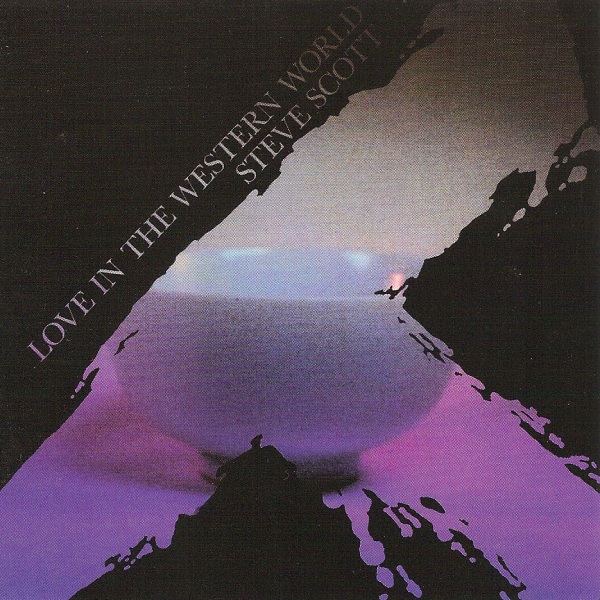
Love in the Western World is the debut album by the US based, British born poet and singer/songwriter Steve Scott, released on Exit Records in 1983, a division of Word. The album was recorded November 1982 by Daryl Zachman at The Warehouse Ministries’ Sangre Studios in Sacramento, California; with Steven Soles of The Alpha Band fame producing. Mixed by Larry Hirsch at Paramount Studios in Hollywood, California. The studio musicians used on the album was The 77’s, another band signed to Exit Records. All songs written by Steve Scott.
The starkly haunting musical/lyrical marriage of Steve Scott’s unique new wave/spoken word sensibilities and an almost grimly realistic view of human agony, is touching.
Steve Scott did actually also record an album in the late 1970s. That album – tentatively entitled Moving Pictures – was produced by Larry Norman (with input from Mark Heard and Tom Howard), and originally scheduled for a release on Norman’s label Solid Rock Records around 1981, though no record ever materialised. (A couple of demos from those sessions later appeared as bonus tracks when Love in the Western World was re-issued on CD by Millennium Eight Records in 2000, while other songs from the unreleased album found their way in live versions, or radically different recorded versions, onto other albums such as Magnificent Obsession (1990) and More than a dream (1997).)
Steve Scott debut effort was the title track of the multi-artist sampler LP Come Back Soon, released on Sangre Records in 1978 (actually also a label with connections to the Warehouse Ministries).
Many years ago as a young pup writer, I was music reviewer for Cornerstone Magazine. And I reviewed many, many albums which I might or might not have liked that well. There were only a few, maybe as many as four or five, which I still today believe stand the test.
One of those came in 1983, an intriguing looking album entitled ‘Love in the Western World’. (Yes, the title was borrowed from Denis de Rougemont’s book of that name.) Exit Records in California, an ultimately ill-fated label, nonetheless gave us such bands as the 77s, Vector, Charlie Peacock, and Steve Scott, the odd Brit responsible for ‘Love in the Western World’. Scott, a sort of mix of Os Guinness and Lou Reed with a side order of Japan and existentialism / lamentations thrown in, had created an album guaranteed not to sell in the cheesy contemporary Christian marketplace. In fact, CCM Magazine at the time panned it as a disaster. (Intriguingly, Larry Norman’s Solid Rock label had a Scott album recorded, but never apparently released it. But that’s another story…)
I listened to ‘Love in the Western World’, was awed by the lyrics as well as Scott’s weird musical sensibilities (he’s backed by the 77s), and panned CCM Magazine while pumping ‘Love in the Western World’ as an absolute gem. The starkly haunting musical / lyrical marriage of his unique new wave / spoken word sensibilities and an almost grimly realistic view of human agony, touched me deeply.
One song in particular, «This Sad Music», still best signifies to me Steve Scott’s complete originality. (I may dedicate another blog entry to «Safety in Numbers», my close second-place Scott offering from ‘Love in the Western World’.) As I have listened, some 25 years after it was written and recorded, I find «This Sad Music» as riveting, painful, and troubling as it was to me way back when.
What I most noticed as I listened recently was the compassion – an element so central to the work that it left me wondering how I’d missed it. I guess we all get a little more fragile, sad of heart, and so (prayerfully and hopefully) more aware of compassion / empathy when we see it than perhaps we were before such lessons came our way. Or, perhaps I speak only personally, whatever… a superlative album [Jon Trott, Blue Christian on a Red Background, April 2007]
‘Love in the Western World’ by Steve Scott clearly has all the makings of a concept album. If it’s supposed to be a conceptual album, it’s extremely lacking in concept, jumping here and there, saying a lot about nothing. With little direction, one can only guess at the concept. Perhaps the purpose is to take us from the «Tower of Babylon» through a journey of poorly written, tiresome songs expressing the sadness and lostness of mankind. The answer to our search doesn’t lie in believing there is «Safety in Numbers». Could we have found the answer in the concluding statements «Walking on Water Wasn’t Built in a Day», and «Flesh and Blood»?
The concept, if there is one, remains unimportant when we consider the music on the disc, which can only be described as monotonous. Three of the weakest cuts are extremely long (5 to 6-1/2 minutes). Their length wouldn’t be so bad if they had something to say or had some kind of instrumentation to break up the dullness. The production by Steven Soles – weak at its best – is a deviation from his usual work.
If anyone should even feel obligated to obtain this LP, he may find some comfort in knowing that there are two worthwhile songs. «Walking in Water Wasn’t Built in a Day» and «Flesh and Blood». The first, a ska-type number, features a chorus which sounds nicely reminiscent of David Bowie’s ‘Ziggy Stardust’ disc. The second, «Flesh and Blood», reveals more hope for Steve Scott’s future work, adding a nice touch to an album that should have been a single. [Steven Vaughan, CCM, 1983]
The whale poem was originally written in 1976, during my fist trip to America. I was staying at a friend’s house in Southern California, and flipping thru channels on the TV using a remote control. On one channel was a TV evangelist lamenting the moral woes of America. On another channel was a news story about some beached and dying whales. I simply juxtaposed and collaged together the two sets of images, and worked from there. I put music behind it in 1980, and we put a version of it on the ‘Western World’ album. Remixing it for the CD version of ‘Horizon’ gave us the opportunity to play with the vocal a bit. [Excerpt from the liner notes of the compilation CD Lost Horizon]
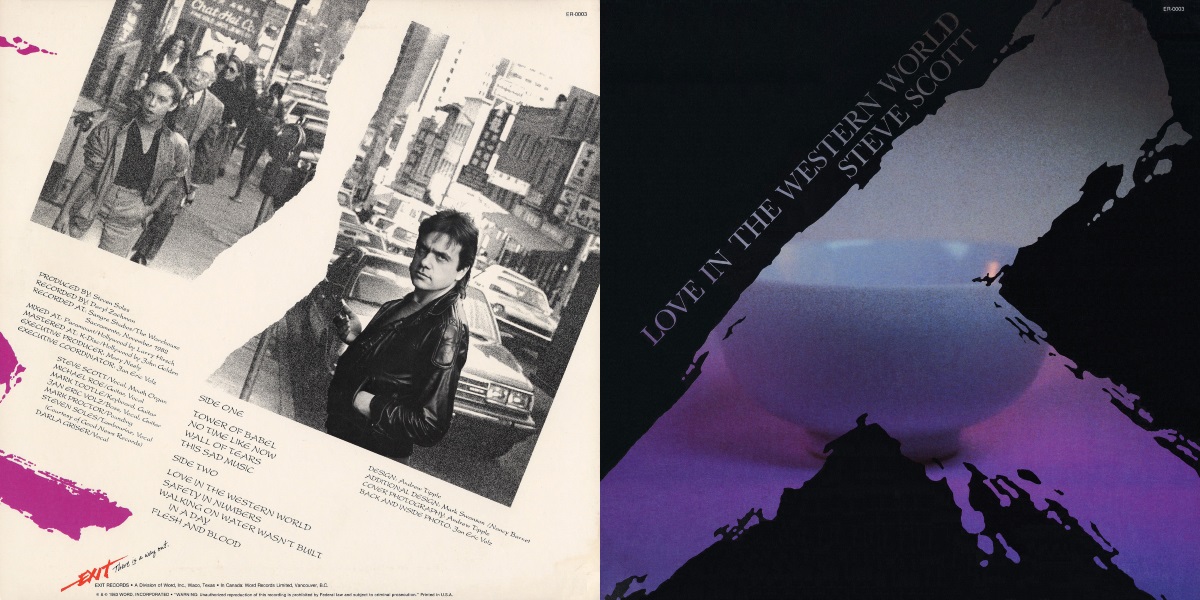
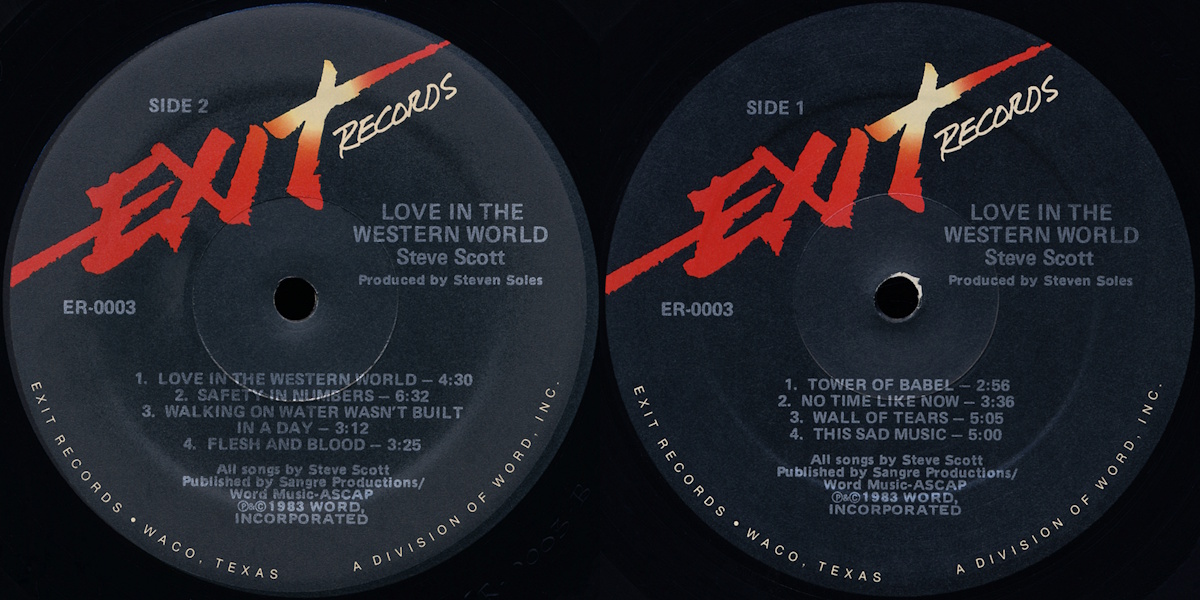
LP tracklist:
Side One
A1. “Tower Of Babel” – 2:56
A2. “No Time Like Now” – 3:36
A3. “Wall Of Tears” – 5:05
A4. “This Sad Music” – 5:00
Side Two
B1. “Love In The Western World” – 4:30
B2. “Safety In Numbers” – 6:32
B3. “Walking On Water Wasn’t Built In A Day” – 3:12
B4. “Flesh And Blood” – 3:25
Note: Simultaneously released on cassette and 12-inch vinyl LP by Exit Records. Re-issued on CD by M8 Records (Millenium Eight Records) in 2000 featuring the following bonus tracks: 09. “Different Kind of Light” – 3:48, 10. “More Than a Dream” – 3:57, 11. “Call of the Wild” (live) – 3:56, 12. “Love In The Western World” (live) – 4:40, 13. “When the Fight is Over” (live) – 4:43.
Liner notes by Steve Scott included in the Millenium Eight Records’ CD re-issue, 2000:
The songs of this recording were written circa 80-82, with a few rescued from pre-LWW limbo mid to late 70s. I’m not about to tell you what these songs “mean” but I will tell you we had fun making the original record, with Captain Steven Soles at the controls and the 77s on the floor (so to speak) and that there are all sorts of obscure (and not so) references and influences scattered throughout. I’ll toss out a few clues and red herrings as we go. (As if you cared, right?)
Tower Of Babel – Jaques Derrida lite with some stuff at the end inspired by the Who’s “Anyway, Anyhow, Anywhere” … I saw the Who live at Saville Theater London in January 67. They were upstaged, somewhat, by a support act, “power trio” fronted by a guitarist from Seattle named Jimi Hendrix. The headlining Who went bonkers anyway, with Townshend 86ing his guitar (I think) during “My Generation”. Not a night to be easily forgotten.
No Time Like Now – This song was built around a three note buzzing keyboard riff partially inspired by the early recordings of a band called Suicide. There were suicidal undertones to some of the lyrics as well. There’s a “live” version of this on Magnificent Obsession that has some sort of yodelling refrain at the end. “Damaged” isn’t the word. It doesn’t even come close. Buy that record.
Wall Of Tears – This came to me in a dream. All right, it didn’t… but it could have. While we were recording this track Steven Soles would cast a shadow over the proceedings by wandering through the studio, humming bits of a Beatles song he thought I’d pilfered a lyrical fragment from.
This Sad Music – This poem owes as much to William Burrouighs cut-ups as it does to Guy Debord’s Society of the Spectacle (it’s getting deep in here… oh, all right, look, I hadn’t read Debord at the time I was writing this poem, OK?). I was “cutting” back and forth (remote control on the TV) from a TV evangelist to a news story about beached and dying whales. This during my first visit to California in 1976. I wrote the music around the time ‘Shogun’ was on TV… the one with Richard Chamberlain. Tons of people said they liked this track best on the album when it first came out which partially pushed me into the kind of work I’ve been doing on albums like The Butterfly Effect and on…
Love In The Western World – Title and some of the “issues” (man) taken from Denis De Rougemont book of same name, and chords based on vague recollections of various Human League tracks. Also, there’s a vaguely recalled plot line from a ‘Starsky and Hutch’ episode in there, somewhere… Vocal approach influenced a bit, I like to think, by the recordings of a British band of unparalleled genius called The Only Ones… they had that self absorbed, maudlin, riff down years before The Smiths appeared on the scene.
Safety In Numbers – Three scenes of stark urban despair backlit by Mr. Roe‘s “deranged, burning helicopter” guitar at the end. The phrase, “Safety in numbers” probably stuck with us around that time because we were all listening to Peter Gabriel… especially the third album, the one with the melting face. Incidentally, the German mix of that is very very good.
Walking On Water Wasn’t Built In A Day – Shortly after this album first came out I got a postcard from a girl in the Mid West asking me if I took the title from something Beat writer Jack Kerouac said while under the influence of mescalin. (Kerouac, not her or me.) It’s nice to know that some of you read. Further proof that some of you are a game crowd came in the form of a gentleman recently telling me that, while under the influence of my track “No More Parades” on the album Lost Horizon, they had persuaded their book reading group to tackle ‘The Good Soldier’ by Ford Madox Ford. Don’t forget to check out More than a Dream version of this track. You’ll be surprised.
Flesh And Blood – And who would disagree? I highly recommend the book ‘The Jesus Style’ by Gayle Erwin. Musical trainspotters, think Comsat Angels circa Fiction.
Different Kind of Light – Written at the behest of Mr. L Norman to lively up the Moving Pictures album. It was covered in pretty straight rock form by the Sevens on the Ping Pong album and there’s a… well, rather different version on the album More than a Dream.
[Producer Larry Norman wanted something a little more lively for the (still unreleased) ‘Moving Pictures’ recorded in the mid 1970s, so I wrote this. When we were tracking it in LA on 24 track 2 inch tape I suggested that we speed the tape up for the chorus so that at ‘normal’ speed Jon Linn’s guitars would sound extra heavy. I described the desired effect as “a golden field of radioactive crows.” As I said, this was tracked in LA for the ‘Moving Pictures’ album, so it’s definitely/probably got Mark Heard, Tom Howard, Randy Stonehill and Larry Norman in there somewhere on rhythm guitars, keyboards and background vocals (and also maybe Sarah…?). I cannot remember the drummer, but any additional percussion would/should have Alex MacDougall‘s name on it… This track actually saw the light of day as a bonus track on the CD reissue of ‘Love in the Western World’ by M8 Records on 2001.]
More Than a Dream – You may have heard this song before with a different lead vocal. This is a “practice mix” from somewhere deep in Moving Pictures land. Also written by me originally to gee up the project, and as you might be able to tell, whacky fun was had by all. Spot those fake English and Liverpudlian accents!! Neither were me, I hasten to add. As if, etc. Now that you’ve heard “the original” rush out and buy the album with the jaunty bierkeller version of this song on it (think “title track”). You won’t be sorry.
Call of the Wild – This is “live” and, if you listen carefully, you will hear guitarist John Flanagan burst into flame!! All right, not really… but you know what I mean. Segues into another version of LWW, this version anchored with a base line that we sort of “borrowed” from a cassette compilation of Japanese rap music.
When the Fight is Over – This from an early acoustic solo concert at Warehouse Christian Ministries in the late 70s.
CREDITS. Produced by Steven Soles. Recorded by Daryl Zachman at Sangre Studios/The Warehouse, Sacramento, CA, November 1982. Mixed by Larry Hirsch at Paramount Studios, Hollywood, CA. Mastered by John Golden at K-Disc, Hollywood, CA. Design by Andrew Tipple. Additional Design by Mark Swanson and Nancy Barnet. Cover Photography by Andrew Tipple. Back and Inside Photo by Jan Eric Volz. Executive-Producer: Mary Neely. Executive Coordinator: Jan Eric Volz. All songs written by Steve Scott.
Musicians: Steve Scott (Vocal, Harmonica), Steven Soles (Tambourine, Vocal), Darla Griser (Vocal), Michael Roe (Guitar, Vocal), Mark Tootle (Keyboard, Guitar), Jan Eric Volz (Bass, Guitar, Vocal), Mark Proctor (Drums).

Reviews
There are no reviews yet.