Description
Emotional Tourist: A Steve Scott Retrospective is a 15 track CD compilation released on ARRCO in January 2012. The compilation draws from the British born poet and singer/songwriter Steve Scott‘s entire recording career featuring songs from most of his albums. Labeled “A career-spanning collection from the poet/musician/artist remastered and available for the vey first time!”
There is tremendous growth of churches in other cultures where art, everyday life and spirituality are interwoven, and I’m frightened that we will find ourselves having nothing to say to the rest of the world. There is also a tremendous hunger for reality and truth in our own culture. The field is wide open for artists and creative people who know what they are doing and why they are doing it.
The role/place of the Christian artist or artist who is Christian is to tell the truth the best way they know how from the platform of their own growth and progress as a person. Some will raise questions (plant seeds), others will guide the conversation as it grows (water), some will provide answers (help with the harvest). According to the apostle Paul, its all good. [Steve Scott]
“Angels can fly because they take themselves lightly,” quipped the UK author Chesterton. London-born musician, poet, and songwriter Steve Scott also takes himself lightly, but as shown here, is by turns thoughtful, profound, whimsical, searching, and always experimental. Larry Norman called Steve the most creative artist he ever worked with. Peter Banks of After the Fire said, “An unusually gifted musical poet? One thing you cannot do with Steve Scott is categorise him.”
The showpiece of this disc, clocking in at over twelve minutes, is «No Memory of You», from The Butterfly Effect, the first album released on Mike Knott‘s legendary ’90s indie label, Blonde Vinyl. It perfectly brings together all of Steve’s interests and styles, with on-location taped conversation, sampled emulator tape loops, ambient music and sounds, and Scott reciting a long, spoken word piece from his continuing series of sometime poetry/travelogue chapbooks, collectively known as “The Boundaries”.
On the CD, that’s track twelve. Three more spoken word pieces follow. They date from different eras and are all different musically, utilizing synthesizers, backwards music, ambient and found sounds. The last track is from a traveling art installation mounted with painter Gaylen Stewart, called Crossing the Boundaries. «Empty Orchestra» (track ten), the literal meaning of karaoke, is the only instrumental track. Listeners are invited to perform or read Steve’s poetry over the music, enabling them to be “Steve Scott for a day”. The remaining spoken word track, «This Sad Music» (track eleven) dates from his mid-’80s, critically acclaimed album, Love in the Western World. The lyrics juxtapose a newscast about dying whales with an evangelist on American TV, recited over minimal music. This was the showpiece of Love in the Western World, and the only spoken word track on that album.
The remaining nine tracks are devoted to Steve’s rock music, again dating from various eras, with the best-known songs presented in little or never heard alt versions. A half dozen Scott albums hail variously from the days of vinyl, 8-tracks, cassettes, and CDs, but this tip of the iceberg may inspire curious listeners to dive in and find more. A great many of Steve’s fans became so after hearing his music or reading his books, and decry that this British treasure is so little known in the United States. This release may help change that. Yet, the last word may be that of Peter Banks of UK band, After the Fire. “A uniquely gifted musical poet? One thing you cannot do with Steve Scott is categorise him.” [alivingdog.com]
Emotional Tourist is probably the best way to describe the experience of consuming the art of Steve Scott. Scott takes you on a journey through the heart and soul of human emotions like no other can. So how do you go about creating a retrospective of a career starting in the 1970s that spanned many forms of music as well as spoken word and poetry reading? While there are volumes of brilliant material left off, what you do have on Emotional Tourist is the cream of the crop. A crop that could have easily been an 8-10 disc box set (if you could get some of the unreleased albums out of the dustbins). The people responsible for this compilation probably gave themselves insomnia just trying to contain it all on one disc.
The songs are brilliantly divided into rock music and spoken word halves. Any fan of 80s style alternative/new wave/pop will love the first 9 tracks. My personal favorite is «Love in the Western World», but fans of The 77s will love Steve’s rendition of a tune he wrote for the band («A Different Kind of Light»). But all of classics are here – «Ghost Train», «Sound of Waves», «Not a Pretty Picture», and so on.
Steve’s lyrics are just as brilliant as his poetry, so the transition to spoken word is not as jarring as one might think. And it is the spoken word poetry readings on the second half of the disc that take this collection to the next level. Scott has always excelled as a poet. «This Sad Music» was one of his earliest recorded readings, a profound song based on what he saw one day while flipping through channels. My favorite is still «No Memory of You», probably because actual recordings of the subjects of the poem are used to create the sonic bed that supports the spoken word. Scott never just reads a poem by itself; he always creates a music soundscape that plays along with the poem. This is what ties the second half of the disc with the first half – his readings sound almost like deconstructed songs, as if they are the evolution of what happened on the first part of the album. Or maybe his songs were always just poems set to music all along? Either way, they flow together well.
The packaging on this collection is well done, with recollections on each song written by Scott himself. Fans of Scott that have all of his CDs will want this disc for the booklet alone. Now we can only hope that this album will be the catalyst to getting the powers that be sitting on top of the unreleased ‘Moving Pictures’ into gear. [Matt Crosslin, Down The Line Magazine, July 2012]
> Apple Music (https://music.apple.com/us/album/emotional-tourist-a-retrospective/487039377)
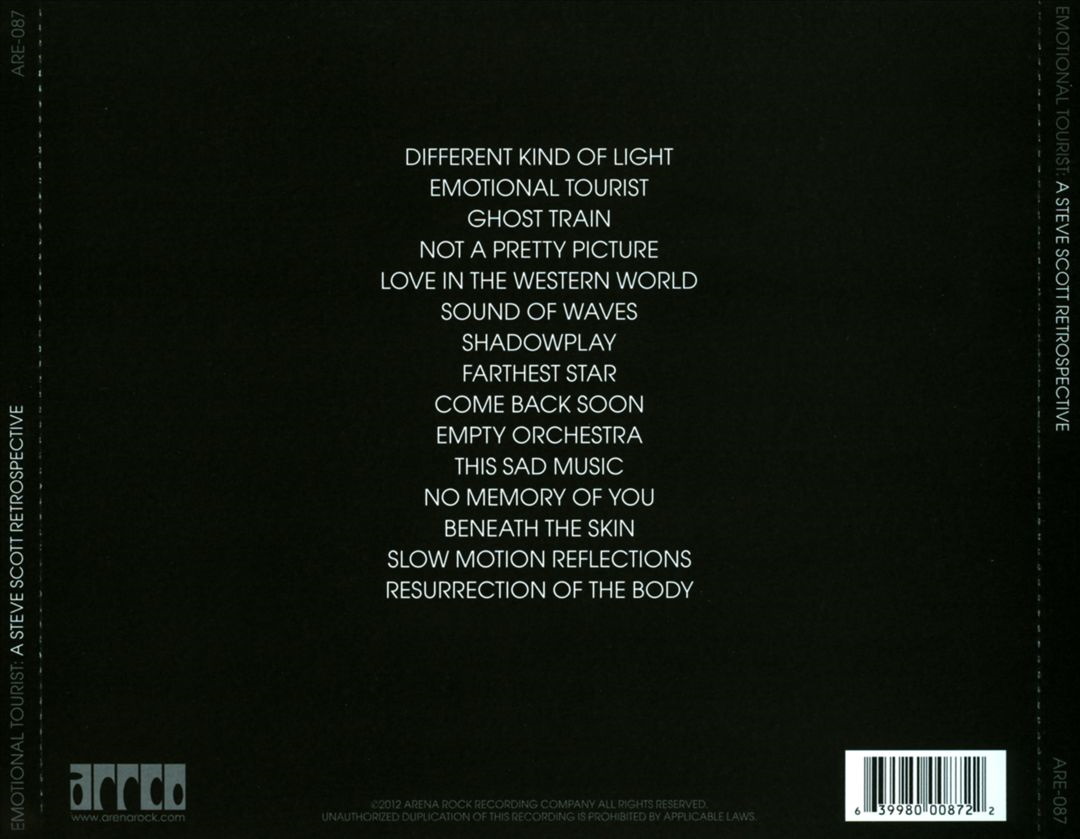
CD tracklist:
01. Different Kind of Light (from Moving Pictures) – 3:47
02. Emotional Tourist (from Emotional Tourist) – 4:00
03. Ghost Train (from Emotional Tourist) – 3:25
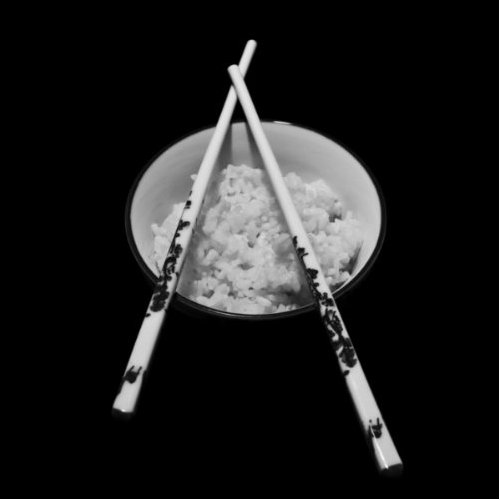
04. Not a Pretty Picture (from Rice EP) – 4:05
05. Love in the Western World (from Love in the Western World) – 4:59
06. Sound of Waves (from Emotional Tourist) – 3:46
07. Shadowplay (from Rice EP) – 4:15
08. Farthest Star (from Moving Pictures) – 5:36
09. Come Back Soon (from the multi-artist compilation Come Back Soon) – 3:59
10. Empty Orchestra (from Empty Orchestra) – 2:39
11. This Sad Music (from Love in the Western World) – 5:13
12. No Memory of You (from The Butterfly Effect) – 12:14
13. Beneath the Skin (from We Dreamed That We Were Strangers) – 5:47
14. Slow Motion Reflections (from Crossing The Boundaries) – 3:28
15. Resurrection of the Body (from Crossing The Boundaries) – 5:51
CD track by track, by Gord Wilson:
01. Different Kind of Light. This is a crowd pleaser, here presented garage band fashion. The 77s covered it on their first album, Ping Pong Over the Abyss, and I heard them, Vector, and Northbound play it as their finale live (one of the high points in my concert-going experience).
02. Emotional Tourist. The perfect marriage of Steve music and lyrics. Radio-friendly exploration of one of Steve’s favorite topics: traveling. Somewhat a theme of the album.
03. Ghost Train. The other well-known and oft-requested standard. Covered by other bands live, many know it from long jams at the Cornerstone festival.
04. Not a Pretty Picture. Steve’s Psychedelic Furs influence.
05. Love in the Western World. Faster, alt version of the title track of Steve’s ’80s album.
06. Sound of Waves. Sort of a pop song. Here in an alt version from a sampler that circulated in the UK (remember disco singles?).
07. Shadowplay. Another perfect song in the vein of the title track, with Asian musical influences, and a motif drawn from Steve’s time in Bali.
08. Farthest Star. Steve unplugged (or almost so), in his haunting ballad mode. Covered live by Larry Norman in Europe.
09. Come Back Soon. Originally appeared on a multi-artist compilation from Sangre Records in the late ’70s. One of many versions.
10. Empty Orchestra track. The only instrumental track included. From a mid ’90s instrumental album. Empty Orchestra is the literal meaning of Karaoke. Listeners were encouraged to read Steve’s poems from the enclosed lyric sheet, so as to become “Steve Scott for a day”. Some of the poems were drawn from Steve’s continuing series of sometime poetry/ travelogue chapbooks collectively called The Boundaries. The title of this poem is “Passages of the Heart”.
11. This Sad Music. This was the centerpiece of Love in the Western World. It’s a spoken word over music poem made by juxtaposing two different channels on American TV: a TV evangelist and a newscast about dying whales.
12. No Memory of You. This long spoken word over music piece clocks in at over twelve minutes. It was originally released on Steve’s early ’90s album, The Butterfly Effect on Mike Knott‘s Blonde Vinyl label. The album’s lyrics were partly drawn from The Boundaries, and musically included on-location recording in Asia and Eastern Europe, ambient and found sounds, emulators, tape loops, sampling and many other techniques exotic for the time, but in common use today.
13. Beneath the Skin. The poem is from the first volume of The Boundaries, but the recording dates from the mid ’90s.
14. Slow Motion Reflections. This and the last track are both spoken word over music, and come from Crossing the Boundaries, a traveling art installation mounted by Steve with painter Gaylen Stewart. Recorded bird calls on the musical track echo the visual multi-media bird paintings by Stewart.
15. The Resurrection of the Body. “Crossing the Boundaries” originally included color pictures of Stewart’s art the listener could look at while playing the tracks. My suggestion for listening to Steve’s spoken pieces is to lie on the rug or sofa, close your eyes, and enjoy.
Reviews
There are no reviews yet.