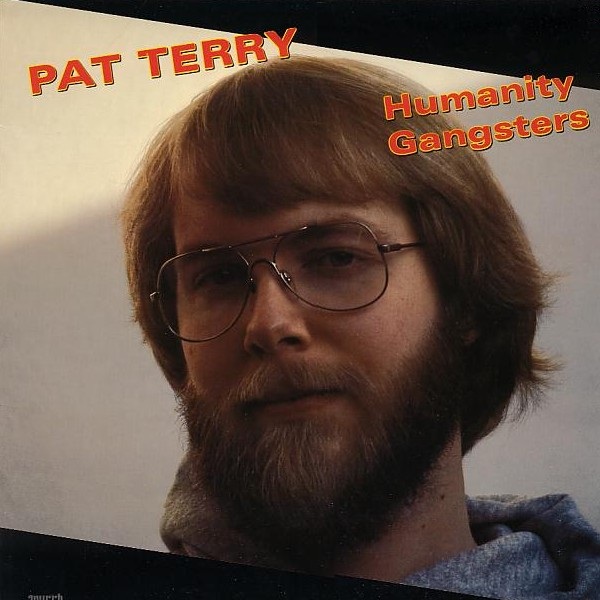
Description
Humanity Gangsters is the first major label solo album by the American singer and songwriter Pat Terry of The Pat Terry Group fame, released on Myrrh Records in April 1982, a division of Word. (Terry actually also had an independent solo album released in 1974, pre-Pat Terry Group). The album was recorded by Mark Heard, Chris Taylor, and Bill Cobb at the latters Poiema Studios in Camarillo and at Whitefield Studios in Santa Ana, California; with Heard and Pat Terry producing. Mixed by Heard and Terry at Wilder Brothers Studios in Los Angeles, California.
Humanity Gangsters was included among the Best Albums of 1982 by CCM Magazine, on a list featuring thirteen albums.
After nearly a decade of writing, performing and touring with a group bearing his name, Pat Terry found himself working as a solo artist in the early 1980’s. While the Pat Terry Group was a Southern Rock/Country combo (with the emphasis on a mellower country feel), Pat Terry the solo artist sported an Americana rocker drive similar to Tom Petty. Terry’s Humanity Gangsters features the same session musicians also featured on producer Mark Heard’s classic album Victims of the Age recorded around the same time.
Mark Heard has been busy. In addition to Victims of the Age, he released Fingerprint in Europe (still unavailable in the States) and co-produced Pat Terry’s first solo album. After six albums with the Pat Terry Group, Terry, a long time friend of Heard’s, began to think about the kind of music he wanted to make and came up with Humanity Gangsters. This is Pat Terry’s finest effort and perhaps his most honest. It is clearly his first attempt to perform almost completely in a rock medium, and as such it’s a pretty good album. Terry returns to his southern roots and delivers a snappy rock sound with an R&B feeling, aided by drummer John Mehler and bassist Billy Batstone‘s rhythm section and Heard’s percussive mix. The main achievement is Terry’s honest and searching lyrics. Like Heard, he is asking questions about his life as a Christian. And he’s coming up with statements of faith that have personal integrity, without the usual cliches that fill much of Christian music today. Terry writes, plays most of the guitars (he has some nice slide work in places), piano, harmonica, and he co-produces the album too. At times his vocals are too nice for the emotion he seeks to express, but after six LPs with the PTG, what can you expect? Humanity Gangsters marks the enjoyable entrance of Pat Terry to the real world. It’s a nice album to be human with. Mark and Pat, be sure to give my love to the Strat Brothers next time you see them. [Quincy Smith-Newcomb, 1982]
[Thom Granger, CCM, July 1982]
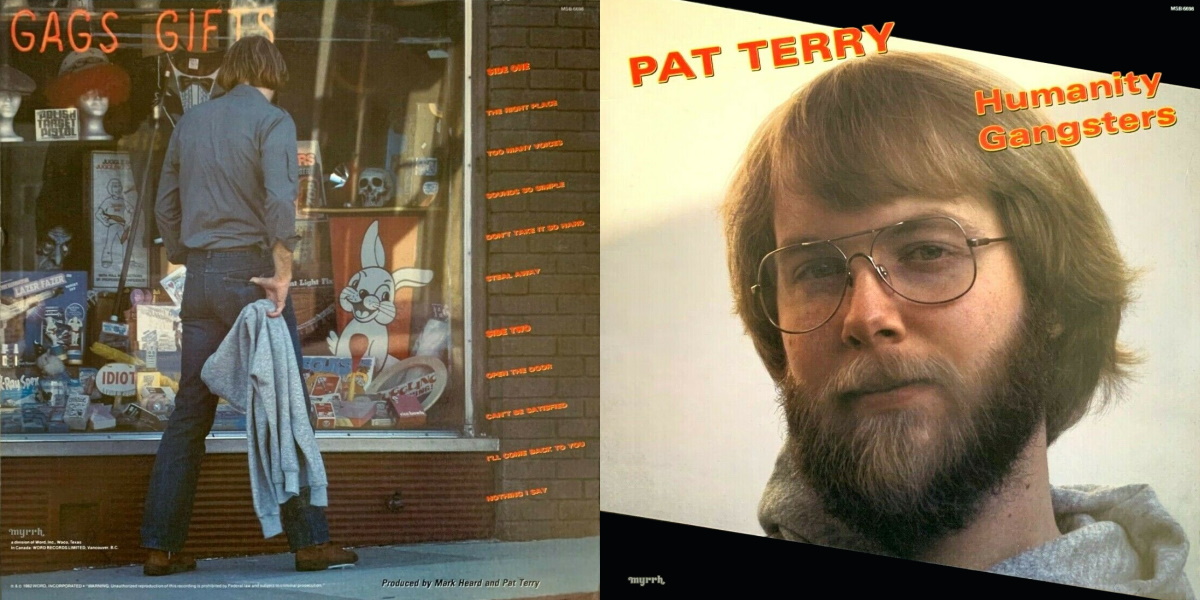
LP tracklist:
Side One
A1. “The Right Place” – 3:46
A2. “Too Many Voices” – 3:02
A3. “Sounds So Simple” – 3:16
A4. “Don’t Take It So Hard” – 5:02
A5. “Steal Away” – 3:55
Side Two
B1. “Open The Door” – 4:23
B2. “Can’t Be Satisfied” – 3:58
B3. “I’ll Come Back To You” – 5:19
B4. “Nothing I Say” – 3:08
Note: Simultaneously released on cassette and 12-inch vinyl LP by Myrrh Records.
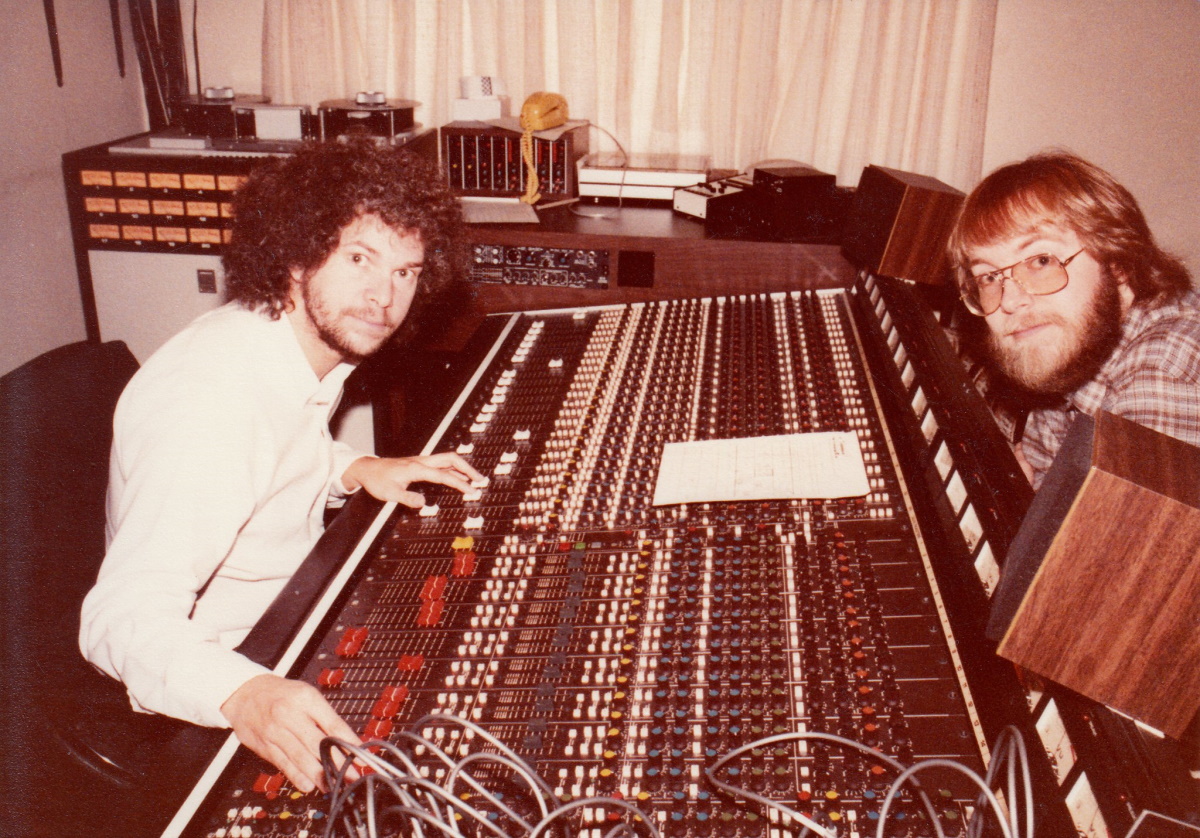 Producer Mark Heard (L) and Pat Terry (R) at Poiema Studios during the Humanity Gangsters sessions.
CREDITS. Produced by Mark Heard and Pat Terry. Recorded at Poiema Studios and Whitefield Studios. Engineered by Mark Heard, Bill Cobb, and Chris Taylor. Mixed by Mark Heard and Pat Terry at Wilder Brothers Studios. Mastered by Bernie Grundman.
Musicians: Pat Terry (Lead Vocals, Harmonica, Acoustic Guitar, Slide Guitar, Electric Guitar, Piano, Prophet 5 Synthesizer), Carl Pickhardt (Piano, Hammond B-3 Organ), Mark Heard (Electric Guitar, Bass), Billy Batstone (Bass), John Mehler (Drums), Alex MacDougall (Percussion, Congas). Backing Vocals by Mark Heard and the Strat Brothers.
Chris Maxwell: Guide us through your journey from The Pat Terry Group years until now. Tell us about your musical changes and your spiritual development.
Pat Terry: It’s hard to comment on that in just a few words, but basically, through the years I’ve continuously asked myself this question… What should it mean to be a Christian person who is also a songwriter? What is the purpose of my creativity? In the latter part of 1978 I was really struggling with those questions. Was music only good to be useful as some kind of religious tract, or did it have some other value that could help me make sense of my life and the world around me? These were questions I felt like I had to answer if I was going to keep making music.
At a certain point I became aware of Francis Schaeffer, reading some of his work on the subject of Christianity and the arts. It really spoke to me. The whole concept of creativity having value – not because it could be useful in some evangelical sense, but rather because it was a reflection of God’s creative character in us – was so liberating. I started feeling that not only was I free to explore a variety of expression in my work, but it was essential for me to do if I was going to be true to myself and to my calling as a creative person.
That eventually led to my disbanding of the Pat Terry Group, and the three solo albums I made with my friend Mark Heard producing. When you hear those albums today they don’t sound particularly radical, but I suppose at that time they were pretty far outside the realm of what Christian record labels were putting out. For me, it was just important to write what I was feeling and go out and play those songs for my audience. In the end I think honesty is all an artist has to offer, and I did my best to own up to my questions in that music. It’s funny… some people are made nervous by music or books or other kinds of art that focus on the struggle of being human, and some are comforted. I’m one of those who feel comforted when I hear music like that. I suppose it’s because it reminds me I’m not alone in my desire to understand life and faithfully keep at it. I’ve received a number of letters through the years from people who were encouraged by that element of those records, and that’s really what I’d hoped for. That reaching out – that connection between people – is part of the reason for Christians to make art.
By 1985 I felt I’d said what I’d wanted to say through those albums, and I’d reached another creative plateau. Having spent so much time recording and touring during the previous few years, I just wanted to spend more time on the thing I loved to do more than anything else, and that was songwriting itself. I loved what I was hearing coming out of Nashville at that time, was aware of the songwriting community there, and wondered what it would be like to just write songs for other people to sing. I started spending a lot of time in Nashville in 1986. Though it was a huge challenge, it was inspiring and fun from the get-go. Probably the best part of it was that I was forced out of my Christian comfort zone and into a world where religious words and phrases didn’t automatically open any doors. You found out real quick if your faith was real or just some kind of cultural security blanket.
I met a lot of people who in one way or another had written off Christians. I’m grateful for that experience. It helped to strip away some things in my life that were just window dressing, and challenged me to cling to those things that were essential to my faith and my art. And of course, the musical atmosphere in Nashville was and still is just great. I’ve had the privilege to write with so many gifted writers, and as a result I’ve learned more about writing than I would have ever discovered on my own. The craft of songwriting is endlessly fascinating to me.
[Excerpt from a 2009-interview with Pat Terry]

Reviews
There are no reviews yet.