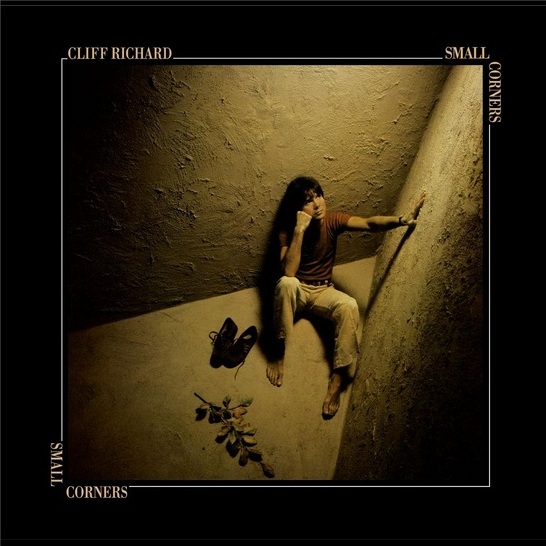
Description
Small Corners is a studio album by the British singer and songwriter Cliff Richard, released on EMI Records in January 1978. The album was recorded during three days in January 1977 by Tony Clark at Abbey Road Studios in London, England; with Cliff Richard self-producing (for the first time). Strings arranged by Nick Ingman.
Small Corners was not Cliff’s first gospel oriented album, though his first to feature contemporary Christian music. Musically the album captures Cliff at a stage where he was combining pop and rock in a fashion that was returning him to the charts. The album peaked at No. 33 on the UK album chart on its release. (The lack of success chart-wise probably had more to do with the lyrical content than any musical deficiency.)
Cliff’s backing band on the album features Graham Todd on keyboards, Bryn Haworth and Terry Britten on guitars (the latter a long time member of Cliff’s live band and as well one of his main songwriters), and a rhythm section consisting of bassist Alan Tarney and drummer Brian Bennett (the latter of the British instrumental rock group The Shadows which actually were Cliff Richard’s backing band from the late 1950’s and on for many years). As usual, background vocals provided by a trio consisting of Tony Rivers, Stewart Calver and John Perry (as well as Cliff Richard himself).
Most of the songs on Small Corners were written by various Christian singers/songwriters. “Why Should The Devil Have All The Good Music“, “I Wish We’d All Been Ready” and “Up In Canada” were written by Larry Norman; “I’ve Got News For You” was written by Randy Stonehill; “Going Home” was written by Annie Herring of 2nd Chapter of Acts, with “Hey Watcha’ Say” co-written by all three 2nd Chapter members; everyone well known American artists. Cliff did also include a couple of songs written by British contemporary Christian artists – “I Love” written by the popular folk duo Malcolm & Alwyn and “Good On The Sally Army” written by singer-songwriter Allan Shiers (a song featured on Shiers’ album The Man In Me, released in 1974). The album also features “Why Me” written by Kris Kristofferson, as well as “Yes He Lives” and “Joseph” written by Terry Britten, Cliff Richard’s long time session guitarist who actually also playes on this album. (“Yes He Lives” was later recorded by Sheila Walsh on her 1983 effort, Drifting, an album produced by Cliff.)
Placing his rock & roll revival on hold for a few days, Cliff Richard and his regular band decamped to Abbey Road studios in January 1977 to cut a new inspirational album, Small Corners. With Richard himself producing, the entire album was bashed out in just three days, January 17-19, and the finished thing would retain that spontaneous air to emerge the most enjoyable and, in many ways least pious, of all Richard’s religious offerings. Highlights are the two lightest-hearted numbers, «Good on the Sally Army» and «Why Should the Devil Have All the Good Music», but a lovely version of «When I Survey the Wondrous Cross» is also sterling stuff – in fact, the weakest number on the album is that selected as its one and only single, «Yes He Lives». Much of the credit for the album’s strength must go to the musicians, who hit every number with the same force they normally employed on the rock records, but Richard himself seems determined that the fans should enjoy themselves, too, and the result is an album that fits snugly in alongside the remainder of his late-’70s output. [Dave Thompson, AMG]
The ’70s saw the establishment of a new form of gospel music where spiritual themes were explored in a pop and rock style. In America it had been called Jesus Rock but by 1977 when Cliff Richard was recording this album it had begun to be called Contemporary Christian Music or CCM. Although this wasn’t the first gospel album of his career, it was certainly his most convincing where he finally drew together a lot of the songs he’d been singing live and recorded them with his current live band. Cliff himself had been enjoying a renaissance in his career which had stalled in the early ’70s but had seen him heading back into the charts with songs like «My Kinda Life», «Devil Woman» and «Miss You Nights». Somehow he’d remembered how to rock again and brought those sounds to his new gospel album. In effect ‘Small Corners’ is part of the missing link between 1976’s «Devil Woman» and the number one hit that completely restored his career, 1979’s «We Don’t Talk Anymore». The album itself has been out of print for quite a while so this digital re-mastered re-release is most welcome since it is an absolute classic Christian music release.
The 1978 album draws on songs from some of the top songwriters of the day and features no less than three Larry Norman songs. His reworking of «Why Should The Devil Have All The Good Music» opens the album with a bunch of kids singing the Sunday school song which gives the album its title before crashing into the song itself. The song was soon established as a live favourite. Larry’s «I Wish We’d All Been Ready» and «Up In Canada» are also included. The rest of the material ranges from a cover of one of Elvis’s favourite gospel songs «Why Me Lord» through to the acapella hymn «When I Survey The Wondrous Cross». Cliff’s version of Malcolm and Alwyn‘s «I Love» works nicely with a poppy approach and «Hey Watcha Say» is undoubtedly better than 2nd Chapter Of Acts‘ original. «Going Home» always felt like a bit of a throwaway track and «Good On The Sally Army» was penned by Allan Shiers, an obscure Christian artist that Cliff had been producing but who never enjoyed much success. Most curious of all were two songs written by a guitarist in Cliff’s band, Terry Britten. Not a Christian, the song «Joseph» seemed a bit vague vocally whereas he hit the jackpot with the dynamic «Yes He Lives», a song about the resurrection from a man who didn’t believe the message. Strange! Britten himself went on to pen «What’s Love Got To Do With It» for Tina Turner so he shouldn’t be upset that when «Yes He Lives» was released as a single it failed to chart. The album itself peaked at number 33 on its February 1978 release. Four months later when I became a Christian I can remember scoffing at one of my new friends when he had this in his collection but after listening to it round his house, it wasn’t long before I bought my own copy. Musically this captures Cliff at a stage where he was combining pop and rock in a fashion that was returning him to the charts. In its own way, this is a classic and its lack of success chart-wise is more to do with the lyrical content than any musical deficiency. This re-mastered version rather incongruously gives the fan three obscure “inspirational” Cliff b-sides from the early ’90s. These may fit in thematically but musically jar somewhat. [Mike Rimmer, Cross Rhythms, May 2007]
> Apple Music (https://music.apple.com/gb/album/small-corners/699668142)
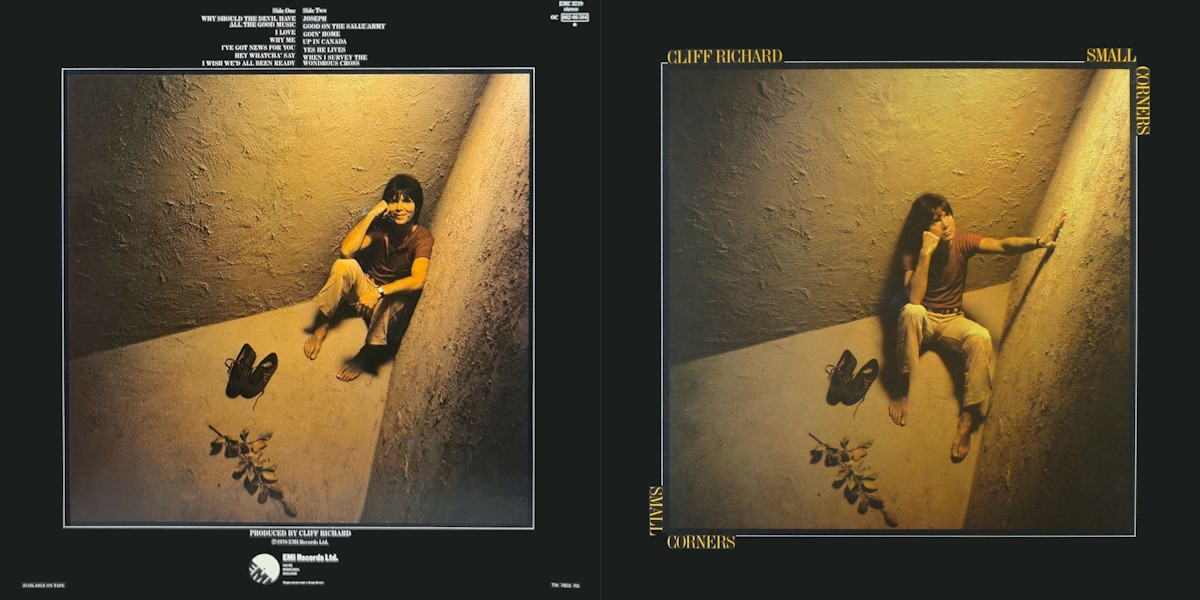
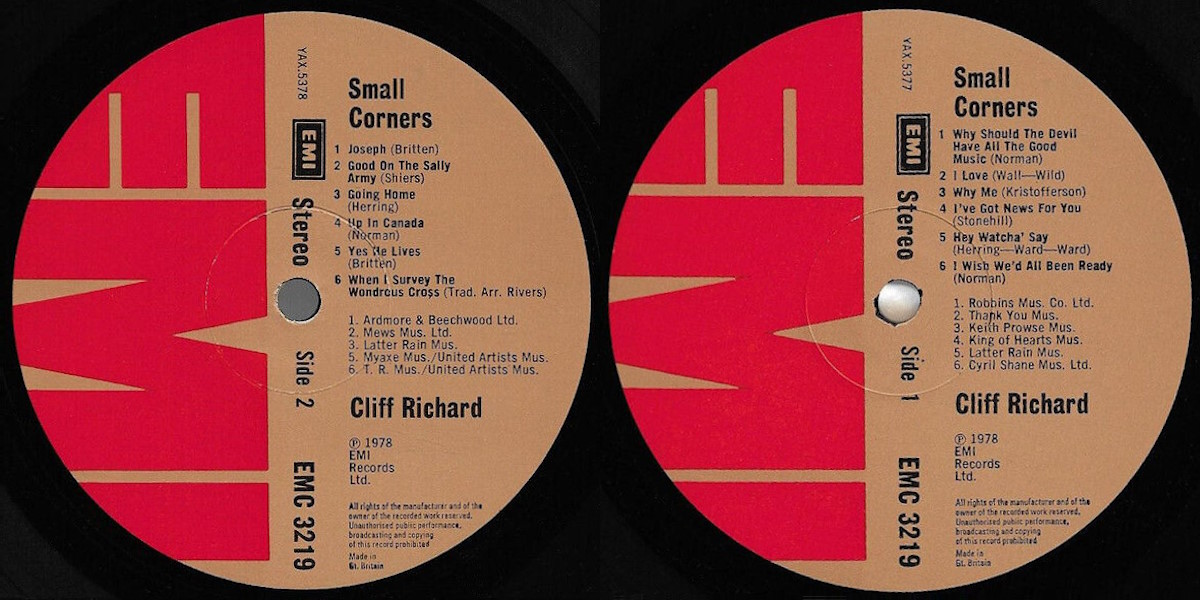
LP tracklist:
Side One
A1. “Why Should The Devil Have All The Good Music” – 4:05
A2. “I Love” – 3:15
A3. “Why Me” – 2:40
A4. “I’ve Got News For You” – 4:14
A5. “Hey Watcha’ Say” – 3:56
A6. “I Wish We’d All Been Ready” – 4:38
Side Two
B1. “Joseph” – 3:22
B2. “Good On The Sally Army” – 3:04
B3. “Going Home” – 2:51
B4. “Up In Canada” – 2:44
B5. “Yes He Lives” – 3:28
B6. “When I Survey The Wondrous Cross” – 2:11
Note: Simultaneously released on cassette and 12-inch vinyl LP by EMI. Re-issued on CD in 2001, Digitally Remastered and featuring two bonus tracks; “More To Life” and “Peace In Our Time”.
“Why Should The Devil Have All The Good Music”, Live at Pop Gospel
“Up In Canada”, Live at Pop Gospel, 06.03.1979


Reviews
There are no reviews yet.