Description
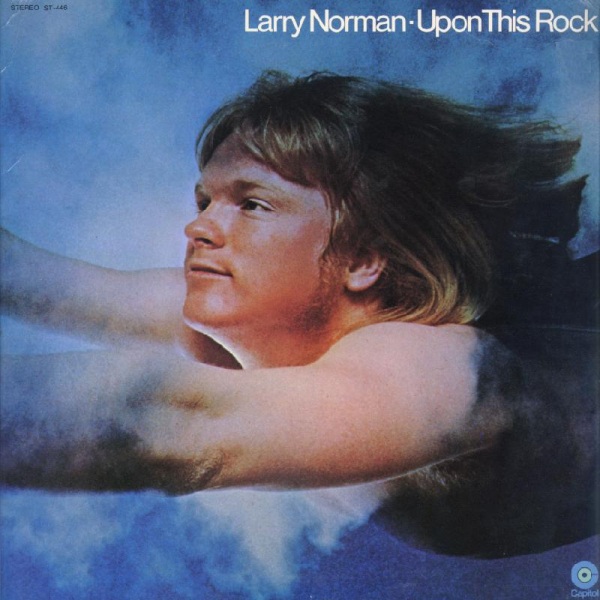
Upon This Rock is the solo debut album by the American singer and songwriter Larry Norman (April 8, 1947 – February 24, 2008) formerly of the band People!, released on Capitol Records in December 1969. (A remixed version of the album was released on the American gospel label Impact Records the following year, a division of Benson. Also released in the UK in the beginning of 1972 on the gospel label Key Records.) The album was recorded at Studio A at the Capitol Records building in Los Angeles with Hal Yoergler producing. Orchestrated by Anthony Harris. Larry was backed by an ace session band featuring four of the studio musicians known as the “Wrecking Crew” – Larry Knechtel on keyboards, Mike Deasy on guitar, and a rhythm section consisting of bassist Joe Osborne and drummer Hal Blaine (musicians featured on classic albums like The Beach Boys’ Pet Sounds and Simon & Garfunkel’s Sounds of Silence and Bridge over Troubled Water, to name a few).
During 1968 and the beginning of 1969 Larry Norman had recorded a handfull of demos that he submitted to Beechwood for publishing. Unbeknownst to Larry, Capitol Records – the label Norman was signed to during his time as a member of the group People! – happened to hear these songs and offered him an album deal which resulted in the recording of Upon This Rock. Because of sickness Larry had not been able to be at the studio during the mix down and so the finished album was presented for him later at a private playback party. Larry was not happy about the final mix and immediately asked Capitol Records if he could re-record various layers of the sound but was told that the budget had been exhausted and that the album would have to stand as it was.
Upon This Rock features a blend of folk, psychedelic, and rock influences, combined with street language and gritty imagery. Upon its release in the mainstream music market in 1969, the album didn’t sell particularly well – it simply didn’t fit into any genre of commercial music at the time. Bob MacKenzie though, a producer and creative director of the Benson Music Publishing Company, had seen the album’s potential. He negotiated a deal with Capitol for the album to be leased to Benson’s contemporary gospel label Impact Records for distribution into Christian bookstores in the US. This time around Larry Norman granted the permission from Capitol to do some re-recording (though he had to pay for the sessions himself), and a remixed version of the album was released on Impact Records in 1970. Later MacKenzie introduced Upon This Rock for the British organization MGO who got to release the album in the UK in the beginning of 1972 on their gospel label Key Records. (In December 1964 there was a meeting of gospel groups in London with Dave Payne to share the experiences of some gospel groups and to talk over problems. This was to be the start of MGO – Musical Gospel Outreach – which was set up initially to “deal with basic group problems.” Soon MGO was covering largely all aspects of beat group evangelism in the UK: They established Buzz – a contemporary gospel magazine publishing its first issue in October 1965; Key Records – a contemporary gospel label; and also arranged a well-attended series of events and concerts.)
According to Tony Cummings, a long time music editor at Cross Rhythms (originally a British in-print gospel magazine that later turned into an online gospel music resource website), the UK release of Upon This Rock, along with a MGO-organised Larry Norman tour during the spring of 1972, lifted the standards of contemporary Christian music in the UK to a new level. (Larry’s UK tour packed in 38 concerts in 35 days!) MGO also worked through the media for exposure, including setting Larry up with a warmly received meeting with the legendary British DJ John Peel, the longest serving of the original BBC Radio 1 DJs. MGO as well negotiated for MGM Records to release Larry’s single “Righteous Rocker” (the song was later re-recorded for his 1972-album Only Visiting This Planet, re-titled “Without Love You Are Nothing”). The single wasn’t a hit but it did produce the following comment from DJ Alan Freeman at BBC Radio 1: “That’s one helluva record!”
Upon This Rock was written to stand outside the Christian culture. I tried to create songs for which there was no anticipated acceptance. I wanted to display the flexibility of the gospel and that there was no limitation to how God could be presented. I used abrasive humor and sarcasm as much as possible, which was also not a traditional aspect of Christian music. I chose negative imagery to attempt to deliver a positive message, like «I Don’t Believe in Miracles» is actually about faith. «I Wish We’d All Been Ready» talked about something I had never heard preached from a pulpit as I grew up. «The Last Supper» and «Ha Ha World» used very surreal imagery which drug users could assimilate. My songs weren’t written for Christians. No, it was not a Christian album for those believers who wanted everything spelled out. It was more like a street fight. I was saying [to Christians], “I’m going to present the gospel, and I’m not going to say it like you want. This album is not for you.” [Larry Norman’s comments on Upon This Rock in an interview with CCM Magazine]
UPON THIS ROCK – Larry Norman – Capitol ST-446
This album, conceived, written and performed by Larry Norman, takes the form of a musical suite, with a spiritual and occasionally mystical flavor. Larry brings his strong singing presence to «Moses In The Wilderness», «Sweet Sweet Song Of Salvation» and «You Can’t Take Away the Lord». There is a wry twist to at least two items: «Forget Your Hexagram» and «The Last Supper». The LP makes for fascinating listening and may churn up some chart action. [CashBox, Vol. XXXI – No. 38 / April 18, 1970 (Album Reviews/Pop Best Bets)]
LARRY NORMAN – Upon This Rock – Capitol ST 446 (S)
Infusing rock music with religious themes is a relatively untried concept, and writer performer Larry Norman should appeal to many with his original and sometimes respectfully humorous applications of this. Most commercial are «Sweet Sweet Song of Salvation» and «I Don’t Believe in Miracles». [Billboard Magazine, April 18, 1970 (Album Reviews/Pop)]
Along with a rather alarming number of bad young songwriters, the country is however producing some very good ones. We must now include among them twenty-three-year-old Larry Norman, who views things in a unique way. Norman, a former member of a group called People, is obviously a product of rock. He is also religious in the most traditional, “Americana” sense of the word. Love the Lord and watch out for the devil. Hip hellfire and brimstone – and, unless I’m crazy, Norman is for real. The album is constructed as a show. Even its title is ingenious. Its basic message is simple, as in «Sing That Sweet Sweet Song of Salvation» (“and let the people know that Jesus cares”). The other side of the coin hints at warnings that resemble superbad trips known among heavy dopers. «Ha Ha World» touches on an acidish fantasy that occurs in the kitchen and includes a disappearing chicken: “I had money and fame but my wealth wasn’t wise/ What good are the coins on a dead man’s eyes/ And the ringing of chimes in my head said it’s time to start praying.” Norman’s statements pop out of his titles: «Walking Backward Down the Stairs» or «Forget Your Hexagram». «Nothing Really Changes» takes a historical trip: “Would Beethoven join a jazz quartet/ Would Ben Hur drive a blue Corvette/ Would Aristotle be an acid head/ Would Cain kill Abel with a bayonet ?” The peculiar creative flow seems unstoppable. Norman’s music is semisophisticated rock, better than some and worse than others. His voice is young, sometimes frisky, sometimes soft. Its tone has the nonsinger sound appropriate to rock. I am unfamiliar with the names of producer Hal Yoergler and arranger Tony Harris, but they’ve done fine work here. Harris seems to be into everything from Berio to the Staple Singers. His album ending is perfect. Larry Norman is an unusual talent and, one suspects, a more peaceful one than you’d expect in a twenty-three-year-old. I like his message and recommend his album. [M.A., High Fidelity magazine, July 1970 ]
Often heralded as the Sgt. Pepper of Christian rock from the father of Christian rock, Upon This Rock may not have been the first Jesus rock album, but few would deny it being the most important. Sure there were earlier artist, but Larry Norman is generally the first name that comes to mind for truly embodying the whole rock persona. This guy looked like a rocker and by golly he sang like one too. Fresh from the group People and their #14 hit «I Love You», Larry began his career by setting forth his Christian vision in no uncertain terms. Here on a mainstream label no less was something more than just a hey-let’s-make-a-God-record mentality typical of the times. Titles like «Sweet Sweet Song Of Salvation» and «I Wish We’d All Been Ready» would become staple songs of the Jesus movement, covered by literally scores of future artist. Not merely “message music”, however, Norman exuded a creativity that ran from wry offbeat humor («Moses In The Wilderness» and «Nothing Really Changes») to twisted Dylan-esque dream imagery («The Last Supper»). While not a perfect album (over-production typical of commercially-minded big labels is sometimes cited), Upon This Rock remains a landmark recording that basically paved the way for everything else. Look for the original Capitol issue as it contains an opening instrumental track «Prelude» that is typically deleted on later pressings by other labels. [Ken Scott, The Archivist, 4th Edition]
Long before the days of CCM and the cross-pollination of rock and gospel, Larry Norman and a small group of California musicians began the “Jesus music” movement. With his haggard appearance, sly wit, and street savvy, Norman was almost a pariah within the formal world of gospel, but a real-life godsend to open-minded music fans. With liberal amounts of sarcasm and a respect for religious skeptics, Norman delivered his church-weary message with skilled pop/rock songwriting. The “Christian Sgt. Pepper” comparisons might be a little overdone, but Norman’s solo debut, Upon This Rock, is perhaps the first truly accomplished and relevant Christian rock testimony ever recorded. Tracks like «Walking Backward» and «Forget Your Hexagram» have an undeniable grooviness and a ringing message that, for its time, is amazingly unapologetic and free of dogma. Upon This Rock is more than a novelty; it is a bold announcement from a man who wasn’t satisfied to simply create a music subgenre – Norman reshaped an industry and the lexicon of the modern gospel. [Jason Anderson, AMG]
2CD Edition, Solid Rock Records
After Larry left his band People! following the release of their album ‘I Love You’, he was enticed back to Capitol Records and invited to make a solo album. Cut in 1969, ‘Upon This Rock’ was an epiphany for Christian music – the first genuine rock album. Put into the context of its time, this was radical stuff which completely failed commercially because it was too rock’n’roll for the Christian community and too Christian for the rock’n’roll community. This is 22 year old Larry Norman making a creative leap and creating a whole new genre of music! Aside from its historical importance, it’s pretty groovy and if you like ’60s vibes with a bit of avant garde piano playing, you’ll love it. Lyrically, there’s no doubt about the message so you get classic Larry songs like the hip pop of «You Can’t Take Away The Lord» and the sing-along «Sweet Song Of Salvation» (which became an immediate hit with the Jesus hippies despite it being Larry’s least favourite song!). You also get the original recording of one of his biggest tunes, «I Wish We’d All Been Ready». «Moses In The Wilderness», a song he’d written as a kid in the ’50s, is full of simple humorous innocence and a great tuba solo! There are two version of «The Last Supper», the familiar wild piano and vocal version and a groovy band/orchestra version which shows how it could have been done. Good call to have just done it with the piano – so much more emotional! «Forget Your Hexagram» was a real wake up call to hippie culture to embrace the truth of Christ and «Nothing Really Changes» is an interesting challenge that history suggests today we merely relive the mistakes and sins of the past and only Jesus can set us free. This version re-instates the instrumental «Prelude» that opens the album and also gives a second bonus track, an alternative mix of the brilliant «Ha Ha World». A totally brilliant rock’n’roll whimsical whirlwind which 30 years later is a complete rarity, almost impossible to find a CD version so take the opportunity to snap one up tout de suite! [Mike Rimmer, Cross Rhythms, August 1998]
> Apple Music (https://music.apple.com/us/album/upon-this-rock/278869770)
LP tracklist (the original Capitol Records 1969 version):
Side One
A1. “Prelude” – 1:07
A2. “You Can’t Take Away the Lord” – 2:00 [2:11]
A3. “I Don’t Believe in Miracles” – 3:11 [3:11]
A4. “Moses in the Wilderness” – 3:09 [3:13]
A5. “Walking Backwards Down the Stairs” – 2:55 [2:45]
A6. “Ha Ha World” – 3:42 [3:25]
Side Two
B1. “Sweet Sweet Song of Salvation” – 4:13 [3:53]
B2. “Forget Your Hexagram” – 2:23 [2:23]
B3. “The Last Supper” – 2:24 [3:14]
B4. “I Wish We’d All Been Ready” – 2:19 [3:15]
B5. “Nothing Really Changes” – 2:59 [3:18]
B6. “Postlude” – 2:06 [2:14]
Note: The album was remixed by Larry Norman before it was re-issued on Impact in 1970 for distribution in the Christian music market (the parentheses above show the length of the remixed tracks). Although listed on the cover of the Impact version, the instrumental track “Prelude” is featured on the original Capitol Records version only.(You can hear the difference on Solid Rock Records’ 2002 double disc collector’s edition CD re-issue of Upon This Rock. The second disc includes a radio show called Powerline featuring an interview with Larry Norman, with the Capitol version playing in the background.) Available at Bandcamp: https://larrynorman.bandcamp.com/album/upon-this-rock
The Powerline Interview from a 1970 radio broadcast, sourced from the bonus disc of the Collector’s Edition 2CD of Upon This Rock, released in 2002, is available at Bandcamp. (All songs are from the Capitol version of Upon This Rock, but edited, in mono and with Larry talking over sections of them.)
https://larrynorman.bandcamp.com/album/powerline-interview-1970
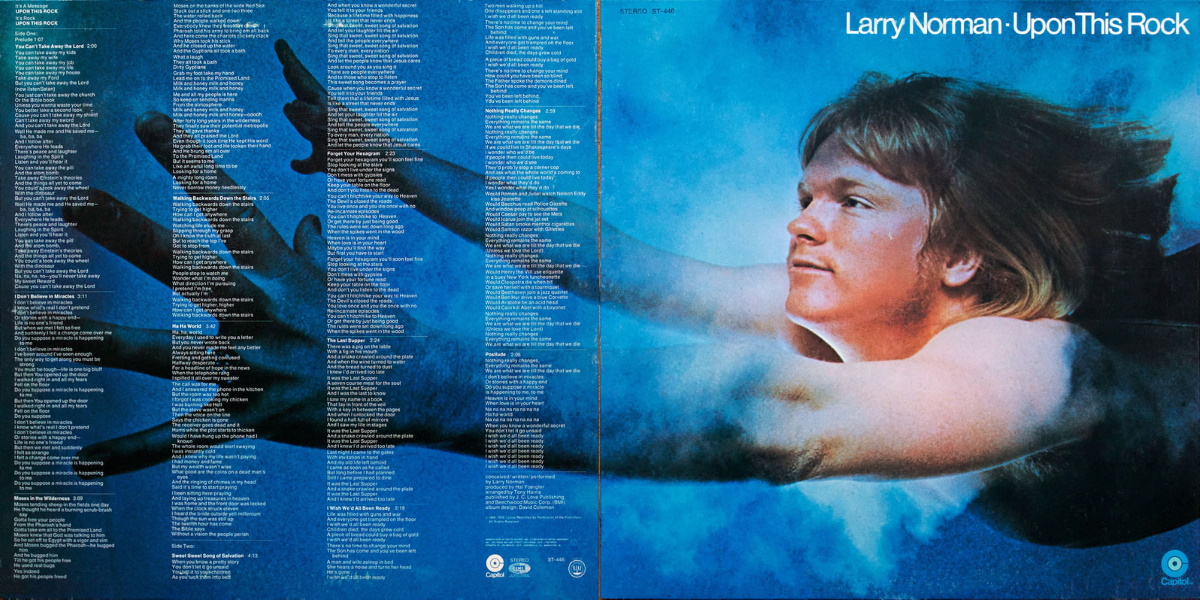
 A full-page advertisement for Larry Norman’s Upon This Rock was featured in the April 18, 1970 issue of CashBox Magazine (Vol. XXXI – number 38): “Larry Norman: Upon This Rock. An album conceived, written and performed by the former lead-singer of “People.” A young artist whose entire ethos, including his talent, is avowedly built around his religion. The medium is rock. The rock of ages.” (The Album Review/Pop Best Bets section of the same issue also featured a review of the album.)
Larry Norman’s re-mixed version of Upon This Rock, released on Impact Records (US) in 1970 and Key Records (UK) in 1972. TRACKLIST: You Can’t Take Away the Lord (2:11) / I Don’t Believe in Miracles (3:11) / Moses in the Wilderness (3:13) / Walking Backwards Down the Stairs (2:45) / Ha Ha World (3:25) / Sweet Sweet Song of Salvation (3:53) / Forget Your Hexagram (2:23) / The Last Supper (3:14) / I Wish We’d All Been Ready (3:15) / Nothing Really Changes (3:18).
The original version of Upon This Rock released on Capitol Records in 1969. TRACKLIST: Prelude (1:07) / You Can’t Take Away the Lord (2:00) / I Don’t Believe in Miracles (3:11) / Moses in the Wilderness (3:09) / Walking Backwards Down the Stairs (2:55) / Ha Ha World (3:42) / Sweet Sweet Song of Salvation (4:13) / Forget Your Hexagram (2:23) / The Last Supper (2:24) / I Wish We’d All Been Ready (2:19) / Nothing Really Changes (2:59) / Postlude (2:06).
CREDITS. Produced by Hal Yoergler. Orchestrations by Anthony Harris. Album design by David Coleman.
Musicians: Larry Norman (vocals, guitar, piano), Mike Deasey (guitar), Larry Knechtel (keyboards), Joe Osborne (bass), Hal Blaine (drums). Background vocals by The Inspirations & Annie, Matthew and Nelly (2nd Chapter of Acts).

Reviews
There are no reviews yet.