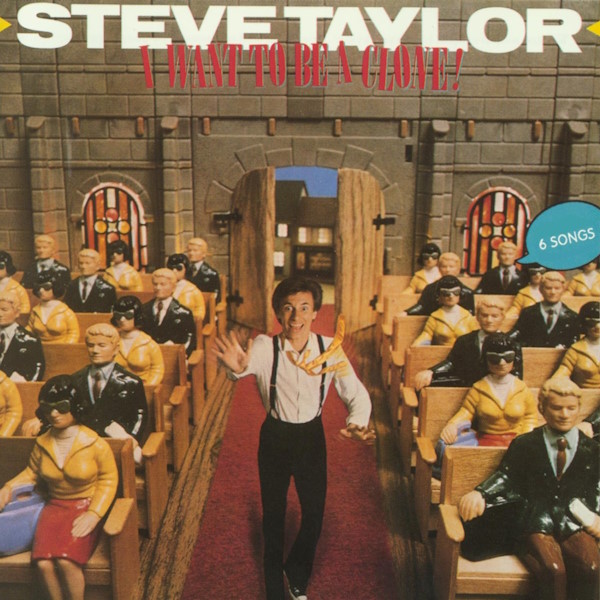
Description
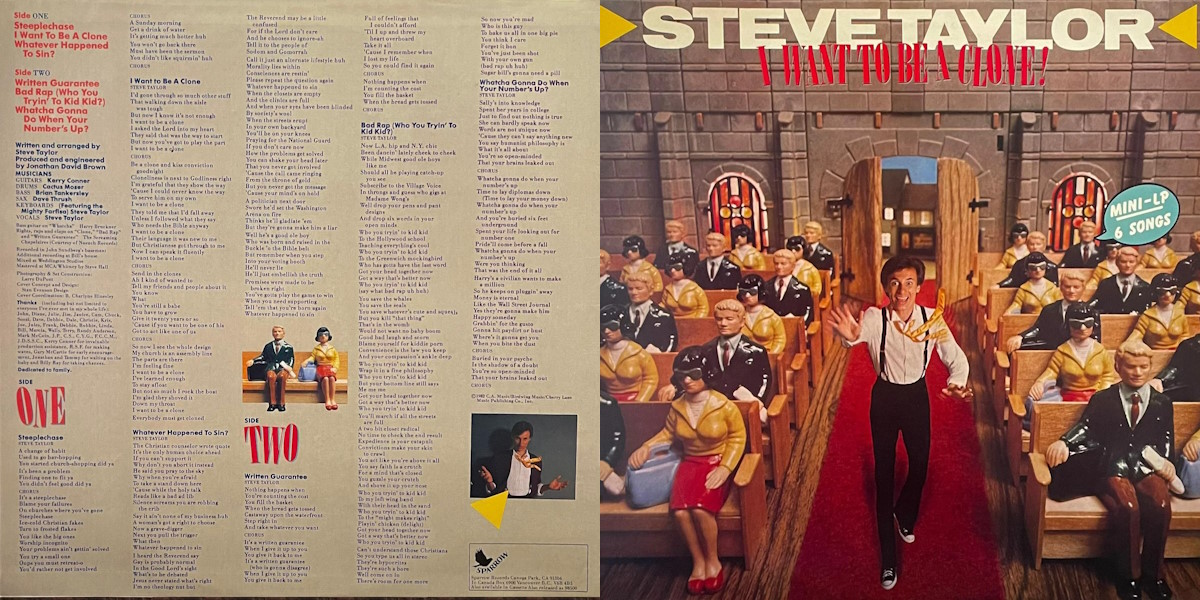
I Want to Be a Clone, a six-track 12-inch vinyl EP, is the debut effort by the American singer, songwriter, and producer Steve Taylor, released on Sparrow Records in 1983. The mini-LP was recorded and produced by Jonathan David Brown. (“Recorded in John Sundberg’s basement; additional recording at Bill’s house.”) Mixed by Brown at Weddington Studios in North Hollywood, California. Written and arranged by Steve Taylor.
I Want to Be a Clone was included among the Best Albums of 1983 by CCM Magazine, voted number seven on a list featuring eleven albums released from the last quarter of 1982 through the last quarter of 1983. – Last January Paul Baker said of Taylor’s debut EP, “With startling clarity the Colorado musician attacks the sanctimonious comfort of the padded pew as well as the ‘alternative lifestyle’ of the pseudo-hip. Each well-aimed lyrical arrow deals with issues, conditions, and attitudes, hitting at the gut level and travelling right to the heart.”
“At the time I started writing,” Taylor recalls, “a lot of Christian music wasn’t very honest. It talked about a Christianity that didn’t exist. You know, ‘Jesus makes me happy all the time, and I praise the Lord every minute of my life, every breath I take’ – it just wasn’t rooted in reality. That’s not even a Biblical reality; we’re all human, we have struggles, we have things we have to face.”
With the release of his first mini-LP, ‘I Want To Be A Clone’, Taylor’s name quickly began to spread. “We had just released that album to see what would happen,” he recalls. “When it started taking off, I had to make a decision: is that what I want to do? And so I decided to go ahead and start touring.”
[Steve Taylor: On The Fritz and Working Better Than Ever, Excerpt from an interview featured in Sparrow Spotlight, 1985]
Listening to The Clash’s «Lost In The Supermarket» Steve Taylor realised that they were asking the right questions but not coming up with any answers, so he proceeded to write one of the most groundbreaking albums that CCM has ever heard and in the process did for the spiky-haired generation what Larry Norman had previously done for the long-hairs and record something that could speak the timeless message in a contemporary way. Taylor’s strengths are his passion and his thought provoking lyrics in which he uses words in ways that stand comparison to the best of the satirists. Think of a New Wave Tom Leher, if you can. ‘I Want To Be A Clone’ contains just six songs, all of them classics. Some speak to the Church: «Steeplechase» questions those who won’t make a lasting commitment but instead jump from congregation to congregation, looking for one that suits them rather than being conformed to the standards set by the Bible. «I Want To Be A Clone» challenges church leaders who force new converts into becoming like them, not like Jesus. But Taylor rightly launches his fiercest attacks on those who ignore God. «Bad Rap (Who You Tryin’ To Kid, Kid?)» and «Whatcha’ Gonna Do When Your Number’s Up?» ask hard questions for the non-believer, «Whatever Happened To Sin?» asks a different question to the compromised Church and «Written Guarantee» reminds us that we do not need to depend on our own efforts to please the Lord. Although a quarter of a century old this little album still has a message worth hearing. Note that all six tracks were included in Taylor’s 1988 compilation ‘The Best We Could Find‘. [Steven Whitehead, Cross Rhythms, March 2008]
> Apple Music (https://music.apple.com/us/album/i-want-to-be-a-clone-ep/715817524)
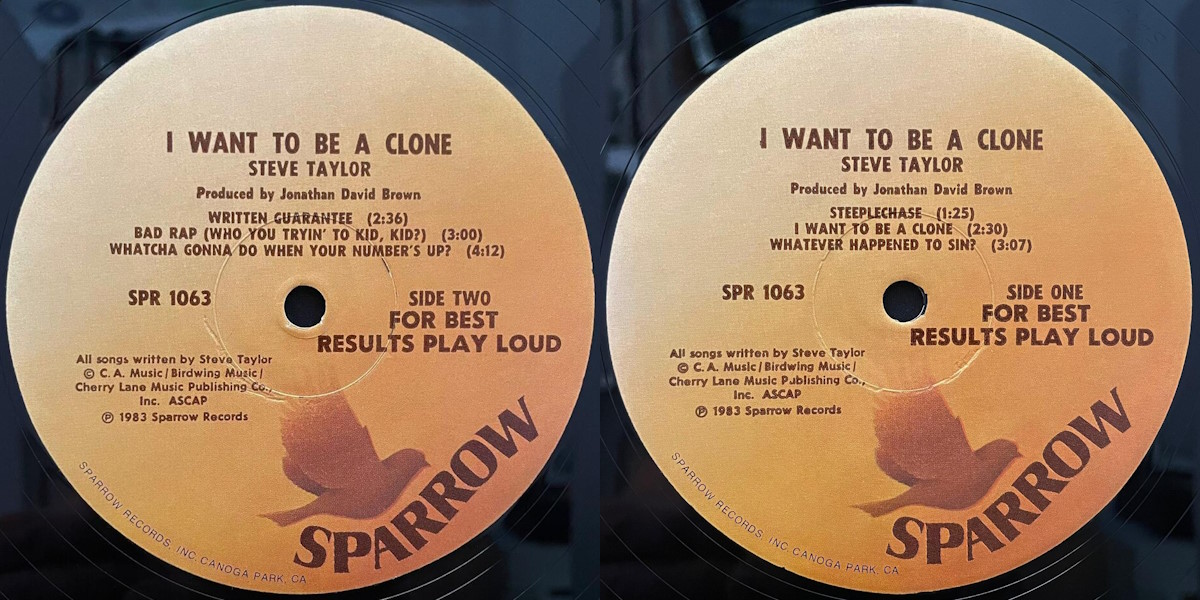
EP tracklist:
Side One
A1. “Steeplechase” – 1:25
A2. “I Want To Be A Clone” – 2:30
A3. “Whatever Happened To Sin?” 3:07
Side Two
B1. “Written Guarantee” – 2:36
B2. “Bad Rap (Who You Tryin’ To Kid, Kid?)” – 3:00
B3. “Watcha Gonna Do When You Number’s Up?” – 4:12
Note: Simultaneously released on cassette (with the same six songs appearing on both sides) and 12-inch vinyl EP by Sparrow Records. (Actually released as both 12-inch EP and 33 ⅓ RPM 10-inch EP in Canada and Australia.) Re-issued on CD by Sparrow Records in 1993. All six tracks were as well included on the 1988-compilation entitled The Best We Could Find.
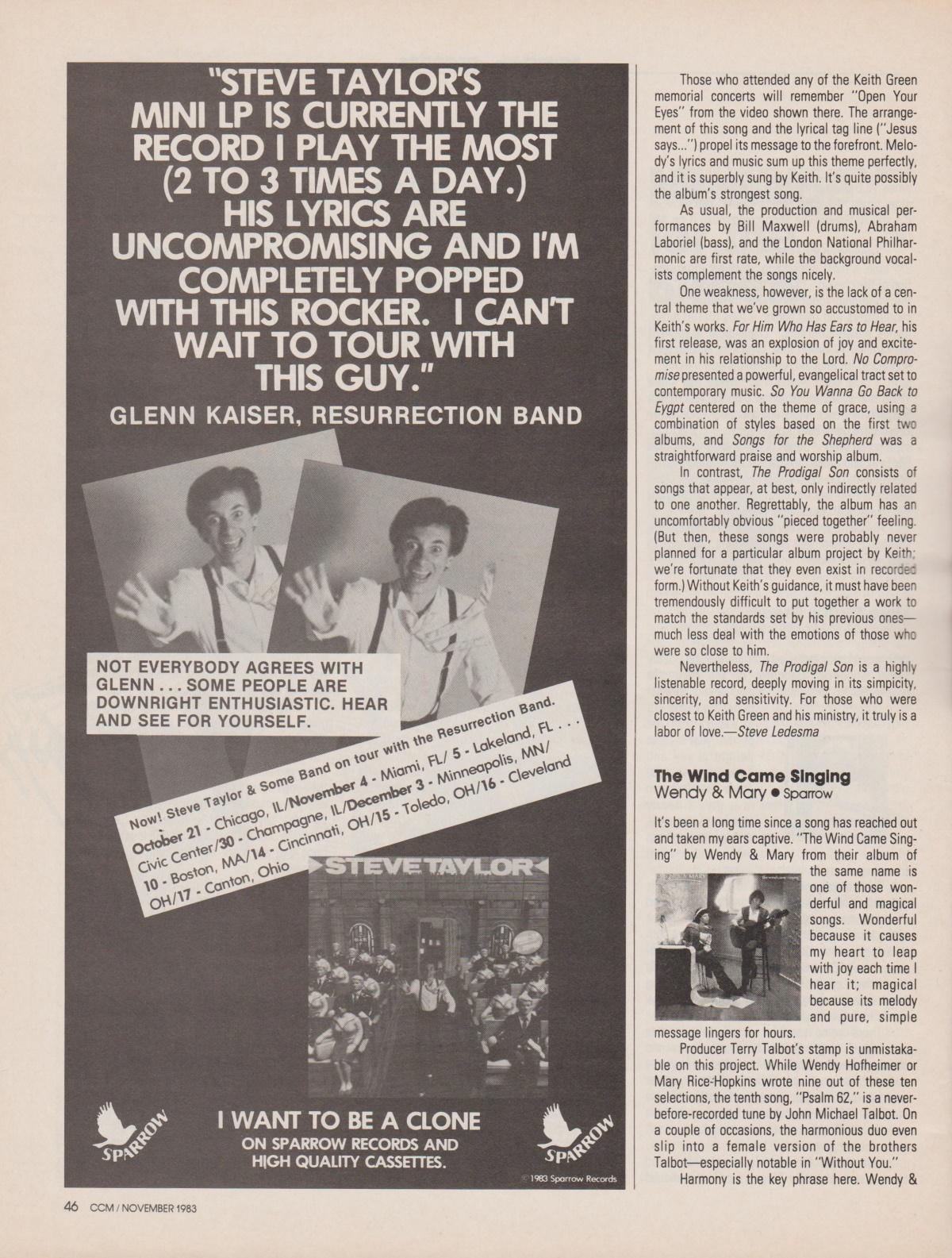 An advertisement for Steve Taylor’s I Want to Be a Clone was featured in the November 1983 issue of CCM Magazine.
CREDITS. Produced and engineered by Jonathan David Brown. Recorded in John Sundberg’s basement; Additional recording at Bill’s house. Mixed at Weddington Studios in North Hollywood, CA. Mastered by Steve Hall at MCA Whitney Recording Studios in Glendale, CA. Written and arranged by Steve Taylor. Photography and Set Construction by Larry DuPont. Cover Concept and Design by Stan Evenson Design. Cover Coordination by B. Charlyne Hinesley.
Musicians: Steve Taylor (Vocals, Keyboards; “Featuring the Mighty Farfisa”), Dave Thrush (Saxophone), Kerry Conner (Guitar), Brian Tankersley (Bass), Harry Bruckner (Bass on track B3), Cactus Moser (Drums). The Screaming Chapelaires (Courtesy of Nosuch Records): Rights, raps and claps on tracks A2, B2, and B1.
Reviews
There are no reviews yet.