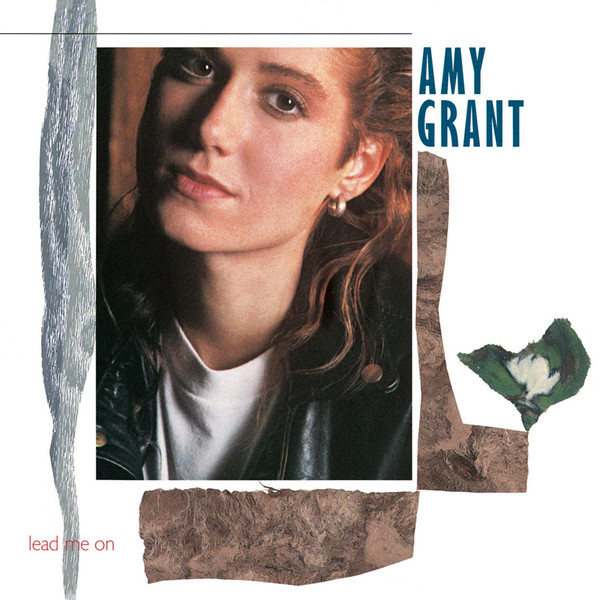
Description
Lead Me On is the seventh studio album by the American singer and songwriter Amy Grant, released on Myrrh Records in June 1988, a division of Word. Also released on A&M Records. The album was recorded by Jeff Balding at various studios in Franklin and Nashville, Tennessee; with Brown Bannister producing. (According to the booklet, “This project was created and developed between the plaster, wood, brick and mortar environments of: The Bennett House – Riverstone Farm – The Castle – Buchanan House – Groundstar“.) Mixed by Balding, Marc DeSisto, Shelly Yakus, John Potoker, and Steve McMillan at A&M Studios and Lion Share Recording Studio in Los Angeles, California, and at Emerald Sound Studios in Nashville, Tennessee.
Amy Grant is listed as writer or co-writer of 8 of the album’s 12 songs. As well featuring “What About the Love?” written by Kye Fleming and Janis Ian (a song initially considered to title the album), “Shadows” written by Karen and Don Peris of The Innocence Mission (a song originally featured on the band’s debut effort, Tending the Rose Garden), “If These Walls Could Speak” written by Jimmy Webb, and “Sure Enough” written by Wayne Kirkpatrick, Mike Brignardello, Shane Keister, and Emily Boothe.
This is a very human recording yet not to the exclusion of Jesus. It is lyrically free and truthful yet not to the exclusion of grace and propriety. Amy’s voice opens up to a new place she hasn’t been before, and contemporary Christian music and the world get to hear an innovative artful package of truth and beauty. Cries of commercial disappointment surrounding ‘Lead Me On’ are nullified by the recording’s lasting spiritual, artistic and eternal value. A model of excellence – not a cliche in sight. [ singer/songwriter & producer Charlie Peacock, CCM, July 1993 ]
It’s amazing what some time away from home will do for a person. After an extended tour of near epic proportions (by Christian music standards), Amy Grant came off the road for 18 months, during which time she and her husband produced among other things, their first child and the albums of their respective careers. ‘Lead Me On’ is not only a companion piece to Gary Chapman’s ‘Everyday Man‘, it also shares artistic ties to themes currently running through Bruce Springsteen’s latest album ‘Tunnel of Love’. More than ever before, Amy shares her heart as writer or co-writer of nine of the album’s 12 songs, on matters of love, life, faith, and as the boss would say “the stuff we’re all so scared of.”
From the opening strains of «1974», the album’s lead-off track, it’s clear that ‘Lead Me On’ has more in common conceptually with 1982’s ‘Age to Age‘ than either ‘Unguarded‘ or ‘Straight Ahead‘. Gone for the moment are the precise pulses of sequencers and drum machines. In fact, the whole effect of «1974» is musically underwhelming. Nevertheless, the message is clear as Grant recalls her conversion experience in a manner that testifies to its innocence as well as its relevance to the present, when she sings “stay with me/ as the years go by/ how I need to see/ that’s still me.”
The effect of placing this song first becomes more apparent next to the title tune, which shows up second. Set to an almost anthemic piece of music, «Lead Me On» paints living portraits of people caught under the yokes of slavery and persecution. Then, in the song’s bridge, she sings something that surely will surprise some. “Man hurts man/ time and time again/ and we drown in the wake of our power/ somebody tell me why.” It’s the first of a series of questions which are stated both directly and indirectly, and it’s what clearly marks the boundaries that separate this album from ‘Age to Age’ or anything else in her career.
In «Shadows» (co-written with Innocence Mission‘s Don and Karen Peris), a Romans 7 dilemma is presented. (“There are two of me/ one does the right things/ one cannot see”.) On «Faithless Heart» Grant asks “Who is the stranger my longing seeks/ I don’t know/ but it scares me through and through”, and though her resolve to be faithful is undeniable, the effect is chilling.
The questions continue in the chorus of «Wait for the Healing», as the survivors of the 60s look toward the future with patience, faith, and perhaps a little trepidation. But the most persistent question on ‘Lead Me On’ titles a song that originally was to title the album itself – «What About the Love?» In a series of vignettes observing the modern world (including the church world) with discomforting accuracy, the question is posed over and over, “Is this all there is/ something’s wrong in heaven tonight/ what about the love?” The question is both rhetorical and categorical, and the finger points both ways. The song, co-written with Janis Ian («At Seventeen», «Society’s Child») has a powerful, almost prophetical quality about it, making it one of the album’s most dramatic moments.
And yet, this is only half of what makes this album so significant. Amidst the turmoil and tough questions of life, there is a peace that passes all understanding and the potential of a glimpse of heaven on earth in the form of an everyday marriage. In songs like «Saved by Love», «Sure Enough», «Say Once More», and the delightful «If You Have to Go Away», ‘Lead Me On’ joins hands with Gary Chapman’s ‘Everyday Man’ and pledges love, faithfulness and devotion “till it’s cold in hell.” At the same time, there’s a bittersweetness about it all that may be too melancholy for some, but is part and parcel to the honesty and reality of this album. In what may be the most intimate moment here, Jimmy Webb’s «If These Walls Could Speak», Amy looks back at her life, family and friends with a sense of remorse for the sins and oversights of her past. It’s a sentiment not often heard and not popular in all Christian circles. It’s Amy at her most unguarded, and it’s understated power is overwhelming.
Finally, with a minor key setting, a backbeat and gospel chorus reminiscent of Foreigner’s «I Want to Know What Love Is», «All Right», sums it all up. “He hears of knocking on heaven’s door/ has taught me this if nothing more/ that it’s all right, what my come.” With forgiveness for the past, acceptance for the present and hope for the future at its core, ‘Lead Me On’ is as fine a Christian manifesto for life in the late 80’s as you’re likely to find. It’s true – the music isn’t as catchy as some of the techno-pop that propelled ‘Unguarded’. and it may take a little longer before you’re humming along, but trust me – you will. These songs have the kind of lasting quality that tells me you’ll be singing them for years to come. [Thom Granger, CCM, July 1988]
Lead Me On: the 20th Anniversary Edition
“We were young…and none of knew quite what to say…” Twenty years ago Amy Grant opened the album Lead Me On with these lines. Considered by many critics to be the best album in CCM history, it is undeniably Amy Grant’s crowning achievement. The songs exude an honesty and fear not seen previously in her work, and not seen again until ‘Behind the Eyes‘. In a way, it’s an album that leaves Grant’s early career behind, and ushers in a new era of maturity, a realization that life has its rough edges and that growth is a process. «Lead Me On» earns its anthemic status honestly, a cry out to God from Isreal of old and Christians today. «Faithless Heart» approaches Rich Mullins brutal self-examination, while «Wait for the Healing» and «All Right» remember the better times of the past and the harsh reality of trying to remain content. Grant’s early works created a generation of pop copycats young, marketable women who could easily be squeezed into a “CCM” mold. This album, however, allowed a more serious songwriter to emerge, and paved the way for artists like Sara Groves to explore the darker sides of the Christian life, the lulls, the pitfalls, and even the anger we feel at God on occasion. Disc two includes acoustic versions of several tracks, an extended live version of «Wait for the Healing», and several live tracks. Five short interview tracks are also here, with Amy discussing the recording process, her spiritual state at the time, and her allowing herself to express honest, “negative” emotions for the first time in her career. There are very few CCM albums that can be considered master works. This is one of them. [Brian A. Smith, The Phantom Tollbooth, 14 November 2008]
> Apple Music (https://music.apple.com/us/album/lead-me-on-20th-anniversary-edition/734284451)
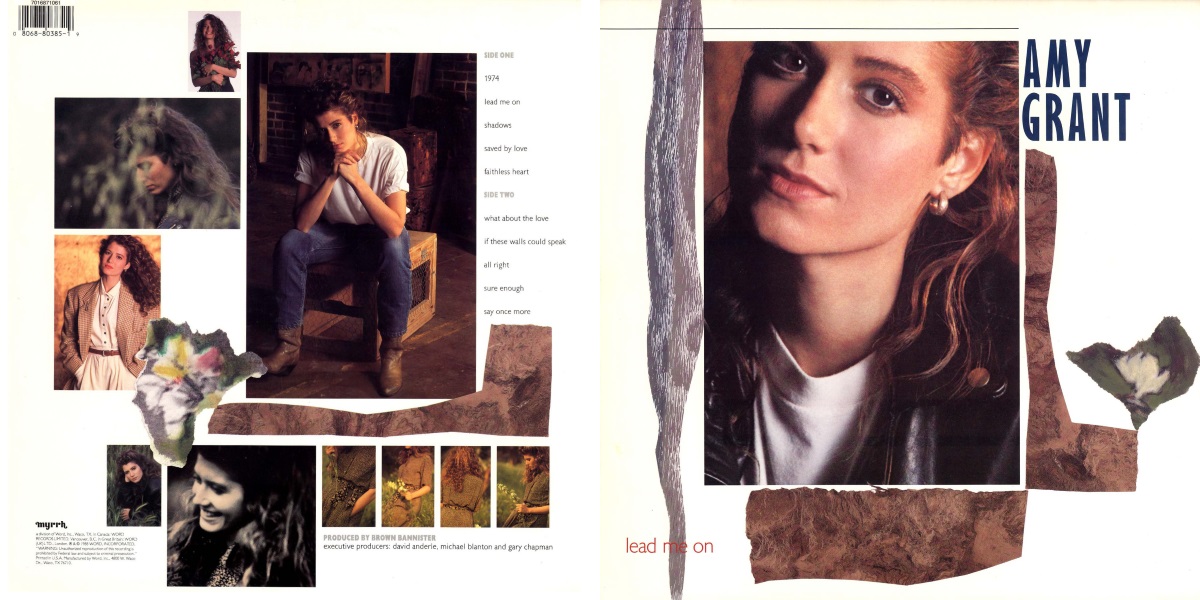
LP tracklist:
Side One
A1. “1974” – 4:22
A2. “Lead Me On” – 5:36
A3. “Shadows” – 5:25
A4. “Saved By Love” – 4:39
A5. “Faithless Heart” – 5:11
Side Two
B1. “What About The Love” – 5:24
B2. “If These Walls Could Speak” – 5:42
B3. “All Right” – 4:23
B4. “Sure Enough” – 4:00
B5. “Say Once More” – 4:56
Bonus Disc. Lead Me On (20th Anniversary Edition), 2008
New Acoustic Recordings
2-01. Lead Me On (Acoustic)
2-02. Intro to Faithless Heart (Amy Grant & Michael W. Smith)
2-03. Faithless Heart (Acoustic) (duet with Will Owsley)
2-04. Say Once More (Acoustic)
Live from Lead Me On Tour 1989
2-05. Waiting For The Healing (Live)
2-06. Shadows (Live)
2-07. All Right (Live)
2-08. Piano intro (Michael W. Smith)
2-09. Lead Me On (Live)
Interview
2-10. Interview with Amy
Note: Simultaneously released on cassette, 12-inch vinyl LP, and CD by both Myrrh and A&M Records. (The CD edition features two extra tracks; “Wait For The Healing” and “If You Have To Go Away”.) Remastered and re-issued in June 2008 as Lead Me On (20th Anniversary Edition) by EMI, featuring a bonus disc.
Lead Me On 20th Anniversay Edition BONUS DISC
“Lead Me On” (MUSIC VIDEO)
Amy Grant in Concert (Lead Me On Tour)
A double-page advertisement for Amy Grant’s upcoming album Lead Me On was featured in the April 1988 issue of CCM Magazine.
Reviews
There are no reviews yet.