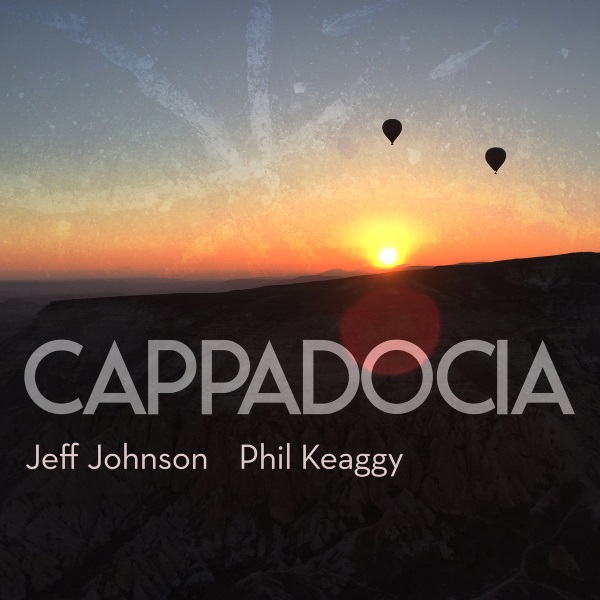
Description
Cappadocia is a instrumental album by the American keyboard player Jeff Johnson and guitarist Phil Keaggy, independently released on Johnson’s label Ark Records in February 2019. The album was produced and recorded by Jeff Johnson and Phil Keaggy at The Ark in Camano Island, Washington; at Kegworth Studio in Nashville, Tennessee; and at The Waterfall Apartment in Laity Lodge, Texas. Mixed at The Ark and mastered by John Golden Mastering in Ventura, California. Featuring Jeff Johnson on keyboards, percussion and vocal and Phil Keaggy on guitars, cümbüş, bass, percussion and vocal.
Those who hang on every note of Phil Keaggy‘s intricate guitar fretwork, or are enthralled by the majestic sweep of Jeff Johnson‘s synthesizer will find here abundant evidence of their signature sounds and trademark talents, but in this latest collaboration, also the birth of something new. The occasion of this newness is something very old, the caves of Cappadocia, spoken of fleetingly in the Bible, which became, in the third century a shelter and refuge for persecuted believers, in which they carved out homes and churches, decorating them as lavishly and artistically as, in less stressful times, they would monasteries and cathedrals.
These pieces, alternately calming and invigorating, probing and restful, ebbing and flowing in musical waves, woven of sounds and silence, mixing the exotic and unknown tones of ancient instruments with the underlying familiar guitar and keyboard, are made all the more entrancing in videos revealing the panorama of this area in modern-day Turkey, as well as the intricate, haunting art of the caves.
Both Phil Keaggy and Jeff Johnson have long been known for their parallel tracks of vocal albums with lyrics, and instrumental albums. They’ve recently ventured into a third area and new ground in their instrumental collaborations, the latest being ‘Cappadocia’, which could be summed up as genius X 2. [Gord Wilson, March 2019]
Phil Keaggy and Jeff Johnson are almost guarantees of quality on their own, but whenever they have worked together – and this is their third collaboration – something particularly beautiful happens.
As well as producing small group worship material, keys player Johnson is a master of atmosphere, with several albums inspired by places and by Stephen Lawhead books. He has also excelled in stripped back meditative releases. Here he brings washes of sound, cascading rhythms and bright motifs.
Keaggy probably needs no introduction to any readers, and his unique guitar sounds – both electric and acoustic – lace this gorgeous release.
But the special thing about this pair is that they blend together perfectly and you really can’t spot all the joins. Both have originated the themes, letting the other embroider them. Both add the most delicate touches and both add percussion; Keaggy plays some flowing fretless bass, while Johnson’s keys also provide rhythmic undergirding; and both add discreet vocals on «Chapel of Stone». I originally wrote that Johnson set the overall feel of the collection, but later it reflects Keaggy’s The Master and the Musician as much as anything. They really bring the best out of each other – this is so much richer than Johnson’s recent Eirlandia.
The title track sets the tone so well: one of the best tracks that they have recorded as a duo, it has a distinct theme over the gentlest washes and the exotic sound of Keaggy playing chumbus (an oud-like Turkish guitar) before he breaks into a hallmark solo.
The Mediterranean flavours re-emerge on other tracks, like the sumptuous «Quo Vadis», and a little on «Parousia (a Presence)».
The superb «Chapel of Stone» is a great example of what works here. Keaggy wrote the main tune, noting that it “develops and takes the listener to places they wouldn’t initially expect! I explored Spanish, bluegrass, old time and even added some subtle mandolin on this.”
But although Keaggy initiated the piece, Johnson is the one who visited Cappadocia and experienced the church carved out from the inside of the rock and hidden from the outside, recalling in the track notes, “This was no cave but a small cathedral with columns and a vaulted ceiling. The acoustic in this place was otherworldly! The music here sort of explores this space with its main sanctuary and connecting rooms including a large dovecot on the second floor. The vocals that Phil and I add at the end sort of represent the echoes from voices past that would have sung chant in this place.”
Long-time Keaggy fans will appreciate the deliberate references he makes back to a few specific tracks on albums like The Wind and the Wheat, the Frio Suite and The Master and the Musician; while less intentionally, the classical guitar on «Quo Vadis» brings to mind his Spanish guitar album Lights of Madrid.
Some people regard this as New Age music, but I’d say it’s intricately composed Christian artistry at its best. Like Frio Suite, although the smooth instrumental can just provide background, the music is far more structured than that, deserves your attention, and is one to get completely lost inside. Highly recommended. [Derek Walker, The Phantom Tollbooth, 16 February 2019]
Last year, new age instrumental artist Jeff Johnson released another of his wonderful collaborations with Irish flutist Brian Dunning, “Eirlandia,” another lush project with lush Celtic and old world influences, that was meant to serve as a musical soundtrack to a fantasy novel series of the same name by author Stephen R. Lawhead. This time out, Johnson has again collaborated with guitarist Phil Keaggy, on a work that feels substantially more arty and intense than their two previous efforts, 2009’s “Frio Suite” and 2012’s “WaterSky.”
Keaggy is a virtuoso, a guitarist’s guitar hero, whose perhaps less well known broadly because most of his recorded work has been within the musical subculture of the contemporary Christian world. In the early 70’s, Keaggy was part of the Glass Harp, a power-trio out of Youngstown, OH, drawing strong crowds, and recorded 3 albums by 1972, with many expecting they would quite naturally follow another area band, The James Gang with Joe Walsh, to national stardom. But in 1973, he recorded an early Jesus music album classic, “What A Day,” playing all of the instruments, before he left his band and joined a religious commune near Ithaca, NY. From there, Keaggy released more albums, including his 1978 instrumental tour de force, “The Master & The Musician.” Over the intervening decades, Keaggy has done some remarkable work even within the confines of that conservative marketplace, especially noteworthy are his live concert albums recorded in collaboration with 2nd Chapter of Acts, “How the West Was One,” a Beatlesque tribute “Phil Keaggy and Sunday’s Child” with Randy Stonehill providing a John Lennon to Keaggy’s McCartney, and a blues rock highwater mark, “Crimson & Blue,” along with innumerable instrumental albums that will appeal to guitar players and fans.
This third collaboration between Johnson and Keaggy, life those before it, is inspired by a piece of geography. “Frio Suite” grew from a retreat experience along the Frio River in Texas, and the paintings of Kathy Hastings. Three years later, “WaterSky,” returned to the Frio, and a canoe voyage floating in the bubbling water of the river canyon. Appropriately enough, Cappadocia looks east, to a majestic place and time in the world’s history, the ancient world of Asia Minor, the eastern mountainous region of Turkey, north of Syria, where the rocky terrain is an UNESCO World Heritage Site, known for its caves and a rock-cut temple in the side of a mountain. In the Fourth Century BCE, early Christian communities prospered and thought was nurtured by the likes of Gregory of Nyssa, who is quoted on the album cover saying that someone “standing up close to a wellspring… will admire that endless gush from within spilling out… The same applies to the one who looks to this divine and infinite beauty… (It) is always newer and more paradoxical than what his sight had already grasped.”
It is that sense of the ineffable, what Gregory described as “the revelations he awaits will always be more magnificent and more divine than that which he had already seen,” that Johnson and Keaggy seek to give expression in their collaborative compositions. As a listener, I’m always drawn more to the colorful runs of notes from Keaggy’s acoustic and electric guitars, on the title track and elsewhere, but it’s Johnson’s textured keyboard synths, and sensitive piano playing that often sets the stage. Smart percussion gives these longer pieces a sense of drama, and Keaggy turns to a cumbus, a Turkish instrument that sounds like the Middle Eastern instrument, the oud, and resonates like the American banjo, to give some of these instrumental tracks an Eastern European feel.
Relying almost entirely on keyboards and Keaggy’s guitars, these compositions manage to sound orchestral at points, but maintain a level of intimacy and connection. I had the pleasure of stumbling some pre-release airings of several tracks on Echoes, the late-night public radio music show that tends toward more ambient, new age sounds, and it was a perfect fit, at times like quieter progressive rock on those places where the percussion and Johnson and Keaggy are focused on the more dramatic terrain of their musical palette, but much of the time they provide a lovely instrumental expression of ideas and emotions not easily expressed. It’s another solid outing, highly musical, at times a mysterious, satisfying listen. [Brian Q. Newcomb, The Fire Note, February 15, 2019]
> Apple Music (https://music.apple.com/us/album/cappadocia/1440563591)
CD tracklist:
01. Cappadocia – 6:56
02. Quo Vadis (Where are You Going)? – 7:52
03. Valley of Swords and Roses – 7:01
04. Parousia (A Presence) – 6:41
05. That Which Is Hidden – 6:57
06. Chapel of Stone – 5:09
07. Dove Visions – 6:32
08. Trinity – 5:08
Note: Available at Bandcamp: https://jeffjohnsonarkmusic.bandcamp.com/album/cappadocia
“Quo Vadis (Where Are You Going)?” (SINGLE)

Reviews
There are no reviews yet.