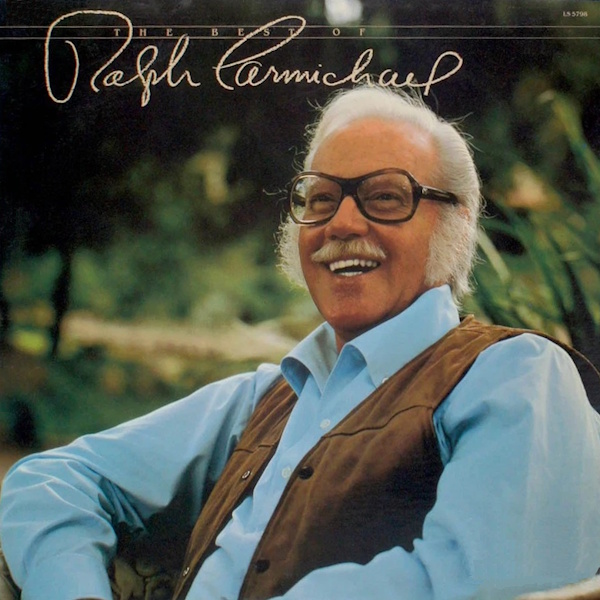
Description
The Best of Ralph Carmichael is a double album compilation by the American composer Ralph Carmichael feat. the Ralph Carmichael Orchestra & Chorus, released on Light Records in 1981. Produced by Bill Cole.
The compilation brings together 23 tracks that showcase some of Ralph Carmichael’s classic choral and instrumental recordings from the 1950’s to 1970’s, including many of his great compositions. Ralph summarized his work in these words: “I feel that love should be expressed both in the ‘telling’ and the ‘showing.’ The ‘telling’ is the easy part, but we have to work a little harder for the ‘showing.’ Music is the only thing I know how to make, so this is my gift to God to show Him, in my way, that I love Him.”
2LP tracklist:
Side One
A1. “He’s Everything To Me” – 2:43
A2. “Beyond The Sunset” – 3:22
A3. “Goin’ Home” – 4:55
A4. “Come Thou Fount” – 2:40
A5. “While It Is Day” – 2:59
A6. “Jericho” – 3:30
Side Two
B1. “A Quiet Place” – 2:50
B2. “Nobody Knows The Trouble I’ve Seen” – 5:37
B3. “Just A Closer Walk With Thee” – 2:25
B4. “Love Can Make The Difference” – 2:26
B5. “Over In Bethlehem” – 3:00
B6. “Reach Out To Jesus” – 3:38
Side Three
C1. “Beyond All Time” – 3:38
C2. “How Great Thou Art” – 5:15
C3. “Jesus Shall Reign” – 2:01
C4. “Jesus Loves Me”/”Jesus Loves The Little Children” – 4:07
C5. “Sun Of My Soul”/”Jesus, The Very Thought Of Thee” – 2:56
C6. “Everytime I Feel The Spirit” – 2:58
Side Four
D1. “Shadrack” – 3:25
D2. “In The Cross Of Christ I Glory” – 2:25
D3. “The Lord Is My Shepherd” – 3:05
D4. “Now I Belong To Jesus” – 3:19
D5. “Like A Lamb”/”The New 23rd” – 4:02
D6. “The Savior Is Waiting” – 3:25
OBITUARY
Died: Ralph Carmichael, Composer Who Fought for Freedom of Christian Music
Founder of Light Records arranged for Nat King Cole, Duke Ellington, and Elvis Presley; scored “The Blob”; developed folk musicals; discovered Andraé Crouch; and believed any style could glorify God.
KEVIN MUNGONS | Christianity Today, OCTOBER 22, 2021Ralph Carmichael, a composer and record producer who shaped the sound of contemporary Christian music, died on October 18 at age 94.
A violin prodigy with perfect pitch and a love for jazz chords, Carmichael built his reputation in Los Angeles TV and film studios before turning to Christian music and throwing open the doors for a new generation to use any and every style to sing about Jesus.
When he recorded his best-known song, «He’s Everything to Me», featured on the Billy Graham World Wide Pictures production The Restless Ones, he brought two guitars, an electric bass, and drums into the studio and kicked off a firestorm of controversy. He featured the new sound in several popular youth musicals and later established Light Records as a label for rising contemporary Christian artists.
“What I have been doing most of my adult life,” he told the Christian Herald in 1986, “is waging stubborn battle for the freedom and liberty to experiment with different kinds of music for the glory of God.”
When tributes poured in near the end of his life, many called Carmichael the “father of contemporary Christian music,” a title he sometimes shared with Christian rocker Larry Norman, despite their obvious differences in style.
Carmichael, for his part, didn’t buy into honorific titles or strictly defined music genres.
“I want neither credit nor blame for creating today’s musical forms,” he once told CT. “I ask only for guidance to know how to use them in good taste to reach ‘now’ people with a message that never changes.”
His “now” music would borrow from any style: pop, jazz, country, rock – all packaged with slick arrangements that sounded good on radio and television. Despite these commercial roots, his music became popular in evangelical worship services and influenced a rising generation of Christian music artists.
“I remember growing up going to my church in Kenova, West Virginia, and singing the music of Ralph Carmichael,” Michael W. Smith told CT this week. “I sang in the New Generation Choir every Sunday night – and I just had not heard anything like it. … He brought a fresh new sound to the 1970s that literally changed my life.”
Playing the ‘wrong’ notes
Carmichael was born in Quincy, Illinois, on May 27, 1927. His father, an ordained Assemblies of God minister, noted Ralph’s precocious affinity for music and started him on violin lessons at age three.
When his father took a church in San Jose, California, Ralph joined the local orchestra while still in high school. Insatiably curious about music theory, he often listened to radio orchestras while sitting at the piano, picking out the notes they played. Immediately he noticed a different sound than conventional hymnal harmony – chords with flatted fifths and ninths, jazz progressions that he taught himself to play.
At 17, he enrolled at Southern California Bible College (now Vanguard University), intending to become a preacher like his father and grandfather. Within a few weeks he was organizing music groups to minister at local churches, a passion that soon overshadowed his studies.
Classmates noticed his keen ear – he could write entire scores while sitting in the corner, away from the piano. The music faculty tried to correct his “wrong” notes, but Carmichael persisted, and his 17-piece stage band began playing on a local television station. The resulting show, The Campus Christian Hour, became a regional favorite.
After hearing Evangeline (Vangie) Otto sing on the radio in 1948, Carmichael tracked her down and they started dating. Soon they married, and for a time their musical relationship seemed ideal. A daughter, Carol Celeste, was born in 1949, but Carmichael’s professional obligations seemed to leave little time for his family.
The television show earned an Emmy in 1951, and suddenly Carmichael was very busy. Two Christian record labels were starting in the Los Angeles area – Sacred Records and Alma Records – and both needed music arrangements.
Carmichael also joined the staff of Temple Baptist in Los Angeles. Despite his Pentecostal roots, he was ordained a Baptist minister.
“In those days,” he later said, “I would work for anybody who could afford me, regardless of their denominational affiliation, so long as they named the name of Christ.”
Studio success
As the church grew, Carmichael created increasingly sophisticated musical programs that required the skills of professional musicians. He began hiring studio players for the church’s special events. Soon he was using the same players for his recording sessions with Christian artists.Always thinking big, Carmichael persuaded the owner of Sacred Records to record a project with full orchestra. He recruited the studio players, paying them union scale, and rented Studio A at Capitol Records. Carmichael chose 12 hymns and wrote arrangements to sound exactly like the popular “dinner music” of the era. When Rhapsody in Sacred Music was released in 1958, it signaled a milestone in the fledgling industry.
Carmichael had discovered his secret sauce – the top-notch Los Angeles studio musicians who could play anything he imagined, with a level of perfection unattainable by the average church group. For the rest of his career, he enjoyed a unique relationship with these first-call players, and many played on his projects for decades.
His new album was discovered by a producer for Nat King Cole, who was planning a new Christmas album. They got along famously – Cole was also a preacher’s kid – and Carmichael ended up touring with him and arranging his studio albums.
For the next 40 years, whenever Hollywood needed a hymn arrangement or a Christmas album, they called Carmichael, the affable minister with the golden ears.
The celebrity musicians included Peggy Lee, Stan Kenton, Bing Crosby, Count Basie, Duke Ellington, Earl (Fatha) Hines, Eddie Fisher, Tex Ritter, Elvis Presley, and dozens more. He spent a year as music director for I Love Lucy, arranged music for several variety shows, and wrote film scores for Finian’s Rainbow (Fred Astaire) and The Blob (Steve McQueen).
Divorce
Despite his newfound success in the music world, his nonstop schedule took a toll on family life. Carmichael admitted to “indiscretions” and a growing addiction to Dexamyl, which kept him amped up for late-night scoring sessions.After a year of separation from Vangie, the couple divorced in 1964. Carmichael hoped it would remain quiet, but the family split was reported by the Los Angeles Times: “The Song Is Ended for the Carmichaels.”
He threw himself even more fully into the music, working nonstop. In that difficult and lonely period before he was married a second time to a woman named Marvella Grace and became a father to her three children, he reflected on his failures.
“Until we give ourselves back to God, we can never be free,” Carmichael said in his 1986 autobiography. “Of course, by ‘free’ I surely don’t mean irresponsible. The fact is, the freer you are, the more responsible you become.”
‘He’s Everything to Me’
Social redemption came from an unexpected place. Billy Graham and Cliff Barrows were looking at their crusade audiences and noting a lot of gray heads. Their formula for stadium events seemed flat, and their innovative Youth for Christ music was now 25 years old. They wanted a new film that spoke to contemporary issues, and they wanted Carmichael to score it.A year earlier Carmichael had experimented with rock-and-roll instrumentation for pianist Roger Williams, turning «Born Free» into a million-selling hit. Now he tried the same with the central song in The Restless Ones, «He’s Everything to Me», giving it a straight-eighths rhythm and a hint of a backbeat.
The song sold five million copies in sheet music and was recorded by more than two hundred artists.
Was it rock? Sort of. The vocals were sung by a fresh-sounding youth choir, and the song ends with a tympani roll – not exactly a head-banger, and certainly not “rock” to upstarts like Larry Norman. But church leaders offered plenty of criticism, whatever it was.
But Carmichael continued writing in the new style, especially with composer and friend Kurt Kaiser, who called their new style “folk musicals.”
Carmichael continued to expand conceptions of “Christian music” with the discovery of Andraé Crouch, who was directing the Teen Challenge Addicts Choir. Carmichael followed Crouch for eight months, quizzed him about his spiritual commitment, then signed him to Light Records. They became fast friends, and the relationship led to several other Black musicians signing with Carmichael.
Though he viewed himself as a maverick, Carmichael lived long enough to see his music become mainstream. He recorded Strike Up the Band in 1994, a full album of gospel jazz, but found that many stores stocked it on the traditional shelf. The same was true for many of his songs. They became popular with youth groups, and a few were even added to evangelical hymnals, such as «The Savior Is Waiting» and «He’s Everything to Me».
He scored or produced 200 albums and wrote 3,000 musical arrangements.
Near the end of his life, he donated his music library to the Great American Songbook Archives, Baylor University, and the University of Arizona Jazz and Popular Music Archive. He was inducted into the Gospel Music Hall of Fame and the National Religious Broadcasters Hall of Fame.
Carmichael is survived by his wife, Marvella; children Andrea, Greg, and Erin; and several grandchildren and great-grandchildren.
Ralph Carmichael In His Own Words
By BOB DARDEN, Billboard Magazine, September 8, 1984 (Gospel Lectern)If Ralph Carmichael isn’t one of the fathers of contemporary Christian music, then he’s certainly one of its uncles. Composer/ arranger/ executive/ visionary Carmichael, the head of the seminal Light label, is one of the few founders of contemporary gospel music to remain active in every facet of the industry today.
This year is Light/Lexicon’s 20th anniversary in religious music; it’s also Carmichael’s 25th anniversary, more or less. This is the first of a two-part column on one of the most affable, talented men in the business – in his own words.
“From the beginning, I’ve had a great curiosity about music. I started piano lessons at age three and a half, and I enjoyed playing what I heard, but it didn’t fulfill me like arranging later would.
“At least I got a good background in music. I’d hear something on the radio and if I couldn’t reproduce it with one violin or one trumpet – both of which I studied – I wouldn’t rest until I’d skulled it out.
“In college I studied for the ministry until I flunked Hebrew and Greek. Even then I was building groups. About 1949 I put together a band with a full brass and string section and rhythm section and eight vocalists and started doing gospel. Somebody thought that was interesting because we ended up on tv, where we stayed 76 weeks and won an Emmy – even though we were up against Milton Berle. We made some records back then for some smaller Christian labels, long before I met Jarrell McCracken.
“One of my records with a big orchestra ended up in the hands of Lee Gillette, head of A&R at Capitol, who took me in. From there I went to working with Nat Cole, first on a Christmas album, then for another eight years. Later I worked with Rosemary Clooney, Peggy Lee, Jack Jones, Earl Hines, Barbara McNair and eventually nine or ten years with Rogers Williams just a whole lot of secular people – all the while still doing what was the love of my life: gospel. It was about that time I wrote ‘The Savior Is Waiting.’
“About 1950 I met Billy Graham and ended up doing a number of films for him, beginning with Mr. Texas,’ which began the Graham film ministry. I kept up the secular work, scoring music for a series of hit tv shows, including ‘I Love Lucy,’My Mother The Car,’ ‘O.K. Crackerby!’ and others.
“One thing led to another 20 years ago, and I decided to form my own publishing company, Lexicon. I had been dissatisfied with the way Christian publishers were handling copyrights; they’d just let them sit there. I thought I could do a better job.
“I wasn’t a salesman, though, so I went to Jarrell McCracken at Word and said we would split it 50/50 if he’d sell what I wrote. I followed that several years later with Light Records.
“By that time, broadly speaking, we had had some acceptance with the big orchestra-with-strings sounds with gospel. I thought I had won the battle. I was a member of a clique on the West Coast that said ‘down with rock’n’roll.’
“I was still writing for Roger Williams at the time. Then one day he called and said, ‘Can you write rock ?’ You know, even eighth notes with a Fender bass passed for rock at the time. I said sure, and that was the ‘Born Free’ album.
“Shortly thereafter, Billy Graham showed me the film ‘The Restless Ones.’ I liked it, and I had a teenage daughter at the time, so I knew the music had to be real, including those bad of even eighth notes. So I wrote ‘He’s Everything To Me.’
“It didn’t sit too well with the powers that be, but their kids loved it. Anyway, that was the beginning of what became a longterm experiment in using the music of the people.
“Some writers have called it the turning point, but the truth is that it would have been turned around eventually. There were some Catholic composers who were already moving in that direction. ‘He’s Everything To Me’ was in the right place at the right time. A lot of folks who had accepted the big orchestras of 1949 to 1963 took 12-14 years to accept what was then called ‘folk-rock.’ There was a lot of resentment among the adults, but the kids just grabbed ahold of it.
“It was about that time that Kurt Kaiser and I put together the musicals ‘Tell It Like It Is‘ and ‘Natural High‘ for the youth choirs, which took the music into churches. Of course, somewhere in there, it dawned on me that people would like a book with the music from the album. You know, companion piece merchandising, offering the book with the same cover as the album.
“By golly, I had the hardest time convincing Word to display them side by side. They wanted to put them next to the back wall or something. It’s like belts and buckles, they gotta go together. Finally, they got the idea and now everybody does it.
“Next came the little chorus books. My notion was to give the kids the most songs for the least money. So in little three-by-five books we packed the melody line, guitar chords and lyrics. First came ‘He’s Everything To Me Plus 53,’ then ‘He’s Everything To Me Plus 103,’ and finally ‘He’s Everything To Me Plus 153’ – they must have sold millions of copies.
“I guess the next notable thing that happened was that I heard this black kid who really had something. Granted, I’ve always had minor thirds and ninth and eleventh chords in my blood, partly from my time with the King Cole Trio and digging Count Basie and Duke Ellington so long, but I knew I had someone here with a marvelous sense of timing.
“It was a real exciting time for me. But when I took the tracks to Word, they said, ‘That’s nice.’ Same with the album. There wasn’t a whole lot of enthusiasm in the beginning. Once he sold 100,000 units, though, he was A-OK. Two years later everyone was trying to sign Andrae Crouch out from under me.
“Then came Danniebelle, Tramaine, Sandra, the Winans and the rest. Two or three years ago I went to a sales conference and saw that Word had signed something like 10 new black acts!”
…
This is the second part of an interview with Ralph Car-michael, one of the founders of contemporary Christian music and the president of Light /Lexicon. (Billboard Magazine, September 15, 1984.)
Twenty years after the founding of Light Records, Ralph Carmichael’s feisty little label is still one of the Big Four in religious music. Today, as has been the case in the past, Light boasts one of the strongest lineups of contemporary black talent in the industry with Andrae & Sandra Crouch, the Winans, Bob Bailey and others. But the rest of contemporary music isn’t neglected. Other Light artists include Dino, Tami Gunden, Scott Smith, Danny Gaither, Karen Voegtlin and, of course, Carmichael himself.
Virtually the entire roster turned up at Light/Lexicon’s 20th anniversary at the 35th annual Christian Booksellers Assn. (CBA) Convention, held earlier this summer in Anaheim. Also on the bill was Thurlow Spurr and the Metroband, a contemporary outfit playing big band gospel arrangements – Carmichael’s first love more than 20 years ago.
As CBA president Harden Young said, “Ralph Carmichael caused a revolution by telling it like it is.” Last week Carmichael talked about the building of Light /Lexicon. This week the topic is the present- and future:
“Right now we’re in the process of paying back $2 million in debts we incurred over our recent two-year down period. That will be accomplished in the spring of ’85. In the meantime, all our creditors are delirious; they never thought we’d make it. If things continue as well as they have, we’ll have our note-burning ceremony then.
“At that point, those dollars that have been siphoned off the cash flow will be pumped back into the company. I’m not sure about Sparrow or some of the smaller labels, but I think Light is now about the only solely owned record company around. I even dismissed my board during our down period so there would be nobody to blame but me. Now it is just me and my wife.
“Our motivation for profit is different from publicly held groups. We don’t pay any dividends. We take our profits and do things we dream about doing with this company.
“What kind of dreams? Like having the top 20 black artists in our company and doing the best that can possibly be done for them, corporately. We dream of showing the religious world that hard rock can be a viable, valuable communication tool to reach millions of kids who won’t listen to anything else.
“The Rez Band isn’t with us anymore, but what a coup it was to see them even for two minutes on the Dove Awards show. That’s somthing we’ll be actively involved in, beginning with the signing of Barnabas. I hope to sign a heavy metal band soon, as well.
“In the next 10 years I see the same growth in church drama as we saw with music in the past 10 years. Drama with choreography, music and literature fused together to form something similar to light opera. Some churches are doing it now.
“And, of course, we’re all watching videos, CD, laser technology, half-speed masters, everything right now. The guy who starts too soon will get hurt; the guy who moves too late will get left behind. There’s a lot to be done, let me tell you.
“I’m in good health. I’m not fearful of change. I’m not into one type of music per se. I’m not going to crusade for something I liked as a child. There’s certain kinds I prefer. But in the end, what’s important is the kind of music that can bring the most people to Christ – whatever it sounds like.
“No music is inherently good or evil. You can use any kind of technology for destruction or praise. I’m ready for change; I welcome it. That’s the only way you’re ever going to be in the right place at the right time.”

Reviews
There are no reviews yet.