Description
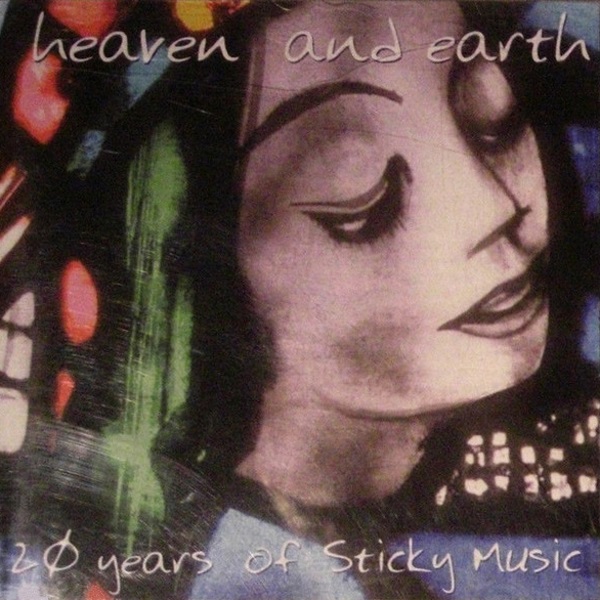
Heaven and Earth, sub-titled 20 Years of Sticky Music, is a multi-artist compilation featuring selected tracks by various Sticky Music-signed artists, independently released on Sticky Music in 2000.
From a Glasgow bedroom to some of the world’s leading record companies… and back to a bedroom again. Over 20 years, outstanding musicians and performers discovered by Scotland’s leading independent record label Sticky Music, have either become household names.. or just gone home again.
From Ricky Ross to Juliet Turner, Talking Drums to Iain Archer, the music created by Sticky label-mates leapt the gap between Heaven and Earth. From underground albums which led to major label success or cult-recordings which transformed the songs of the saints, Sticky has been the last word in independence and artistic quality. It’s unique community of artists says it all: here’s to the next twenty. The studio’s just past the bathroom.
– Martin Wroe [Note printed on the back of the CD]
Along with Plankton, Edinburgh’s Sticky Music have been a brave independent a billion miles away from the cultural insularity of most Christian orientated companies, instead finding brilliant grassroots talent, recording them with the minimum of fuss and often giving them a ladder to the next level. There’s heaps of good stuff here – two tracks from the pioneering techno pop rock team Talking Drums, two from beloved Irish songsmith Iain Archer, plus intriguing cuts from blue eyed soulman DB McGlynn, the “Presbyterian garage band” Calvin’s Dream and some pioneering alternative worship from Late Late Service. The guys who run Sticky, Lies Damned Lies, are also represented with two spiffing tracks. It’s a shame that presumably contractual reasons stopped the tiny outfit from putting something from Ricky Ross’s ‘Surprised By Joy’ album on this lovingly put together compilation. But there’s still much here for ageing Greenbelters, Christian music historians and plain lovers of good music to enjoy. [Tony Cummings, Cross Rhythms, November 2002]
CD tracklist:
01. Talking Drums – Pretend a Stranger (from Reassembly, 1986)
02. Iain Archer – Wishing (from Playing Dead, 1995)
03. Juliet Turner – Beyond the Backyard (from Let’s Hear it for Pizza, 1996)
04. Lies Damned Lies – Heavenly Train (from Flying Kites, 1991)
05. Late Late Service – Going to Jerusalem (from LLS3, 1993)
06. Calvin’s Dream – Philistines (from Fanatical, 1993)
07. Billy Penn’s Brother – Taxi to Treblinka (from Ruckus in Real Time, 1992)
08. Talking Drums – Compromise (from Demos, 1984)
09. Steve Butler – Hill of the Angels (from Love Come Down, 2000)
10. Late Late Service – The Earth Is the Lord’s (from LLS4, 1994)
11. DB McGlynn – Redemption (from To Hell with the Handkerchief, 1992)
12. Dan Donovan – Please Don’t Lose Me Now (from Trashbone Thang, 1993)
13. Lies Damned Lies – In the Air (from Lamentations, 1996)
14. Iain Archer – Crazy Bird (from Crazy Bird, 1996)
15. Steve Butler – How Much I Love You (from Oblique, 1980)
Sticky Music: Skids, Lies and Sticky Tape
By Steve Best, Cross Rhythms, 7th January 2003
(Originally published in the Cross Rhythms Magazine #72)One of Britain’s pioneering record labels, STICKY MUSIC, recently clocked up 20 years of existence. Steve Best spoke to one of the brave indie’s founders, Steve Butler.
Observers of the British Christian music scene have in the past noted that there tends to be a few large record companies pouring out a stream of releases, a sizeable number of independent artists taking the recording plunge and releasing albums themselves, but just about nothing in between. Christian orientated independent record labels with a larger roster than one artist are few and far between. There is Plankton Records, Little Misty Music, Room3Records, Meltdown, Reyach Records and one or two more. But the harsh financial realities of few points of sale and STL’s near monopoly of distribution into Christian bookshops mean that most brave new independents fizzle out after one or two releases. A striking exception to this rule is Edinburgh’s Sticky Music. Despite all the odds, the company, run by Steve Butler, Dot Reid and Charlie Irvine (who occasionally metamorphosise as the acoustic orientated rock band Lies Damned Lies), have kept going and recently celebrated the fact with a glorious compilation, ‘Heaven And Earth: 20 Years Of Sticky Music’. The label’s roster past and present is impressive: Greenbelt favourite Iain Archer, Irish singer/songwriter Juliet Turner, rock eccentric Dan Donovan, alternative worship pioneers Late Late Service, Presbyterian garage band Calvin’s Dream, left of centre songsmith Billy Penn’s Brother, white soul man DB McGlynn, techno pop rock band Talking Drums and even, for one glorious moment, Ricky Ross before he went off to fame and fortune with mainstream million sellers Deacon Blue.
The seeds of Sticky were sown back in 1980 when Butler was a student and aspiring songwriter. “I took the bold step of thinking maybe I should issue some of the songs on tape,” he recalls, “and I was discussing with someone: ‘Aren’t we supposed to have a label name?’ The suggestion was made – Sticky Tapes! – because it was on tape. That’s how cunningly witty it all was. I then started collaborating with Charlie (Irvine – guitar) and Dot (Reid – keyboards) and it was never really a strategy. We all just loved making records and we’ve managed somehow to keep doing it without going bankrupt for all these years. It’s about a love of songwriting and a love of producing albums that have a wee life of their own. It’s a never ending privilege.”
Both Talking Drums and Lies Damned Lies have flirted all too briefly with major label success, LDL were even dispatched to the USA by their label Virgin in 1987 to record their debut LP, the only one for the major before Sticky took over their distribution. So is Steve happy with the way things have eventually turned out, or would he have liked for his band to have hit the Big Time? “Obviously it would have been interesting to see what would have happened if we had been able to have enough of a commercial success to have the freedom to work on a bigger level and reach a bigger audience,” admits Steve. “However, I’ve known quite a lot of people who got caught up in all that and it was (for them) a fairly negative and draining experience and drained all the lifeblood out of them as musicians and as people. It’s really only a very small elite who manage to be commercially successful and do what they really want to do at the same time. I don’t think we would have made the records we have made had we gone down that path and in a humble way, maybe that’s better than doing something that was less about who we are and more about what the record company wants.”
Surely the pressure by major labels to produce sellable product means that bands are constantly expected to produce the goods in an unnatural hurry for some (and LDL has not being the most prolific of bands) could have caused extreme tension. “That’s something which didn’t sit very comfortably with us,” agrees Steve, “as people and as writers, so the freedom to be able to produce music when it felt right, without a hammer hanging over our heads, is very valuable. It’s meant that the whole thing has been organic. We can look back over about 15 years and feel proud of what we’ve produced.”
The new LDL album, ‘Last Place On The Map’, is their first since 1996’s ‘Lamentations’. What on earth have the band been doing in the interim six years, I wonder. “We’ve all been going through life changes,” explains Steve. “Getting terribly caught up in domestic stuff, kids, moving jobs and more responsible work that we’re involved in, and it just became much harder for us. I think initially also it was just good to leave it for a bit. You need space to grow. We actually started this new album about two and a half years ago. It’s taken ages to get it together because the times that we can all actually be together are relatively rare and precious these days. There’s no rush! It’s much better to take time and produce something that you feel good about and that you’ll still feel good about in years to come.”
I venture the opinion that Lies Damned Lies make music that is quite cerebral, thinking man’s music. “Well that’s okay, I’m relatively happy with that”, replies Steve carefully. “I hope it touches on an emotional level as well, because we only pursue songs we start working on when we are moved by them. When the rawness of a piece of honesty comes through, we are looking for that, and quite a lot of stuff gets rejected because it doesn’t really do that. It’s kind of counter-culture music.” He continues, “I suppose the Christian faith is too, in a way.” Steve admits that whilst there may be other forms of music which are more sellable, LDL looks to create space for songwriting and music that he describes as “more holistic”, or, in the case of the song «Trust» on the new album, a song “from the stomach”.
On the subject of who Lies Damned Lies are aiming their music at, a subject I hesitate to bring up, as I don’t like to distinguish between music for Christians or non-Christians, Steve is clear: all people. “There’s nothing directional about who we’re aiming at, because one of our problems is we don’t aim at all! We decided a long time ago that we didn’t want to work either as writers and musicians or promote our music to an environment that was closed in any way at all, so as far as we can make it possible, we just want to share the music and not label it as any particular genre. I think if you label it, then you’re closing doors. For us, it’s an open door policy, but as it happens, unsurprisingly, the vast majority of people who relate to our music are Christians, because they’re just relating to us as people, and that’s lovely, but we’ve tried to keep out of any arguments about who we are, and how we might label our record label. It’s not an issue for us.”
Although the Sticky following is fairly select, Steve regularly receives letters from all over the world and he relates how at a recent Scottish gig, two fans came all the way from London to experience the LDL phenomenon. When it comes to fame and fortune and having a wider following, it is clear that Steve and the guys are content with the status quo.
It’s probably no great surprise that much of the music heard on the radio today, both Christian and secular, leaves Steve cold. “I’m not very interested in about 90 per cent of what I hear. So much ‘new’ music is really regurgitation. Is there anything new being done? My teenage son is suddenly getting into The Who, because he’s gleaned that actually this is the real thing. These guys were an example of the original classy songwriting, gutsy kind of rock that really was about ‘My Generation’. A lot of what’s being produced now is a re-working, trying to capture something of that energy, and most of it’s just not working for me. Rock music is a bit done, I think. Even the post-modern technological-driven music is sounding a bit done now.”
When it comes to reality music shows such as Popstars and Fame Academy, Steve is equally unimpressed. “It’s just all about producing flatulent sponge cake, it’s just nonsense. I don’t think it’s doing anything destructive, it’s just reinforcing popular music as throwaway fluff. It’s just entertainment aimed at children really. We’re not really talking about music there at all, as far as I’m concerned. Personally I feel a bit sorry for the youngsters that are caught up in being turned into products, because the next part of the sequence is being discarded. It’s all a bit vacuous. If people want to do it, that’s fine, but don’t talk to me about it being music, certainly not music in any sense of creativity.”
Finally, I ask Steve about Scottish music. For years now, the most consistently high quality pop music has come from Scotland, from bands such as The Skids, Hue & Cry, Simple Minds, Big Country and Deacon Blue. So what is it about Scottish music that makes it connect so well? Steve thinks for a moment; “I’ve always thought that if you grew up in Scotland, you learned lots of melodies at school and there’s a kind of ‘rootedness’ about Scottish melody – folk roots of traditional Scottish music – that we all take in when we are children. That’s very different, I think, from the roots of English melody. It’s a kind of ‘sing-song-iness’ that finds its archetype in Gaelic – spoken and sung – and I think that’s got something to do with it. Even we in Lies Damned Lies are always challenging ourselves about whether our music is melodic, because for us, that’s what moves us. Up here we’re pre-programmed a bit more. These are staggering generalisations, but that’s my theory!”
Reviews
There are no reviews yet.