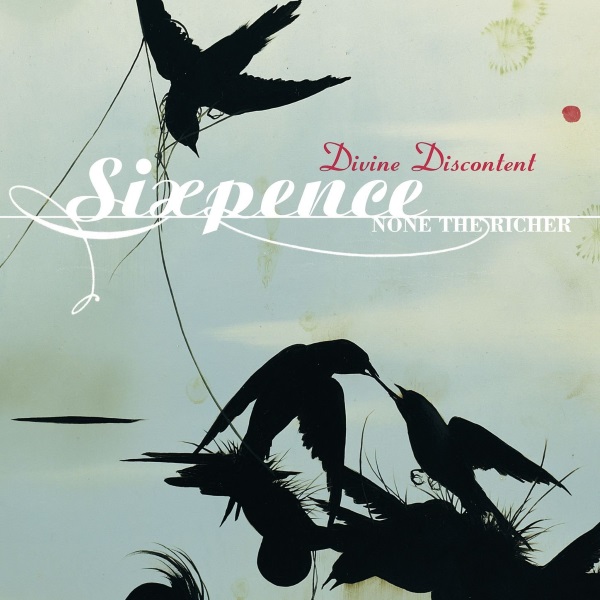
Description
Divine Discontent is the fourth studio album by the American pop band Sixpence None the Richer, released on Reprise Records in October 2002, in co-operation with Squint Entertainment. Trivia: Divine Discontent is the first release to feature information in the liner notes regarding U2 frontman Bono’s DATA initiative (Debt-AIDS-Trade-Africa).
Ten years would pass before the next full-length studio album was released by Sixpence, Lost in Transition. In the meantime Sixpence vocalist Leigh Nash worked on other projects. In 2006 she released her first solo album, entitled Blue on Blue, and her lead vocals and lyrics were as well featured on the self-titled debut album by Fauxliage released the following year.
«Kiss Me» continues to play, like a small miracle, in grocery stores and on hit radio across the nation. It’s a testament to how poetry can sometimes slip past the sentiment-merchants and land in the Top 40 among clichés and the empty hooks.
I’m sure Sixpence None the Richer had no idea how far that little song would go. It must have been exciting for them, but also a bit amusing, because «Kiss Me» is the simplest, most sentimental song on their self-titled 1997 release. Anyone who got excited about it and decided to check out the rest of the catalogue was in for quite a jolt.
Matt Slocum writes heavy lyrics, verses full of doubt, questioning, struggle, faith and hope. Few songwriters use pop and rock as a vehicle for prayer the way he does; he stands under the banner of contemporary psalmists alongside Bono, Bruce Cockburn, Julie Miller, and Linford Detweiler, to name a few. His somber psalms sting because they are delivered by the light, airy voice of Leigh Nash. Nash sounds like the kind of singer whose agents would advise her to spend her short career on frivolous pop ditties; instead, she brings qualities of vulnerability and humility to her expressions of grandiose spiritual themes. To borrow a phrase: It’s a voice “like a bloom that pushes up through stony ground.”
The band knows a lot about struggle and doubt. It’s been a period of delays, label troubles, band member rotations, and personal relationship breakdowns … the same kind of crucible that delayed their last record. So it’s no surprise that their new album is titled Divine Discontent. It’s a perfect title, highlighting the Almighty’s hand at work in even the most unsettling times. These songs shine like gems made under extreme pressure.
In fact, they are almost too shiny. But now I’m talking about production, not songwriting. You can tell these songs have been polished to within an inch of their lives, making this album sound more artificial than their previous release. The instrumentation is incredibly tight, the production densely layered and lush. The band has never sounded tighter, more professional, or more confident. That impresses me, but at the same time I find myself wishing for some rough edges or some improvisation. Last time, they sounded like a band on a stage playing as if their lives depended on it. Here, the luxuriant beds of strings and the overlaid guitars speak of long studio hours, making most songs feel like soundboard events. Outside of the orchestral backup, there’s very little experimentation, very few new aural ideas here.
Fortunately, the lyrics and melodies are compelling and bold
With «Breathe Your Name» they burst out of the gate with probably the catchiest pop song since… well… «Kiss Me». (Grocery store radio, here it comes.) But it’s no trifle. Athough the chorus is laced with references to losing control and heavy breathing – staple terms for songs of romantic obsession – a closer read reveals that this is a prayer for God’s guidance in times of confusion. It’s so “up” sounding that the raw need at the center sneaks up on you.
Another track that should find a long lifespan on the radio is their clever cover of Crowded House’s «Don’t Dream It’s Over». Sixpence has a knack for choosing perfect cover songs. They actually improved the La’s «There She Goes» and showed excellent discernment in covering Sam Phillips’ «I Need Love». But I wish they had done something new with this great song instead of making it just a pop re-creation of the original hit. Even the guitar solo hits all the same notes. Sure it sounds great, but a little more interpretation would have been interesting.
Some of the songs are too good, too ambitious, for radio. Digging in the dirt of a recent breakup, Slocum’s prayer «Still Burning» has the sting of truth: “I can’t believe you want me to begin again…” But his affirmation of trust in the midst of question and turmoil is bold: “Your heart is a hand that takes hold of me.” Heralding God’s ever presence in trouble, he takes up a step to a re-affirmation of his role in the Grand Scheme:
This is my call
I belong to you…
This is my call
to sing the melodies of you
This is my call
I can do nothing else.*(These are approximated lyrics. No lyrics sheet is provided in the album sleeve OR online. What’s up with that?!)
It’s a simple mission statement, but the music rises on a stirring string motif. It’s as if Leigh’s run out of words to sing, but the spirit is still willing its prayer in tones too deep for words.
Having led us onto solid ground, the band is primed to do some heavy work. And that’s exactly what they do, leading us from a personal space to the political stage for the heaviest rock number of the Sixpence catalogue. Nash’s lyrics for «Paralyzed» expose an angst rarely admitted by a songwriter: The fear that his God-given craft is useless in view of the larger world crises. At the beginning, the singer is watching the news, and something he sees there shakes him. It’s hard not to play a mental slideshow of recent events as the music rises to «Bullet the Blue Sky» roar.
I change the channel, mute the sound
Take a walk to clear my head
I go to do an interview
About a song, (three minutes long!)It’s a frank confession, and then he lets loose what’s really on his heart:
Feels like I’m fiddling while Rome is burning down
Should I lay my fiddle down and take a rifle from the ground?He should take heart – U2 has gone on to show just how much healing and hope can come from hopeful music in a hurtful time. There is no time that we need their work more.
The lyrics circle back to the personal, as «Eyes Wide Open» details the frenzied, fast lifestyle of a girl struggling to keep her balance in the city. The song has a full, forceful rock sound reminiscent of the recent Over the Rhine anthems like «Goodbye». It is here that I feel the enormity of the sound grows somewhat wearying. Only at the very end, in the poetic and sentimental «A Million Parachutes» are we allowed a quieter, more intimate moment with Leigh and Company.
Nevertheless, the album’s peak is yet to come. The thrilling euphoria of «Dizzy» may be a peak for Sixpence None the Richer. The title certainly fits, as they whip up a tornado of sound to Leigh’s beautifully broken confessions of doubt and struggle. She compares herself to Thomas touching Jesus’ wounds, struggling for evidence enough to bolster her faith, struggling to bear the burden of guilt like the Apostle Peter with “crowing burning my ears.” But then she prays to be what she wishes to be:
I want to be like David
Throw his clothes to the wind and dance a jigI’ll give you myself
It’s all that I have
Broken and frail
I’m clay in your hands
And I’m spinning unconcealed
Dizzy on this wheel
For you my Love.«A Million Parachutes» lets the album fade in glowing embers while the snow falls. It’s a quiet admission of desire for the return of warmer, brighter things, and yet a determined appreciation of the beauty of the snow and the snowflakes “like a million parachutes, small men on a mission.” A better image of grace I haven’t heard in a song in years.
Divine Discontent is an album Sixpence can be proud of. And I’m sure they hope, right along with their fans, that the journey to the next release will not be such a long, difficult road. I also hope these restless spirits journey into some new stylistic territories soon, so they do not become redundant. Maybe it’s just a matter of finding the right producer. Does somebody have a phone number for T-Bone Burnett? [Jeffrey Overstreet, The Phantom Tollbooth, 12/20/2002]
In 1999 Sixpence None The Richer caught lightening in a bottle when their self-titled album, (their third LP in four years,) managed the nearly inconceivable combination of artistic brilliance and major market saturation for a “new” artist. The idea that pop music could be beautiful was proven again. «Kiss Me» provided the perfect entry-point to a collection of songs that challenged musical convention and dared to ask the hardest questions. By the time the ubiquitous single peaked the album was over two years old and talk was already underway about the dreaded follow-up. It has been said that the only thing harder than scoring a number-one hit is scoring a second number-one hit. However, those who knew them best were certain the band would follow up their success with a stunner of an album that would obliterate the idea that they were another one-hit wonder. The enchanting chemistry of principal writer and guitarist Matt Slocum and vocalist Leigh Nash was more than capable of replicating that lightening whenever called upon, of that much they were certain.
Sneak peeks at new songs throughout the band’s seemingly never-ending touring set the faithful to squirming with anticipation. At times the new material sounded more aggressive, darker, and more akin to their work on This Beautiful Mess than anything from the «Kiss Me» universe. More recent shows, however, have introduced audiences to a sweeter, gentler, more adult-pop sound ala Squeeze or Natalie Merchant. Considering the two-year delay between the original completion of the album and it’s eventual release, and the fact that every time a new release date was set the band went back into the studio to update the project, the world may never know what the band’s original follow-up would have sounded like. But the version the world will hear is a picture of intelligent pop music on a grand scale.
Divine Discontent is a perfectly balanced demonstration of tension, grace, beauty, anger and hope, in instrumental perspective, melody and lyric. From aching romance to heartfelt despair the songs play out like scenes in a beautiful foreign film. There is an exotic quality amidst the complex neo-classical arrangements, progressive chord and rhythm structures and the sublime lyrical poetry – most from the mind and hands of Slocum – that is set ablaze by the flawless and emotive vocal interpretation of Nash. Whether it be the startling rage of the emotional high point, «Paralyzed», or the intimate wisdom of the album’s lyrical centerpiece «Tension Is A Passing Note», each song strikes the perfect balance between simple and sublime. Not unlike the deceptively sweet Lennon and McCartney classic «Michelle», Slocum and Nash combine seamlessly and arrive at a place of pop perfection to which few dare even aspire.
The collection of thirteen tracks manages an impressive balance of stand-alone singles and album congruity. The lead track, debut single, and most obvious «Kiss Me» follow-up, «Breathe Your Name» sounds ready-to-use as a soundtrack song or VH1 video. In fact, the first four songs, all the newest to be recorded for the album, are a relentless set of irascible pop gems. The thematic thread traces visions and versions of love, tension and the frustration of being a work-in-progress. Fortunately the album takes a deeper and more textured tone with «Still Burning», a sparse and melancholy piece that reiterates Slocum’s place as one of the greatest lyricists working today, and takes the whole record in a different direction. One of the earliest songs written for the album, and possibly the best worship song released in years, «Melody Of You», has survived intact and is followed by the lone rocker, «Paralyzed», which echoes and amplifies the pain and desperation felt by a journalist who’s best friend was killed covering the war in Kosovo. The tragic story provides the perfect example of bad things happening to good people, and sets up the counterbalance to the album’s bittersweet romantic ditties. The record closes strong, with the driving «Eyes Wide Open», (a lovely McCartney-influenced tune written by Nash,) the beautiful «Dizzy» (which brilliantly casts the tension of the Christian experience of perpetual brokenness and rebuilding in the form of a lump of clay spinning on a potter’s wheel and King David dancing before the Arc of the Covenant,) and the stunning «Tension Is A Passing Note». The disc ends with another newer song «A Million Parachutes», and a cover of Crowded House’s «Don’t Dream It’s Over», a song that might be considered a throw-away shot at following up their cover of The La’s «There She Goes» if it wasn’t so perfect lyrically and melodically for this album.
Divine Discontent, though certainly born in a furnace of frustration, arrives as one of the strongest examples of faith, art and accessibility that this critic has ever heard. The real feat is this band’s ability to craft such eloquent pop music that deals so artfully with the most difficult issues facing mankind. It certainly ranks as one of the most beautiful pop albums ever to come from the faith-art community. [John J. Thompson, HM Magazine, online 2002]
> Apple Music (https://music.apple.com/us/album/divine-discontent/1163450625)
CD tracklist:
01. Breathe Your Name – 3:56
02. Tonight – 3:52
03. Down And Out Of Time – 3:28
04. Don’t Dream It’s Over – 4:04
05. Waiting On The Sun – 2:54
06. Still Burning – 4:02
07. Melody Of You – 4:50
08. Paralyzed – 3:54
09. I’ve Been Waiting – 4:19
10. Eyes Wide Open – 3:28
11. Dizzy – 6:36
12. Tension Is A Passing Note – 3:30
13. A Million Parachutes – 6:19
Note: Simultaneously released on cassette and CD by Reprise Records. Re-issued on 12-inch vinyl double LP by Curb Records/Squint Entertainment in 2024, pressed on splatter vinyl.

Reviews
There are no reviews yet.