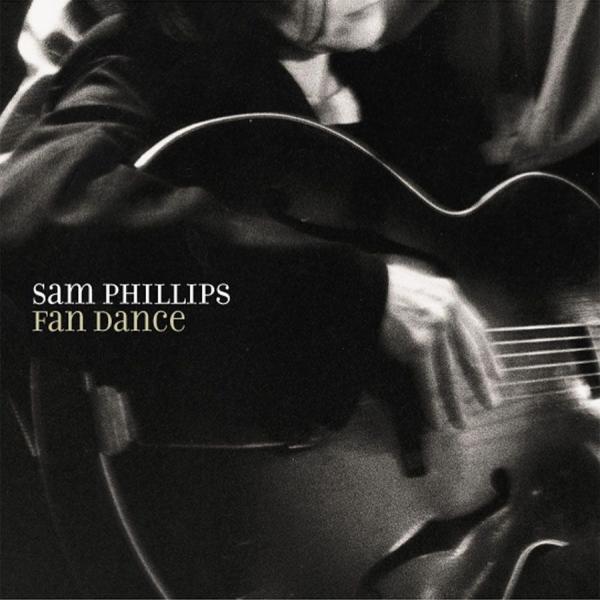
Description
Fan Dance is the fifth studio album by the American singer and songwriter Sam Phillips, released on Nonesuch Records in 2001. All Music Guide stated that “with ‘Fan Dance’, Sam Phillips has made an album that proves modesty is one the rarest and most welcome virtues in pop music today.”
Recorded (mostly) live in the studio, ‘Fan Dance’ is the quietest album Sam Phillips has ever made. Inspired by the Parisian novelist Colette, these are “difficult” songs – intelligently crafted, the lyrics nearly opaque – that are more theatrical than confessional, closer to the music hall than the coffeehouse. Fan Dance doesn’t have the dense, interwoven settings of Phillips’ last album, Omnipop (1996), but it’s far from simple, with harpsichord, cello, and “quattro banjo guitar” as well as acoustic guitar, piano, bass, and drums mixing in a beautifully unconventional set of arrangements. T Bone Burnett‘s production is careful to keep all these instruments gently clashing together, giving the songs a restless, unsettling intimacy. [Acoustic Guitar Magazine]
> Apple Music (https://music.apple.com/us/album/fan-dance/73237722)
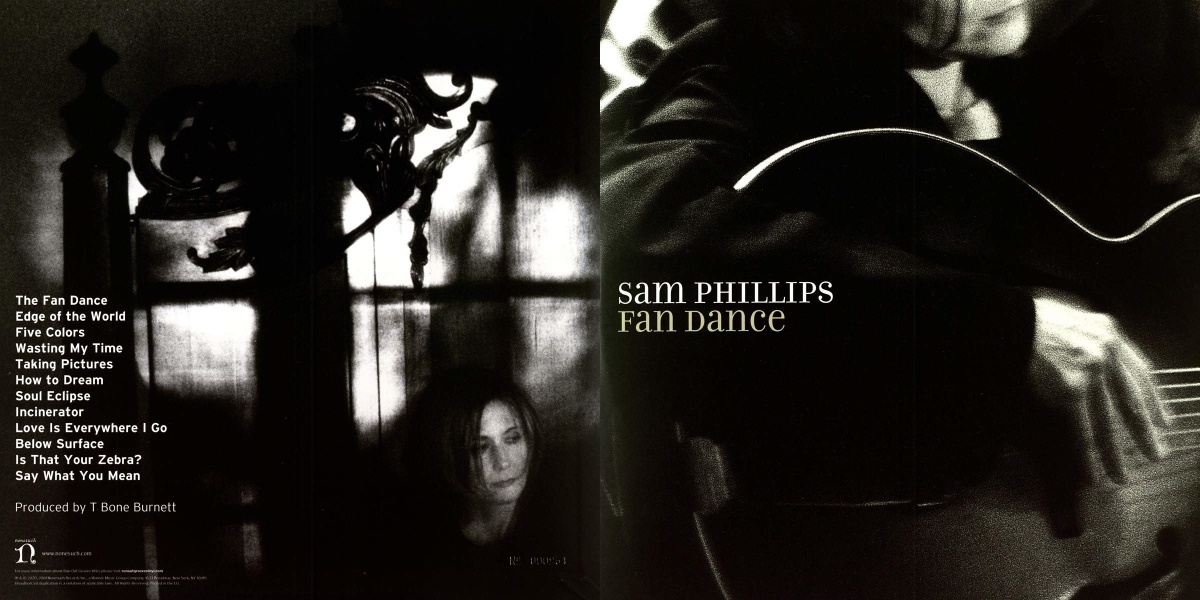
CD tracklist:
01. The Fan Dance – 3:46
02. Edge Of The World – 3:01
03. Five Colors – 3:43
04. Wasting My Time – 3:08
05. Taking Pictures – 1:58
06. How To Dream – 3:07
07. Soul Eclipse – 3:12
08. Incinerator – 2:03
09. Love Is Everywhere I Go – 2:03
10. Below The Surface – 1:41
11. Is That Your Zebra? – 1:49
12. Say What You Mean – 3:38
Note: Re-issued on 12-inch vinyl LP by Run Out Groove/Nonesuch Records in 2020.
In «Say What You Mean», the scorching closer to Sam Phillips’ new album Fan Dance, Phillips sings:
I’ll be desperate I’ll be lonely but I won’t be ashamed
No isolation no terror unnamed…
She’s talking about the price, and the reward, of telling the truth.She might be addressing her younger self, who struggled for the freedom to do just that. Trapped in the Christian music industry of the 1980s, Phillips wanted the freedom to ask questions and explore mysteries. When she began working with a producer named T-Bone Burnett, who liked her honest and heartfelt songs better than the formulaic sentiment, she turned her back on Jesus propaganda and started speaking her mind. She left the stage that had made her a star and started over, disappearing from the mainstream and becoming an obscure artist, in spite of earning great respect and accolades from critics, musicians, and artists everywhere.
More than ten years later, she is still dazzling her peers and her fans with riddling, delicious, and personal pop. Fan Dance arrives after a five-year hiatus, and it is worth the wait.
Sparser, Stronger
Once when she was asked about the function of art, Phillips paraphrased Thomas Merton: “The piece should point beyond all words into the silence; in other words… inspire people.” Fan Dance does just that. Putting down the pyrotechnic pop/rock of her last four albums, giving her usual social commentary and sarcasm a rest, Phillips sits down with a guitar to do some serious soul searching.
The album is produced with a deep reverence by T-Bone Burnett. He knows that this time, he had better just set things up and then get out of the way. Burnett has a unique ability to find the perfect balance for his musicians, so that we can hear each contributor clearly, and can almost see them interacting. Unlike Daniel Lanois, whose “sound” is distinct in the recordings of all he works with, Burnett is more focused on revealing the artists themselves; you might call him “The Invisible Producer.”
Here, the sounds range from the clear, first-take, live quality of a simple guitar («The Fan Dance») to a more experimental studio playfulness («Incinerator») that recalls recent work by Tom Waits. Sam knows how to pick a band. Marc Ribot, an innovative guitar trickster, has been a longtime Phillips collaborator. He can deliver notes so resonant and deep they seem to come from underground; then, in the next song, he’s plunking his way along like John Cleese in a silly walk. Jim Keltner, rock’s most prolific and professional drummer, delivers exactly what each song needs, and this is a remarkably restrained affair, letting the energy come from the lyrics rather than the rhythms. Phillips’ energetic, precise strumming stays right in line. Van Dyke Parks adds a resonant string arrangement for «Wasting My Time». And Gillian Welch has the distinct privilege of being Phillips’ first female backup singer.
Rarely does Burnett lay on the special effects, but when he does they merely underline or enhance the proceedings, as in the sudden atmospheric undercurrent that explodes and elevates «Love is Everywhere I Go», as song so beautiful and so painfully brief that you’ll insist it’s a lost classic by the Beatles.
Lyrics About Longing
A “fan dance” is a striptease, and the album is just that; she’s teasing us with riddles and mysteries. But Phillips’ own coy persona is not the center of attention. She’s wrestling with the elusive nature of truth, chasing glimmers of the infinite. She avoids platitudes and sentiment, preferring the painful truths. The questions emerge from the insufficiency of the concrete world to fulfill her appetites. A few previous songs – «Private Storm», «Answers Don’t Come Easy», and «Your Hands» – have hinted at a deep sadness and longing, a reluctant agreeance to wait for answers and a yearning to connect with the divine. As she sang in 1996, she’d rather have real love and a real God than a “sentimental prison” or “the political church.” The God in Phillips music does not live within the lines drawn by people who are scared to behold him in all his glory; these songs speak of a courage to behold him as he is, no matter what the consequences. I’m reminded of a question C.S. Lewis liked to ask: Since there is something to answer every craving human beings have, should there not then be something to answer our desire for divine love?
In «Edge of the World» she declares to a person in crisis, “You’re so afraid of what you want that you don’t want it anymore.” In «Five Colors», reason and the tangible world aren’t enough for her; she “can’t find refuge in the angle” so she’ll “walk the mystery of the curve.” In «Wasting My Time», she confesses that her life’s meaning is a mystery filled with clues to its meaning: “My soul’s a worn out road/ Where you’ve left a trail of reminders.” Who is the ‘you’ here? There is a Presence drawing her along towards understanding.
The clearest sign that it is God who eludes her, who calls her on, comes in «Below Surface», in which God is mentioned as “growing underground,” a rising and encroaching presence. At the same time, she tell us “desire is pulling me down.” Does this collapse refer to a desire for the creator? Or is she suggesting that aging, weakening, and death are the final steps of desire, the last steps to the reunion? (This echoes an earlier lyric in «Edge of the World», where she promises “Time will pull us to the floor.”) We’re returning to the mysteries we came from, to all that we are missing. This God has more in common with gravity than the heavens. In «Taking Pictures», Phillips touches on themes addressed by one of her favorite writers, Walker Percy, who has also written about the insufficiency of images. And she echoes Bob Dylan when she sings “Nostalgia isn’t what it used to be.” (Dylan once said in an interview, “Nostalgia is death.”) In pursuing the promises of photographs, she admits, “The places I go are never there.” And in «How to Dream», humankind’s pursuit of fulfillment through science and intellect falls short:
We search the sky planets chasing stars
Pulling toward deep affection
Weights and numbers measure a wound that won’t heal…These rational pursuits turn wicked in «Incinerator», where she eludes the possessive grasp of someone whose compulsions are deductive, diminishing, and destructive.
At first glance, «Love is Everywhere I Go» is the most straightforwardly positive love song Phillips have ever written. The first verse goes by so fast it sounds like she can’t wait to get to the contagiously sweet chorus. Yet, even in its assertions of hope and goodness, the song still insists on the as-yet-unattainable nature of the Answers:
Burning light inside my dreams
I wake up in the dark
The light is outside my door.I am reminded of what she sang more than a decade ago on The Turning… “The answers don’t come easy… I can wait.”
For those frustrated with the lack of didactic delivery, she drives the point home with a wink called «Is That Your Zebra?», where the lyrics are only “Who, what, why, how, where, when?”
These are, admittedly, guesses at what lies beneath these discomforting, blunt, and almost cryptic poems. But that might be just what Phillips wants. She told one interviewer: “I feel like one of the things I want to do is cause doubt… I want to pull things down, pull the curtains down and get people to think.” For this listener, as this rather over-long review suggests, she does.
While so many persist in trying to tell us the meanings of life and love, Sam Phillips’ journeys run farther, find more along the way than most artists, because they are driven by questions that only grow larger with time.
Long may she inquire.
Note
Sam Phillips’ husband, T-Bone Burnett, who has produced all of her albums, shared this with the online fan club recently:
“It is difficult for me to talk about Sam because if I were to say that she is one of the two or three best songwriters working today or that she is maybe the best pure singer I have ever worked with, I might be accused of favoritism, but that is the case I think this is the best record I’ve ever had the privilege of working on, and that I hope you all get as much love and joy out of it as I have.”
These are the words of a man who has produced albums by Elvis Costello, Gillian Welch, the Wallflowers, Jimmie Dale Gilmore, and Bruce Cockburn…and has worked with others like U2 and Bob Dylan. Could you ask for a higher recommendation? [Jeffrey Overstreet, The Phantom Tollbooth, 8/29/2001]

Reviews
There are no reviews yet.