Description
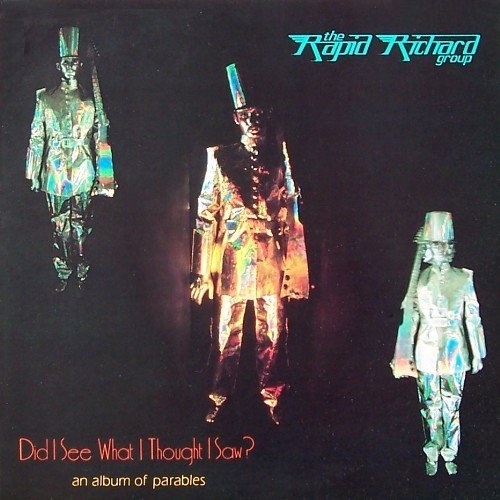
Did I See What I Thought I Saw?, sub-titled an album of parables, is the sole album by the American rock band The Rapid Richard Group, independently released on Home Spun in 1977.
You could call this the third Agape album and you wouldn’t be far off. Essentially a custom solo project from Richard Greenburg, bassist for Victims Of Tradition, joined by fellow Agape drummer Mike Jungkman. Add to that token appearances by Jim Hess and Fred Caban and the line-up’s complete. One could speculate that while Caban was responsible for Agape’s blues and psych direction, Greenburg provided the more progressive elements. As you’d expect Did I See is heavy duty hard rock. With lots of guitar and artsy keyboards it’s a sound not too distant from Victims, yet even more in the progressive rock direction and with more of a home-made feel. Greenburg’s rapid-fire guitar leads dominate this monster, catching our attention right from the start with a wah-wah and feed-backed exploration of a Beethoven string quartet opus! That track is «Ears», the first of nine tales on this thematic project subtitled “an album of parables”. The pace doesn’t let up for the boogie-boppin’ «The Prodigal Ducks» spotlighting Hess’s jazzy keyboard licks. «The Hobo» sounds like a pure Caban track while «The Tempest» rocks slowly, halting midway for a detonating barrage of frenzied guitar explosives. Next is the ballad «The Obstinate Toy Soldier», followed by the 7-minute art rock masterpiece «Religion’s Pigeon». «Groundhog» has kick-butt Clapton-esque hard rock crunch while «The Sparrow» coasts with a Victims-like jazz-influenced groove. «The Parables» sums up all the prior tales, explaining the spiritual angle of each. Apparently a lot of these songs were being performed by Agape at the time of their demise. 500 pressed. For those thirsting for more of this ground-breaking Jesus rock band you’re in for quite a treat. [Ken Scott, The Archivist, 4th Edition].
LP tracklist:
Side One
A1. “Beethoven String Quartet (Roll Over Chuck Berry)”
A2. “Ears”
A3. “The Prodigal Ducks”
A4. “The Hobo”
A5. “The Tempest”
Side Two
B1. “The Obstinate Toy Soldier”
B2. “Religion’s Pigeon”
B3. “Groundhog”
B4. “The Sparrows”
B5. “The Parables”
Note: Only 300 or so original albums were circulated. Re-issued on CD by Richard Greenburg himself in 2015: “I want to announce that on May 30, 2015 I released an enhanced version on CD and downloadable through CDBaby.com I spent over a year adding improvements in my new analog and digital studio, while trying to maintain the original feel and energy. I believe I made the sound quality better, while adding a few harmonies and supporting parts that I was not able to create in my 4 track studio between 1972 and 1977. I also have some original unopened vinyl copies. They are extremely rare. Visit me at www.smashtaculars.com/rapidrichard for more information.”
Here are some thoughts by “Rapid Richard” (Greenburg) penned 6/5/2015 (http://www.smashtaculars.com/rapidrichard/):
It was a fantastic experience to be part of the early (and later) years of the Jesus Movement in Southern California. I accepted Jesus Christ as my personal Lord and Savior at an Agape concert at the beach in Corona Del Mar, June 28, 1969. The stories you hear about people’s lives changing in miraculous ways after doing that are true on many levels, spiritually, emotionally, physically, and even musically. Agape had been together for about one year when I heard them play. At that time, they had not yet recorded their first album, “Gospel Hard Rock”. Little did I know that in a year and a half, I would have left my secular rock band as lead guitarist and become the bass player for Agape. I would play on their second album, Victims of Tradition, and be with them 4 and a half years before breaking up, largely due to the tragic death of our keyboardist, Jim Hess, my best friend, at the age of 22.
Agape was arguably the first hard rock Christian band on record. That day at Corona Del Mar, they were the only Christian band I had ever heard. Of course I had heard Christian messages from some of my earlier rock influencers, like the Byrds “Jesus is Just Alright” and Blind Faith’s “In The Presence of the Lord”. In those early years, other bands were forming geographically South of Los Angeles County where we lived, and we started to hear about them. Notably Love Song and the other Calvary Chapel groups, which all played mellow, soft rock – still beatiful and meaningful to many listeners. But we were not like them.
Our guitarist Fred Caban had been the room mate of who turned out later to be the biggest Christian recording artists of the 1960s and 70s, Larry Norman and Randy Stonehill. Randy, who had not yet recorded his first album, would sometimes open for Agape when we were on tour. They were both from a background of snappier music than other Christian bands, but hardly considered hard rock.
When I first heard Agape, I could hear the Jimi Hendrix and Doors influences loud and clear, along with blues influenced by the likes of John Mayall’s Bluesbreakers. But the music was somehow full of pure shining light and cleanness of spirit, things that can’t be said about those secular artists. It was that element that drew me in and made me want to be part of this new music. But the thing that differentiated us from all other Christian bands and artists of the time, was that we had no goal of playing music that would bless Christian listeners. Our hearts were entirely evangelistic, with the desire to reach people from our subculture in their musical language with the news of Christ’s saving and transforming power. It was a life-or-death message to rescue people from a fate worse than death, and give them a future better than life (as the world knew it). We sang of His atoning work on the cross and resurrection to pay for our sins and give us new life. We brought people into the real born-again experience. We knew it was the answer to the millions of young people confused and in bondage to the darkness of that era. We played everywhere we could, and thousands of people came forward to receive Christ (when you count them all up over time). That was our calling for the day, and it was forefront in our lives as we attended college and prepared for adulthood.
Before we went into the studio to record Victims of Tradition in 1972, I started writing songs and planning the Rapid Richard Group album. I wanted to make an album of parables, of a different musical style than Agape, more along my musical tastes and creative leanings. It too would be from the heart of evangelism, but in the same manner that Jesus used parables to get through to the public in a way that subtly drew them in. I worked on the album for five years with the help of my close friends from Agape, and a bunch of other incredible musicians that God brought into my life.
The album was released in 1977, after Agape broke up. However, I admit I dropped the ball and failed to promote it. I sold the first 300 or so copies easily to people around me. I approached a major Christian label. They said it sounded just like what was trending on the radio at the time, but the Christian buying public was not ready for it. I also sent it to a number of secular producers. One such producer became interested, and I spent over a year trying to create music and put a new band together to take my “career” to the next level, with the hope of eventually parlaying it into a larger forum for future messaging. In that few months after the 1977 release, musical styles changed as new artists came on the scene, and I started writing newer, more secular songs to record with this top level producer, now renowned for prodicing Queen, Foreigner, The Cars, Journey, Cheap Trick, Devo, Alice Cooper, Lindsey Buckingham, Be Bop Deluxe, Dusty Springfield, and dozens of other famous artists. In that period, the rest of the 500 albums I pressed, stayed in my garage as I pursued other interests. I eventually landed a job with a large Fortune 500 company, at which I have now been employed 34 years. Today, the albums are still safely stored.
The famous producer knew us as the Rapid Richard Group, but with mostly new musicians, we later changed our name to one that never became known outside a small circle of people. We called ourselves “Pictures”. The famous producer and I drifted apart. That is another way of saying after years of auditoning and trying different line-ups I was never able to put a recording/touring band together of musicians that were persistent, committed, and fully capable, so I felt empty-handed to re-contact the producer.
Eventually, with frustration that group broke up. I continued writing and recording over the years as I made a good living in corporate America. I tried to open a recording studio in Hollywood right after I graduated from my master’s program in business during the 80s, but the business failed, partly because I was working full time elsewhere and counting on others to make the business a success. After that experience, I became a worship leader and spent decades enjoying bringing believers into a place of worship and praise to God (outside business hours). I wrote a number of worshipful songs. But, I did not do much with them outside of worship leading. One of the songs is available on I-Tunes and CD Baby, “I’m in Your Arms Now”. That song WAS written to bless Christians, and still carried evangelistic undertones. You can download it for free at www.smashtaculars.com/HP/ .
As you can see, I retained a strong relationship with Christ all those years, but not without setbacks, trials, and tribulations, which I’m sure most Christians can relate to. I had kept the studio equipment, then later invested in digital recording equipment as well. I took on the hobby of taking many of the tapes and songs I had started as demos in the 70s and 80s and bringing them to full production. Mostly, I did this for fun and for my kids, so they could both hear the music I wrote and understand their Dad’s background.
In 2014, after my kids grew up, I released two albums of the secular music under the name “The Smashtaculars”. One song on the second album, the “J Word” did have a Christian message. It was performed with a “throwback” feel using the 60s vernacular of artists like the Byrds and the Grateful Dead, Dylan-influenced pop-rock.
After releasing those two albums, I turned my attention to enhancing and remixing The Rapid Richard Group’s “Did I See What I Thought I Saw” album. I spent many months on that project, and I finally released it at the end of May 2015. In the last few years, that album has been growing in popularity in bootleg form through mp3 downloads in many countries. Trading of original copies seems to have slowed as the price is now so high. I am now putting my remaining copies up for sale a few at a time for “hard-core” collectors and for less than the going price. With only 500 pressed, they will always be rare and valuable to those enthralled with the music of the Jesus Movement.
Reviews
There are no reviews yet.