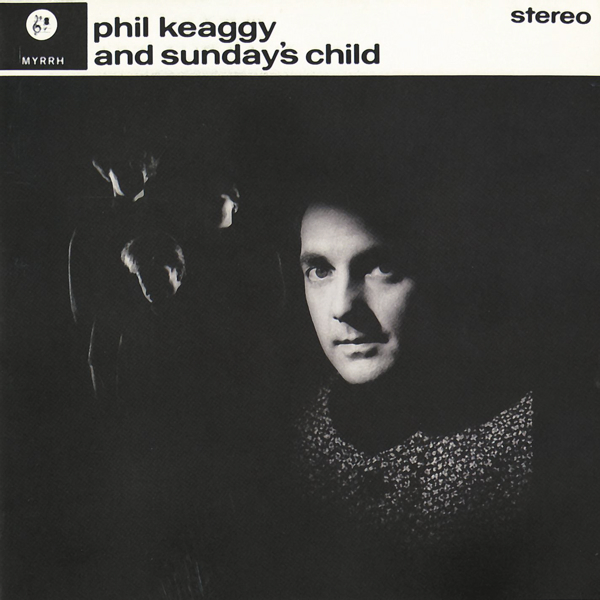
Description
Phil Keaggy and Sunday’s Child is the eleventh solo album by the American singer, songwriter, and guitarist Phil Keaggy, released on Myrrh Records in October 1988, a division of Word. Also manufactured and distributed by A&M Records. The album was recorded between June 6th and August 15th, 1988 by Jack Joseph Puig at Music Grinder in Hollywood and at Neverland Studios in Los Alamitos, California; with Lynn Arthur Nichols producing. (Nichols actually was a member of Keaggy’s late 70s rock outfit Phil Keaggy Band, and as well a member of the short-lived rock combo Chagall Guevara in the beginning of the ’90s.) Mixed by Puig at Bill Schnee Studios in North Hollywood, California. The cover artwork pays homage to the sleeve design of The Beatles’ 1963-album With The Beatles.
Sunday’s Child is the first album of Phil Keaggy’s ’60s Britpop inspired album trilogy released between 1988 and 1993. (Find Me In These Fields and Crimson and Blue being the second and the last installments, respectively.) Featuring Keaggy on lead vocals and guitars, backed by long-time Russ Taff sideman James Hollihan on guitars and a rock solid rhythm section consisting of former Outlaws bassist Rick Cua and drummer Mike Mead (later of Chagall Guevara fame), with Robbie Buchanan sitting in on Hammond B-3 organ on various tracks. Backing vocals provided by Lynn Arthur Nichols, Russ Taff, Randy Stonehill, Mark Heard, Derri Daugherty of The Choir fame, The Imperials‘ Jimmie Lee Sloas, and Alwyn Wall of Malcolm & Alwyn fame.
For this record, Phil Keaggy and his band of cohorts were attempting to re-create one of those classic albums from the mid-’60s a la the Byrds or the Beatles, using only vintage guitars played through vintage amplifiers. They even used Ringo’s old drum set…the album is Keaggy’s strongest ever, and a landmark for the Christian music industry. Opening with a brilliant, heartfelt, happy-go-lucky «Tell Me How You Feel», Sunday’s Child rocks one punchy number after another. The title track comes closest to an early Beatles sound, with its jangly lyrics and simple 1-4-5 major blues progression. Others, such as «Big Eraser» or the opening to «I’ve Just Begun (Again)» hark back to a more psychedelic time. Keaggy’s guitar sounds amazing (as usual) and his playing is very refreshing to hear on these old fat guitars. There also is excellent bass work by Rick Cua (Outlaws) throughout…this is a timeless record that always manages to sound fresh with each listen. [Mark Allender, AMG]
Phil Keaggy is one of a very few Christian artists for whom loyalty amongst his listenership has almost never been threatened. In a business where “one false move, and you’re history” is much more than a cliche, Keaggy’s ability to sell at least a respectable amount of any new product (even when they were almost impossible to find) should be seen as a pretty valuable commodity in the volatile world of Christian music. Good thing too, since the man is a powerhouse of talent, with enough chops in his guitar repertoire alone to merit major features in the trades. The puzzling fact is, though, his potential hasn’t even begun to be realized – making him yet another of our “best kept secrets.”
One of the problems has been the lack of a really solid album to put him over the top. With the release of Phil Keaggy and Sundays Child, that moment may just be close at hand. His first for Myrrh, and produced by the label’s vice president of A&R Lynn Nichols, the album is both an affectionate look at pop music’s past and a significant contribution to the here and now. It’s the first time since 1977’s Emerging that Keaggy has taken on the moniker of a band to title an album project. (Trivia buffs may remember that Nichols was a part of the PKB.) Funny thing is, the Sunday’s Child lineup consists of entirely different personnel than the Keaggy/Stonehill Band, which he is touring with to promote the album. Oh well, it’s only rock ‘n’ roll.
And I like it. Though the kickoff track, «Tell Me How You Feel», will invite the McCartney comparisons we’ve come to expect, it’s one of only two tunes for which that shoe will fit. An interesting twist this time is how the similarities extend to Keaggy’s bass playing, not only melodic as McCartney’s, but sporting a riff lifted right from «Rain». Otherwise, it’s the differences about this track that set the tone for the whole album.
For the first time ever, Keaggy delivers an ’80s rock recording defined by both arrangement and recording technique. Missing in action is a guitar solo, and the fact is, there are very few to be found on the album. Not to worry though, because his is clearly a guitar player’s record. More about that later. The title track, «Sunday’s Child», written for the infamous “Braindead” project by Keaggy and Stonehill, is a Beatiesque bash, featuring Randy and Phil sounding like John and Paul, with a touch of late ’60s Stones harmonies thrown in for good measure. It’s sure to be a concert crowd pleaser.
«I Always Do», a new Mark Heard tune, caps off the Pauline fun with a catchy chorus and a surprisingly strong guitar solo at the end. «I’m Gonna Get You Now» kicks off with a nod to a late ’60s Stones riff from a song that I’d better not name.
The formidable rhythm section of Rick Cua on bass and Mike Mead on drums are impressive throughout the whole album. On «Blessed be the Ties» (with words by Steve Taylor), Keaggy mounts his vocal with an intimate, European style reminiscent of John Lennon on «#9 Dream» without turning his back on his own approach.
Side two (unless you’re playing a CD!) roars into action with «Ain’t Got No», written by Randy and Sandi Stonehill, and featuring Randy and Russ Taff shouting loud and proud, contrasting the riches of the world with the love that lasts over some stellar slide guitar.
«Big Eraser» is a thoroughly modern song, quite different for Keaggy, with an ethereal approach that begs for a video and considers crossover possibilities. The cassette and CD contain another new Mark Heard tune, «Everything Is Alright», a love song that sounds like it was written by Keaggy instead of for him. Nice, but not essential.
The album’s last rocker, Stonehill’s «Walk in Two Worlds», is a classy example of just how good this band can sound. The song builds in intensity, undergirded by a Hammond B-3 wash, as guitars and bass hammer home the tension of a Christian’s pilgrimage. The record concludes with a potential classic. «Talk About Suffering», a traditional spiritual, has been respectfully rearranged by Keaggy with seemingly hundreds of ringing guitars recalling The Byrds in a holy cacophony of anthemic proportions. The lovely harmonies, by The Imperials‘ Jimmie Lee and Mark Heard, and Keaggy’s own eloquent solo, makes you wish this one never ended. It’s a fitting close to Phil Keaggy and Sunday’s Child, his best studio work ever and a strong candidate for one of the year’s best. [Thom Granger, CCM, November 1988]
Phil Keaggy’s 2022 notes for his album Sunday’s Child:
In 1986, my Wind and The Wheat project was released. It was pure joy to make an album like that. Thank you Tommy Coomes. I had changed management and was newly signed to the Word label by 1988. One of my 1970s bandmates, the talented Lynn Nichols became my enthusiastic producer for a new adventurous album project.
I had been traveling and recording with friend and songwriter Randy Stonehill and we wrote the title song for this next album – to be called Sunday’s Child. Mark Maxwell was my A&R man and he and Lynn laid out a course to take for this new recording.
We recorded tracks and overdubs in various California studios. The majority of my band were flown in from Nashville: Mike Mead (drums), James Hollihand (guitar), Rick Cua (bass) and we had guest appearances from many incredible musicians, writers (Steve Taylor, Lance Demers and others) and singers appear on the songs: Randy Stonehill, Russ Taff, Mark Heard, Derri Daugherty, Jimmie Lee Sloas, Lynn Nichols, Alwyn Wall and some LA players as well: Robbie Buchanan and Lenny Castro. It was a big venture, but we were young and had the energy.
Jack Joseph Puig was our main recording and mixing engineer, but we had other fine engineers as well: Dave Hackbarth, KC McMackin… also David Schober and Brian Tankersly (God rest both those dear friends)! Eddie Keaggy was also a huge help in the recording process.
When the album was finally finished, I got “word” that RCA Records was interested in releasing the album… but such was record company politics, and that prospect was abandoned. I was pretty keen on the idea that the Nipper would be my label mascot.
Friends were very encouraging about the album! It seemed to resonate with musicians and British Rock fans. It was probably difficult for my new record label to know how to market Sunday’s Child to the CCM market. Still, it was a fun album to tour and Randy and I shared a great band and went on the road with it and his new release at the time as well, which I believe was Wild Frontier.
Looking back, I see how special it was to work alongside some amazing talent – and the very gifted Mark Heard was truly a great asset to this album with 2 of his incredible songs, «I Always Do» and «Everything Is Alright». (His wonderful demos are on the bonus discs, as well as versions of both songs with his vocal.)
We used vintage gear – old guitars and Vox amps. You can really hear and feel the heat of the tubes in those amplifiers. Special thanks goes out to Ben Pearson who took many of the photographs.
So, now it’s been about 34 years since we made this project together and the music still stands and resonates. Glad to see it made available once again here on Bandcamp. Thanks for listening. – Phil Keaggy, 8/6/22
> Apple Music (https://music.apple.com/us/album/phil-keaggy-and-sundays-child/1167815276)
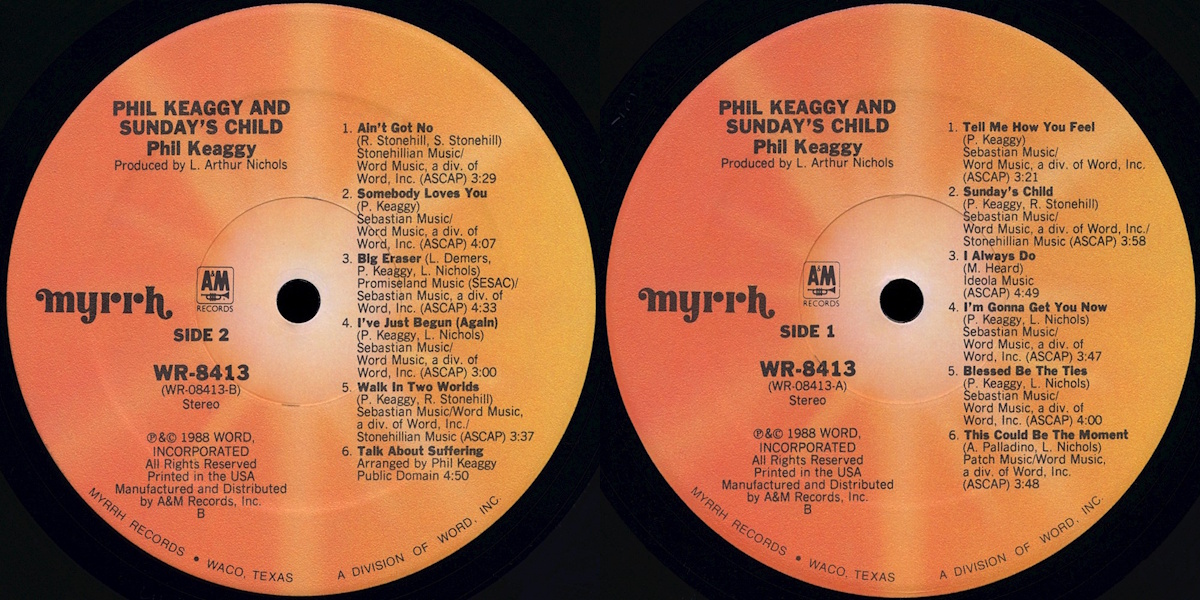
LP tracklist:
Side One
A1. “Tell Me How You Feel” – 3:21
A2. “Sunday’s Child” – 3:57
A3. “I Always Do” – 4:50
A4. “I’m Gonna Get You Now” – 3:47
A5. “Blessed Be The Ties” – 3:56
A6. “This Could Be The Moment” – 3:48
Side Two
B1. “Ain’t Got No” – 3:29
B2. “Somebody Loves You” – 4:05
B3. “Big Eraser” – 4:33
B4. “I’ve Just Begun (Again)” – 3:00
B5. “Walk In Two Worlds” – 3:37
B6. “Talk About Suffering” – 4:50
Note: Simultaneously released on cassette, 12-inch vinyl LP, and CD by Myrrh Records, with both the cassette and the CD versions featuring a bonus track; the Mark Heard written “Everything Is Alright” (5:00). Myrrh released several singles from the album, a 7-inch single featuring “Tell Me How You Feel“, b/w “Big Eraser” (catalogue number 689720-DJ), a 12-inch single featuring “Sunday’s Child”, b/w “Walk In Two Worlds” (catalogue number 901-6897-151), and a 12-inch 33 ⅓ RPM single featuring “Talk About Suffering”, b/w “Ain’t Got No” (catalogue number 689757-DJ) . Available at Bandcamp along with two Bonus Discs:
https://philkeaggy.bandcamp.com/album/phil-keaggy-and-sundays-child
https://philkeaggy.bandcamp.com/album/phil-keaggy-and-sundays-child-bonus-disc-a
https://philkeaggy.bandcamp.com/album/phil-keaggy-and-sundays-child-bonus-disc-b
https://randystonehill.bandcamp.com/album/composing-sundays-child-1987
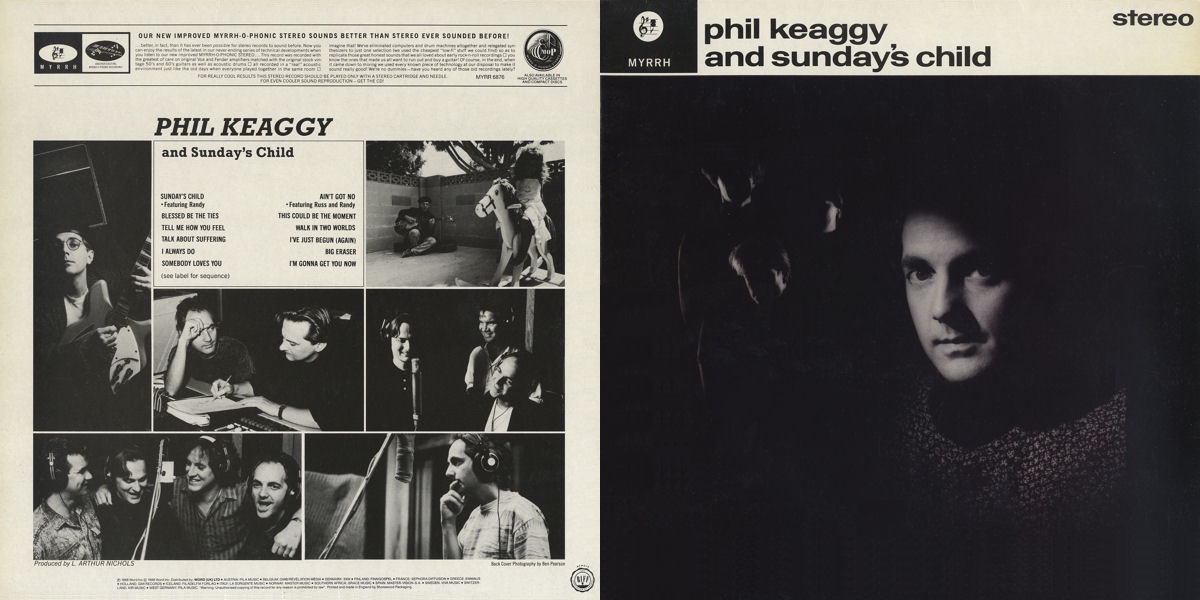
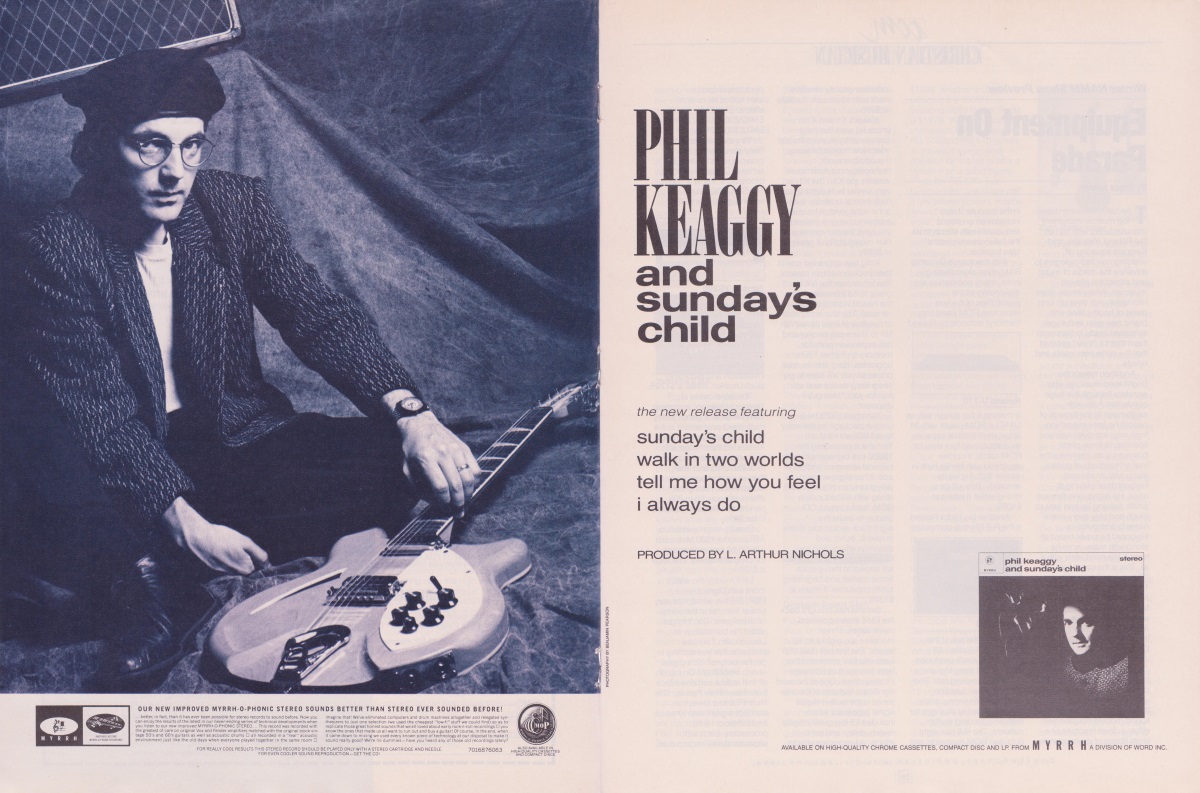 A double-page advertisement for Phil Keaggy and Sunday’s Child was featured in the January 1989 issue of CCM Magazine.
 The January 1989 issue of CCM Magazine featured a cover story on Phil Keaggy.
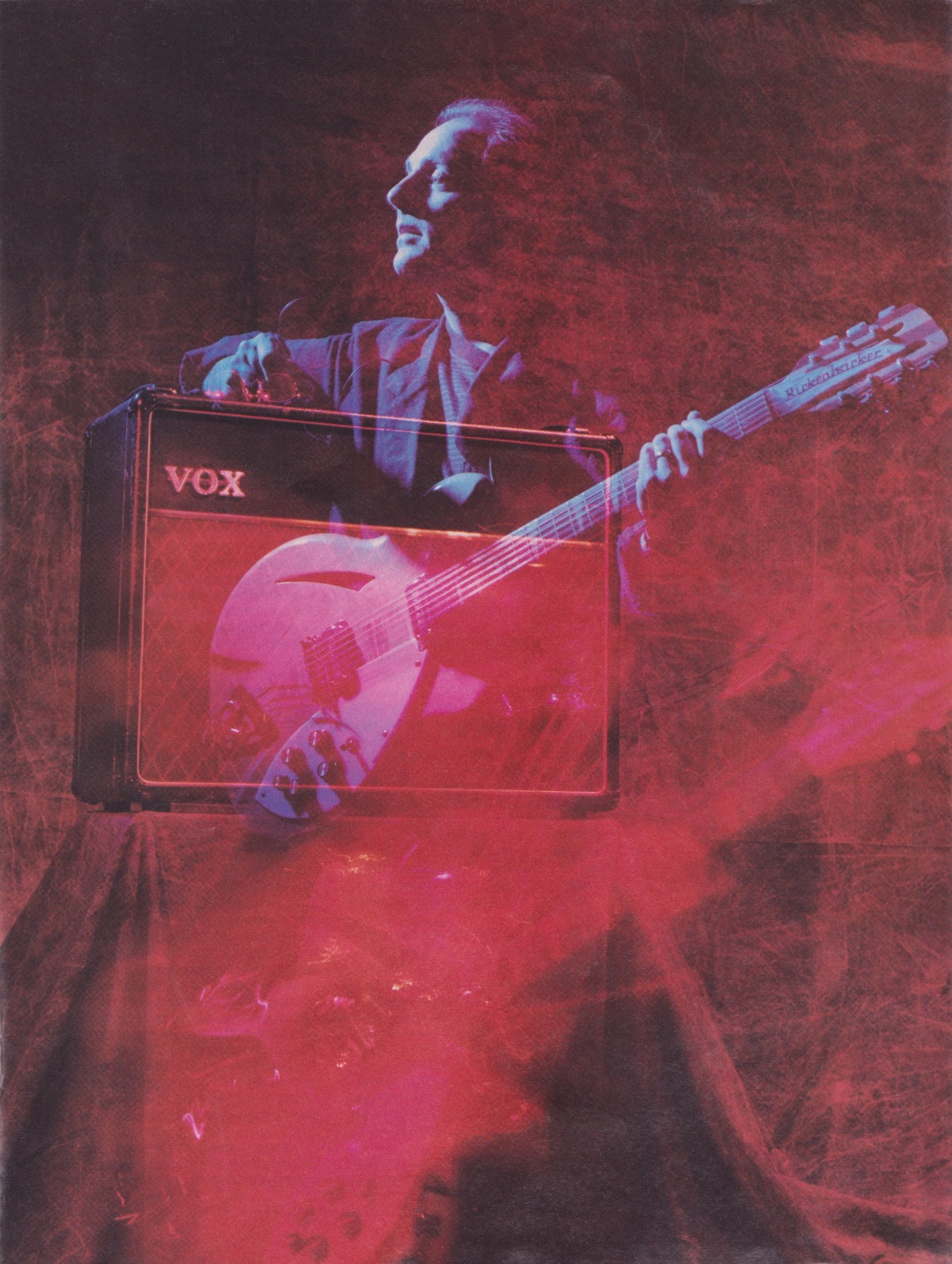 Phil Keaggy with his vintage Rickenbacker guitar, as pictured in the cover story on Keaggy featured in the January 1989 issue of CCM Magazine.
CREDITS. Produced by L. Arthur Nichols. Director of Recording: Jack Joseph Puig. Overdub Engineer: David Schober. Assisted by Eddie Keaggy, Dave Hackbarth, KC McMackin, Bart Stevens, and Wade Jaynes. Recorded at Music Grinder, Hollywood, CA, and Neverland Studios, Los Alamitos, CA, between June 6, 1988 and August 15, 1988. Additional studios: Bill Schnee Studios, North Hollywood, CA, Fingerprint Recorders, Montrose, CA, and The Hop, Sherman Oaks, Los Angeles, CA. Mixed by Jack Joseph Puig at Bill Schnee Studios. Additional Engineers: Brian Tankersley and Mark Heard. Photography by Dan Arsenault. Additional Photography by Ben Pearson (Back Cover). Art Direction and Design by Ph. D. Grooming by Scott Parker. Styling by Maria Sarno. A&R Coordinator: Deb Rhodes. Production Manager: Laurie Fink. Special thanks to the Drum Doctor for the use of Ringo’s old drum kit.
Musicians: Phil Keaggy (Lead Vocals, Guitars, 1st Guitar Solo on track A6, Bass – tracks: A1,A3,A5; Handclaps on track A1), Randy Stonehill (Lead Vocals on track A2 and B1), Russ Taff (Lead Vocals on track B1), James Hollihan (Guitars, 2nd Guitar Solo on track A6), Lynn Nichols (Guitar on track A5), Robbie Buchanan (Hammond B-3 Organ – tracks: A3,A6,B1,B5), Rick Cua (Bass), Mike Mead (Drums), Lenny Castro (Percussion – tracks: A1,A2,A5,A6,B1,B2,B3,B5,B6; Handclaps on track A1), Steve Taylor (Handclaps on track A1), Rudy Valentine (Megaphone on track A4). Backing Vocals: Phil Keaggy (A1,A6,B1,B2,B3,B4,B5,B6), Jimmie Lee Sloas (A6,B6), Mark Heard (A6,B2,B6), Lynn Nichols (B1,B3,B4,B5), Russ Taff (B1,B5), Randy Stonehill (B1), Alwyn Wall (B2), Derri Daugherty (B3,B4).
Reviews
There are no reviews yet.