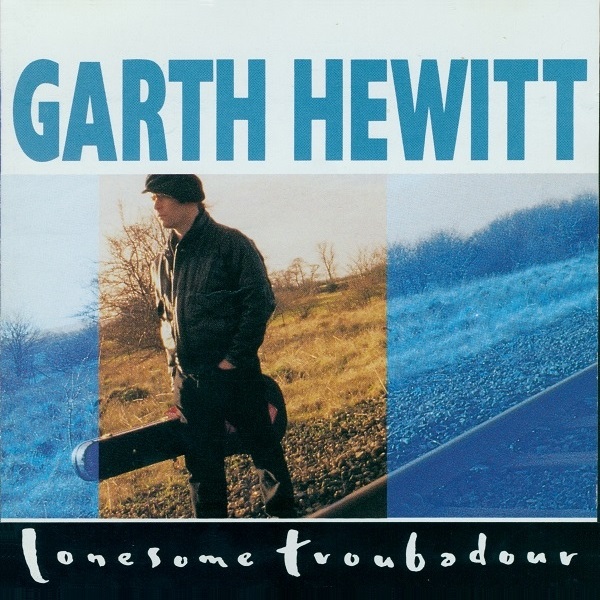
Description
Lonesome Troubadour is a studio album by the British singer and songwriter Garth Hewitt, released on Myrrh Records in 1991, a division of Word. The album was produced, recorded, and mixed during January 1990 by the American singer-songwriter Mark Heard at Fingerprint, his studio in Los Angeles, California. Mark Heard also provides guitar, dulcimer, accordion, mandolin and autoharp which together with Byron Berline’s fiddle and Garth Hewitt’s Dylanesque vocals and harmonica interjections give the whole thing a feel of Desire-era Dylan. Backing vocals provided by Heard, Pam Dwinell, and Randy Stonehill.
Forming part of the a digital only reissue of much of activist and singer/songwriter Hewitt’s back catalogue, this 1991 release built on the foundations laid by its predecessor ‘Scars‘. There was no doubt that Hewitt had now got into his protest song stride and, together with the late and much missed US Jesus music pioneer Mark Heard adding improved production values to the proceedings, this Los Angeles-recorded collection pulls no punches. Once again, Hewitt comes down on the side of the oppressed with rubbish tip scavengers («Little Outlaws, Dirty Angels» and «Shadows In The Mist») and dispossessed Palestinians («A Song For Miriam» and «Ten Measures Of Beauty») amongst others having their plight heard in uncompromising fashion. Although never one to mince his words – check out the perfectly pitched warning against adultery in «Not A Love Story» as a prime example – Hewitt is careful to offer up some hope in line with his Christian faith to avoid his message getting lost in a mire of self-righteous morality. For example, «Full Moon Over Mozambique» is ultimately a song of optimism amidst the hell of war whilst «Dance On Injustice» – a song that reflects Jesus’ own compassion for the poor and disadvantaged – and «Dancing The Polka In Tiananmen Square» both contain a confident prediction that justice, peace and love will win through in the end. Musically, this album is more assured and, for the most part, Hewitt inhabits a Bob Dylan guise to great if somewhat imitative effect. Nonetheless, stylistic departures such as the dirge-like drumming on «Dancing The Polka In Tiananmen Square» and the worshipfully tender «Deep Silence» – a song that reflects the writer’s own journey of salvation – add variety to what rates as one of Hewitt’s strongest releases of his long career. [Lins Honeyman, Cross Rhythms, February 2012]
> Spotify (https://open.spotify.com/album/5jHoJ3woe9datnvvW8oqmN)
CD tracklist:
01. Lonesome Troubadour – 4:24
02. Little Outlaws Dirty Angels – 3:55
03. Trailling Clouds Of Glory – 3:56
04. Not A Love Story – 3:10
05. Full Moon Over Mozambique – 4:00
06. Deep Silence – 4:10
07. Dance On Injustice – 3:46
08. A Song For Miriam – 3:26
09. Ten Measures Of Beauty (Ten Measures Of Sorrow) – 3:48
10. Shadows In The Mist – 4:21
11. Dancing The Polka In Tiananmen Square – 2:56
12. Broken Image – 3:28
Note: Simultaneously released on cassette and CD by Myrrh Records.
Mark Heard was one of the most influential people on me musically, but also such a good friend. It was a strangely moving time of recording – the first Gulf War broke out as we were doing it, and the wonderful fiddle player Byron Berline came in to play on «Ten Measures of Beauty» and wondered if it had been written the night before. Randy Stonehill also came in to do some backing vocals. Mark was particularly good at giving me confidence to be myself musically, and I had just got agreement for him to record the next album for me, when tragically he died. [Garth Hewitt, excerpt from the liner notes of his compilation album 30]
It is usually the human things I remember from my sessions rather than the technicalities. I rarely use charts, indeed, I don’t read music, and some of my favorite players are the ones who see the session as a jam. I’ll never forget Byron Berline coming over to play fiddle on Garth Hewitt’s record the day after Scuds began landing in Israel. Garth’s song was a waltz and began, “Ten measures of sorrow God gave to the world, nine to Jerusalem, one to the rest.” It was inspired by Garth’s visit with some Melchite friends in East Jerusalem, and had given him a real feeling for the sadness of the situation of the Palestinians living there.
I was setting up a headphone mix for Byron as I played the tape, and he didn’t even ask the key or anything, but began playing from the top, without a complete cue mix. Of course, I had hit the record button just in case, and he nailed the whole song first take without ever having heard it before. He was playing his heart out.
I told him it was a keeper, and he, much impressed with the timeliness of the song, asked Garth, “Did you write that song last night?” His emotion about the war was part and parcel of his performance, as it was a jam to him. That’s what music is about, and those are the types of experiences I value most in looking for the visceral and unidentifiable thing it is that makes music music, and not something else.
[Excerpt from “Life in the Industry: A Musician’s Diary” by Mark Heard, originally published in ‘Image: A Journal of the Arts and Religion’, 2, 1992]
CREDITS. Produced, recorded and mixed by Mark Heard at Fingerprint, Los Angeles, January 1991. Drums recorded at Neverland, Los Angeles. Second Engineer: Derri Daugherty. All songs written by Garth Hewitt. Design by James Kessell. Photography by Theresa Wassif.
Musicians: Garth Hewitt (Lead Vocals, Acoustic Guitars, Dobro Guitars, Harmonica), Mark Heard (Electric Guitar, Dulcimer Guitar, Accordion, Mandolin, Hammond, Autoharp), Byron Berline (Fiddle), Glen Holmen (Standup Bass, Acoustic Bass, Electric Bass), Doug Matthews (Drums), David Baker (Percussion). Backing Vocals: Garth Hewitt, Mark Heard, Pam Dwinell, Randy Stonehill.
Reviews
There are no reviews yet.