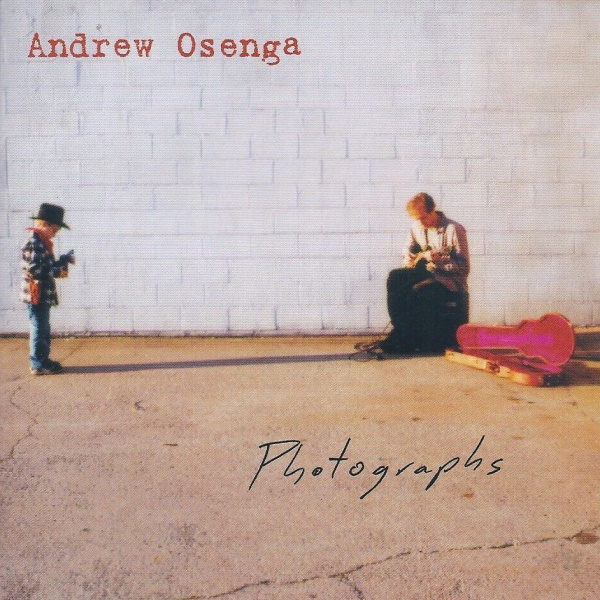
Description
Photographs is an album by the American singer, songwriter, and producer Andrew Osenga of The Normals and Caedmon’s Call fame, independently released by Osenga in 2002. The album was produced by Andrew Osenga.
Who? What? I know, I know – unless you’ve been following indie CCM for the past decade, you’ve never heard of the guy. But trust me, this album’s fantastic. Using an array of guitars and synthesized sounds, Osenga has shaped a multi-textured pensive work of art. His textual painting is spot on – from the rolling guitars and choral sounds in his first track, capturing the essence of the river near his hometown, to the crashing symbols and wailing guitars that accompany his tale of a heedless romp in Vegas. This thoughtful musicality, along with his poignant lyrics on life, love, and faith, lend the album such artistic weight that it remains one of the few CCM records that’s actually accessible to people who don’t identify as Christians. It really is good – I promise. [Josh Tremill, PRISM Magazine, 2009]
Attempting to wrap ones arms around the music of Andrew Osenga is an exercise in futility. Granted, one detects intermittent flashes of familiarity – the grit, passion and throaty growl of a Bruce Springsteen, the poetic sensibility of a Bob Dylan, or the narrative inclination and vocal timbre of a Billy Joel. Still, like trying to capture the residue of a wonderful dream or to lasso a falling star, the wholly unpretentious songs of Andrew Osenga escape unbridled, ultimately defying convenient labels and meaningful comparisons.
Photographs is Osenga’s lead-off entry into the standing-room only, independent arena of Christian music. Osenga now segues down the path of a solo artist, having previously garnered a recording contract, mainstream CCM acceptance, and a legion of supportive fans over the last five years as frontman for the Normals.
One might expect an artist who has held high cards in his hand at such a young age – to manifest some hint of pretense. To the contrary, when I chatted with Osenga in Nashville recently, his demeanor was humble, modest and unaffected – an absolute parallel for his debut project. In short, the man and his music perfectly reflect the other.
Though the songs on Photographs aren’t all autobiographical, they feel as personal as a scrapbook – as if they were recorded only for private posterity. Family picture albums inevitably contain snapshots that are less than perfect – a goofy expression or embarrassing pose – people locked in time, calling to mind recollections that aren’t always cheerful. And that’s the setting for Photographs, frozen frames featuring characters and scenes from Americana that we identify with and easily care about – probably because they remind us of ourselves.
«Kankakee» establishes the project on a personal, familial tone. The subtle harmony by Matthew Perryman Jones punctuates the title line with delicate, but deep expression. The blending of Osenga/Jones voices, and later that of Alison Osenga, is layered just right. And yes, Ms. Osenga is not just one of the background vocalists on this project – she’s also Andrew’s wife. As with many of the lyrics on Photographs, with «Kankakee» we aren’t force-fed a conclusion or obvious agenda – a wonderful compliment to the listener. Contrast this approach with the prevailing fashion of mainstream CCM, which is often flat-out redundant and simple-minded.
«Kara» might demonstrate the greatest degree of universality of any song on the project, recounting a first love which fades insidiously, like the falling sun. Witness Osenga serving as his own production designer, editor and character development writer with this passage from the first verse:
Here where I live, in Indiana,
It is a small town like any other,
There lived the prettiest girl around.
She had blonde hair and glasses.
Her name was Kara.
She was a senior at the high school.
I was on break from the university.
Sure I had seen her. Sure I had known her.
She was a girl then, now she was a woman.The song succinctly narrates the tentative first steps of infatuation, the transition and evolution of love, and finally the reality of life’s complications. Even those rarely given to introspection are inevitably faced with questions and regrets. What happened? Why? What if? If only! It’s enough to keep a guy up late some nights.
Later, the story collapses in on itself, sucked into a swirling vortex of complex confusion which is underscored musically with minor chord changes, a lazy wandering electric guitar and meandering vocals. Meanwhile, the deliberate drum cadence lingers, as if to say, in spite of these changes, “The pulse of life goes on…”
First, I came back home every chance I could get
Then things started getting a little busier,
and the holidays were over.
Before you knew it
I took a summer job in Indianapolis,
and the city draped its fog over me.
I told myself I was too busy to write.Biggest mistake I ever made.
Photographs probably won’t be on the musical wish list of those who purchase music for overt, obvious spiritual encouragement. Osenga’s vocal style is such that even those lyrics that in some sense offer an optimistic outlook are delivered with a melancholy, wistful tone. Notwithstanding, those that discover truth and ultimately hope in the knowledge that at least one other pilgrim has stumbled on the speed bumps of doubt and regret – but still found redemption – will appreciate the honest introspection of Andrew Osenga.
Osenga fits the profile of a growing fraternity of Christian singer/songwriter types that carry the courage to be candid. Candor extends honesty one step further, into the realm of the personal. While honesty is difficult, candor is rare. Osenga seems to possess both.
Though Photographs is not an acoustic album per se’, those that appreciate sparse, acoustic music arrangements will want to secure a copy. Osenga dishes up a nice acoustic vibe, though the compositions are embellished tastefully with other instruments, sometimes of the “plugged in” variety. According to Osenga, “This started as a purely acoustic project, but evolved into something more.” Some instruments were played and overdubbed himself – the rest of which were provided by Osenga’s friends, many of which are pillars of the growing Nashville fellowship of musicians – a group made up largely of friends who often play on each others projects.
Another standout “snapshot” is the confessional, «Too Far to Walk». Written from the desperate perspective of a believer whose deliberate sin has gotten the better of him, the resultant pain and regret is palpable. The line “I get scared that forgiveness is for better people, so I give up trying to fight … Jesus you’ll have to come get me, cause it’s too far to walk tonight,” is awesome in its unmitigated truth. Wanton rebelliousness to the will of God results in a weakness of spirit that paralyses. This may be one step down the ladder of unrestrained iniquity than the pickle Paul describes in Romans 7:14-25.
Normals fans will be interested in hearing «We Were Sure We Would Change the World», an obvious retrospective swan song to the band. Fans looking for a clue to the group’s dissolution will probably find it in this song, though in typical Osenga fashion, you will have to work for it. The title track «Photograph», «Man of the House», and «The High School Band» are other sonic and lyrical highlights.
Osenga’s husky voice is readily identifiable. Strangely, it’s an instrument that is both controlled and wildly expressive. It serves the songs rather than the other way around. Though we admire its expressive quality, it doesn’t distract from the narrative with bizarre vocal gymnastics. Still, like a seasoned actor on the big screen, we forget we are receiving a “performance” because we are so engrossed in story and character. Admittedly, Osenga receives an assist from his own vivid material. Still, great songs delivered by a lesser talent would leave us unconvinced.
Photographs provides clear evidence that Andrew Osenga is one of the most gifted lyricists in Christian music today. From song to song, though we are never really sure if he’s created a character or is sharing something from his own scrapbook, we can’t deny that we are moved. As a songwriter, Osenga matches felicitous melodies with ideal velocity and intensity. Assuming the persona of a character in a narrative, Osenga develops people we care about – indeed, people that we know, maybe really well. Get the picture? Say cheese! [Curt McLey, The Phantom Tollbooth, June 22, 2003]
> iTunes (https://music.apple.com/us/album/photographs/178295013)
CD tracklist:
01. Kankakee
02. Kara
03. The High School Band
04. Photograph
05. The Man Of The House
06. We Were Sure We Would Change The World
07. Vegas
08. When Will I Run
09. Too Far To Walk
10. Beautiful Girl
11. New Mexico
[youtube_sc url=”” playlist=”e4nHU_LSS-w,bpsSH25XhUw,Xya7dWdX1y4,-W2Dp6iUwmQ,dI5L0FX9h2A,yRoUwCf9gnU,7VvSQEgf3as,Y8b4uNAtnU8,RzJPfmcXcRE,U-wcHCtirWY,OANWGh_jDGU,KGcFurcWDtY,FJ6Mk7oN9DI” title=”Andrew Osenga, Photographs – Kankakee + Kara + The High School Band + Photograph + The Man Of The House + We Were Sure We Would Change The World + Vegas + When Will I Run + Too Far To Walk + Beautiful Girl + New Mexico + The High School Band (acoustic version) + New Mexico (late-night piano version)” autohide=”1″ rel=”0″]

Reviews
There are no reviews yet.