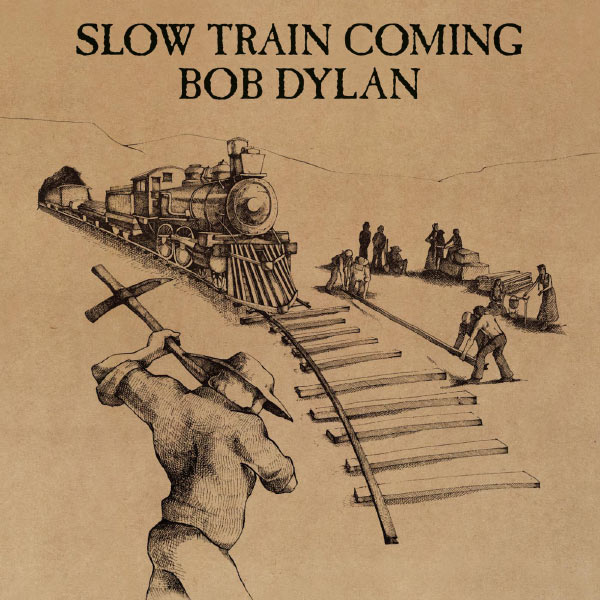
Description
Slow Train Coming is the first album in the gospel trilogy of the American singer and songwriter Bob Dylan, released on Columbia Records in August 1979. The album was recorded by Gregg Hamm assisted by David Yates at Muscle Shoals Sound Studios in Sheffield, Alabama; with Jerry Wexler and Barry Beckett producing. Arrangements by Harrison Calloway. All songs written by Bob Dylan.
Featuring Bob Dylan on guitar and vocals, backed by producer Barry Beckett on keyboards, Mark Knopfler on guitar, Tim Drummond on bass, and Pick Withers on drums, with Beckett and Mickey Buckins providing percussion. Horns by Muscle Shoals Horns. Background vocals provided by Carolyn Dennis, Helena Springs, and Regina Havis.
With noted rhythm and blues producers Jerry Wexler and Barry Beckett behind the desk, and two members of the British rock band Dire Straits in the session band (Knopfler and Withers), the album was a critical and commercial success, bringing Dylan his first Grammy Award as Best Male Vocalist for “Gotta Serve Somebody”, and as well winning the Gospel Music Association’s Dove Award in the category Best Gospel Album by a Secular Artist. The album went platinum in the US, where it reached No. 3, and peaked at No. 2 on the charts in the UK.
Slow Train Coming was included among CCM Magazine’s Top 10 Contemporary/Rock Albums of 1979 – The statement we all dreamed about took us by surprise this year when it came in the person and work of Bob Dylan, a changed man with a lot on his mind. Dylan laid it on the line with the fire of an old testament prophet in a landmark album that was also one of 1979’s best sellers.
The album track “Gotta Serve Somebody” won Bob Dylan a Grammy in the Best Rock Vocal Performance, Male category at the 22th Annual Grammy Awards. The album won Gospel Music Association’s Dove Award in the category Best Gospel Album by a Secular Artist at the 11th Annual Dove Awards, March 26, 1980.
Yes, it’s true. Singer and songwriter Bob Dylan is professing Jesus Christ as Lord. He is doing it quietly through his new album, ‘Slow Train Coming’. Like most of what he does publicly, he is keeping the message foremost, disdaining the subculture’s cult of conquered heroes and forsaking the notoriety of the born-again “club.” He remains true to the prophetic posture that has earned him the respect and attention of his peers in the popular music arena… He is able to see the sticky sweet personalization puffery of some segments of American Christianity: “Spiritual advisers and gurus to guide your every mood/ Instant inner peace in every step you take, got to be a prude…/ Do you ever wonder just what God requires?/ You think he’s just an errand boy to satisfy your wandering desires” is sung in the context of “Adulterers in churches, pornography in schools/ You got gangsters in power and lawbreakers makin’ rules/ When you gonna wake up? When you gonna wake up’?/ Strengthen the things that remain.” [Christianity Today, January 1980]
Slow Train Coming represents the first in a series of three albums that overtly expressed Dylan’s conversion to Christianity. Critics in general have not been particularly kind to this “phase” of Dylan’s career. While obviously not as ground breaking as his earlier classics like Bringing It All Back Home, Highway 61 Revisited and Blonde On Blonde, this album has stood the test of time as one of the finest artistic expressions of new-found faith. Of course even Dylan’s table scraps would have been haute cuisine for the lagging late-‘70s Jesus music subculture, where trite lyrics and bland music were all too common. Thankfully Slow Train Coming would have none of that. Lyrically Dylan ran the spectrum from bold proclamations like «Gotta Serve Somebody» to more personal introspective ballads like «I Believe In You» and «When He Returns», all the while maintaining song-writing that was accomplished, discerning and heartfelt. His barbed insights were still as pointed with conviction as ever («Slow Train», «When You Gonna Wake Up»), albeit guided by a new perspective («Gonna Change My Way Of Thinking»). The music was top-notch and professional as well. By this time r&b and soul were heavily influencing Dylan’s familiar rock/folk-rock palette. Credits include the Muscle Shoals Horns, female backing vocals and Dire Straits guitarist Mark Knopfler. A milestone recording that seemed to slip in unannounced and without fanfare into the whole CCM scene, then proceeded to blow it all away and set new standards for what could be accomplished. [Ken Scott, The Archivist, 4th edition]
Slow Train Coming (2007 Reissue)
It would be hard to overstate the anticipation which surrounded the release of ‘Slow Train Coming’ in 1979. Word had been leaking out that Dylan, a rock icon of the stature of Presley, Lennon or Hendrix, had become a Christian and was making a – gasp – gospel album! The big question was, would this mean a classic, spiritually-themed album from one of rock’s great poets or a collection of cheesy “Kum-by-ya” choruses? It’s probably debatable whether ‘Slow Train Coming’ really matches up to the glories of Dylan’s 1960s output. However, it remains a fine album and one of the highlights of his later career. Recorded at the famous Muscle Shoals Studio by Jerry Wexler and featuring a youthful Mark Knopfler on guitar, it presents nine classic rock tunes with an inevitable Dire Straits flavour. Dylan’s writing on the album displays his characteristic genius for finding the right words and turning an idea on its head – particularly on songs like «I Believe In You», «When You Gonna Wake Up» and the title track. «Man Gave Names To All The Animals» shows the enthusiastic naïveté of the new believer, while others are steeped in the End Times theology which was so prevalent in late 1970s California. No matter how one approaches this album it remains a compelling selection of tracks and, graced as it is with Knopfler’s inspired guitar, could also be ranked as one of the best albums that Dire Straits never made! [Trevor Raggatt, Cross Rhythms, June 2007]
> Apple Music (https://music.apple.com/us/album/slow-train-coming/181457864)
LP tracklist:
Side One
A1. “Gotta Serve Somebody” – 5:22
A2. “Precious Angel” – 6:27
A3. “I Believe in You” – 5:02
A4. “Slow Train” – 5:55
Side Two
B1. “Gonna Change My Way of Thinking” – 5:25
B2. “Do Right to Me Baby (Do Unto Others)” – 3:50
B3. “When You Gonna Wake Up” – 5:25
B4. “Man Gave Names to All the Animals” – 4:23
B5. “When He Returns” – 4:30
Note: Simultaneously released on 8-track tape, cassette, and 12-inch vinyl LP by Columbia Records. Later re-issued on CD.
Bob Dylan, Live at the Grammy Awards, 1980.
Bob Dylan, Live at Massey Hall, Toronto, Canada, April 20, 1980. Featuring Bob Dylan (vocals, guitar, piano), Fred Tackett (guitar), Spooner Oldham (keyboards), Terry Young (keyboards), Tim Drummond (bass), and Jim Keltner (drums). Background vocals by Clydie King, Gwen Evans, Mary Elizabeth Bridges, Regina Havis, and Mona Lisa Young.
It takes only one listening to realize that Slow Train Coming (Columbia Records) is the best album Bob Dylan has made since The Basement Tapes (recorded with the Band in 1967 but not released until 1975). The more I hear the new album – at least fifty times since early July – the more I feel that it’s one of the finest records Dylan has ever made. In time, it is possible that it might even be considered his greatest.
A broadly drawn historical perspective is the most valid way to consider Slow Train Coming, especially if it is important to understand the old-time religion and evangelism woven into these songs. Before anyone had even heard this album, the news that Dylan was doing a little Bible reading stirred up great winds of cynicism and distrust: a kind of controversy recalling the intensity of past debates about Dylan.
Bob Dylan has, at long last, come back into our lives and times, and it is with the most commercial LP he’s ever released. Slow Train Coming has been made with a care and attention to detail that Dylan never gave any of his earlier records. The decision to take such time and care comes from a deep artistic and personal re-evaluation. He wanted — and after so many weak efforts and near failures, perhaps felt he had no choice — a commercial success. He was also smart enough to see that this thrust might even be the only road left for his return to brilliance.
The musicians on this album are the best Dylan has worked with since Highway 61 Revisited (1965), Blonde on Blonde (1966) and The Basement Tapes (1967).
Bob Dylan once again has something urgent to sing. He’s back in the land of opportunity, fate and inexplicable twists. Slow Train Coming, built on an accumulation of reluctant and arduous changes, is the record that’s been a long time coming, with an awesome, sudden stroke of transcendent and cohesive vision. This is what makes it so overwhelming.
Dylan’s new songs are statements of strength and simplicity, and the lyrics again equal his early classics. The words are rich with the ambiguity of great art. Dylan has not self-consciously reached for the colorful imagery and language of Highway 61 Revisited, symbols that, as we look back, seem dated. Slow Train Coming’s lyrics are timeless, simple, yet rich in potential levels of meaning.
Dylan’s apocalyptic visions and Biblical symbolism are wholly consistent with the “protest” or “message” songs that are the historical foundation of his work. We also recognize the characters and the humor from earlier tunes: thieves, the rich and the poor. Instead of dwarfs, we have bankers. And, as always, landlords.
The album’s religious content is pervasive; but more than anything, Slow Train Coming comes directly from Dylan’s own traditions: songs of protest and patriotism; love songs — stories of romance, adoration and friendship.
Dylan’s longstanding philosophy is that personal and public conduct, standards and ethical behavior, cannot be allowed to be separated from each other. These are parables, more numerous and closely woven than ever before, assembled with the judgmental and righteous morality that has transfixed us on every great album and song Dylan has made.
Slow Train Coming is pure, true Dylan, probably the purest and truest Dylan ever. The religious symbolism is a logical progression of Dylan’s Manichaean vision of life and his pain-filled struggle with good and evil.
Musically, this is probably Dylan’s finest record, a rare coming together of inspiration, desire and talent that completely fuse strength, vision and art. [Excerpt from the Rolling Stone Magazine review by Jann S. Wenner, September 1979]


Reviews
There are no reviews yet.