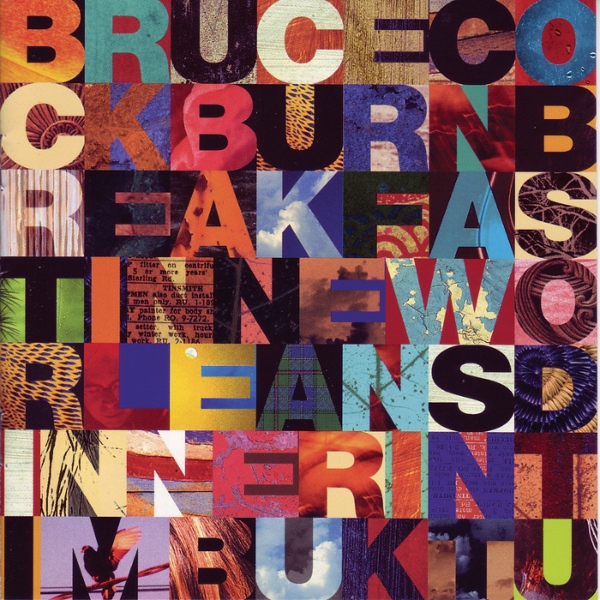
Description
Breakfast in New Orleans, Dinner in Timbuktu is the twentieth studio album by the Canadian singer, songwriter, and guitarist Bruce Cockburn, released on True North Records in September 1999. The album was recorded by John Whynot at various studios in Canada and the US – Reaction Studios, The Gas Station, and Pinhead Recorders in Toronto; as well as The Doghouse in Nashville, Tennessee – with Bruce Cockburn and Colin Linden producing. Mixed by Whynot at Sound City Studios in Los Angeles, California. All songs written by Bruce Cockburn, except the Lewis/Stock/Rose classic “Blueberry Hill”.
Breakfast in New Orleans, Dinner in Timbuktu emerged as something of a sequel to The Charity of Night. Both albums are really band records in a way that owes much to the T-Bone Burnett influence, the producer of Cockburn’s two first efforts of the ’90s, Nothing But A Burning Light and Dart to the Heart. While The Charity of Night did reflect a clining to fugitive bits of light in the dark, Breakfast in New Orleans is about healing.
Canadian singer/songwriter Bruce Cockburn has delighted music’s intellectuals with songs of insight and charity for three decades. In «Isn’t That What Friends Are For?», from his 25th album ‘Breakfast in New Orleans, Dinner in Timbuktu’, he describes his efforts. “I’ve been scraping little shavings off my ration of light,” he speaks/sings, “And I formed it into a ball…/ And I blow across it and I send it to you/ Against those moments when the darkness blows under your door.”
In a music soundscape abundantly populated by one-hit wonders, Cockburn is an anomaly. An articulate poet and storyteller, his retellings lift up the holy and beautiful moments in life from the rush of mundane time so that listeners can hold them long enough to learn their lessons. Graceful insights that risk honesty for the sake of the art, Cockburn’s work scratches beneath the skin of the human experience and finds “rumours of glory,” a phrase from his best early-era album, ‘Humans‘ (1980).
Musically, Cockburn reaches back to that era’s musicality: acoustic guitar over world beat rhythms set the tone, while jazz and the roots of blues and rock weave their way into his folky songs. Just as his lyrics maintain a vital, culturally-informed edge, Cockburn’s found a balance between the music of the past and his need to grow. Cockburn is joined on several tracks by Lucinda Williams, Margo Timmins (Cowboy Junkies) and Jonell Mosser (‘Boys on the Side’ soundtrack) on harmony vocals, giving the project still more texture.
Never overtly religious, Cockburn’s kind kind words and gentle and compassionate manner suggest that the faith journey continues toward the «Last Night of the World», where “the flame of hope among the hopeless” is “the biggest heartbreak of all.” [Brian Quincy Newcomb, CCM, January 2000]
The first track on Bruce Cockburn’s new album is perhaps a good place to find the clues as to what this Canadian singer songwriter’s career has been all about. There are lines of travelogue, as our hero enters the streets of what might be a foreign city (it usually is), there are the lines of social and political observation and the whole thing adds up to be being about this guy overwhelmed with the pace and clammer of the world around him and trying to find some sense. The last thing is that in the midst of all the poetic genius and lyrical provocation and illumination Cockburn is dying to make his contribution.
‘Breakfast…Dinner…’ is a very poetic piece with a couple of instrumentals and a cover version thrown in. So poetic indeed that many of the 8 original lyrics are spoken rather than sung though there is always a melodic chorus on which Cockburn is accompanied by female vocalists – Lucinda Williams and Margo Timmins (Cowboy Junkies). It does leave me thinking that when I am introducing friends to the wonders of this genius’s work that this will not be the album to start at. However, for those of us who are fans it is a perfect fulfilling of the potential that began with his return from the major label to his own independence on Charity Of Night.
That is not to say that the album is musically opaque. It is pleasantly bouyant stroll of a CD that has been influenced again by Cockburn’s interest in world music discovered on his varied travels. This is best evidenced in the contribution Daniel Janke’s kora playing. The kora is a 21 stringed African harp lute. Percussion is subtle but fascinating and of course Cockburn’s guitar playing is virtuoso. Indeed on the Rykodisc website Cockburn tells us that the introduction of the kora effected the music written especially the rather sexually explicit «Mango».
Cockburn’s poetic lyrics are well known and some of this album is as good as he’s ever been. «Isn’t That What Friends Are For» is a gem. As Bruce once sang ten years ago on «Don’t Feel Your Touch», “to be held in the hands of a friend is to be a king”. After the obligatory and brilliant word picture of forest in an autumn sky, Cockburn makes observations humanity’s seeming insignificance: “Towering blades of grass/ Glimpse only sometimes the amazing breadth of heaven”. His last verse is powerfully poignant making you wish that you had a friend like this. He shaves and rolls up the ration of light he has and blows it “against those moments when the darkness blows under your door”. Goose bumps!
Musical anoraks might see a couple of links to the last U2 album Pop. The Dublin band are friends of Cockburn and have confessed their admiration, quoting him in «God Part 2». Here their fellow faith pilgrim uses an almost identical song title «Last Night On Earth» and the chorus of the Pop version is “give it away” very similar to the opening track here. Cockburn’s song, titled «Last Night Of The World», he has explained is about refugees he met in Mexico whose dignity in their hopeless poverty makes our complaining a decadent obscenity. While introducing the song at Greenbelt he spoke of being on tour with Sam Phillips. One of the band carried a bag everywhere he went. When asked what it was for, he replied it was in case of the apocalypse at which point Phillips asked, what else you would need apart from two glasses and a bottle of champagne????!!!!!!!!!!
«Let The Bad Air Out» is a jaunty wee fun song about sin, as speedy as the album gets and is about ridding the world of all that is evil by just opening the window. «Use Me While You Can» is another work of detailed travelogue observation sitting around the idea of how small our time here is. Cockburn then offers that contribution that he always longs to make. He invites us to use him while he is around. And so we should. No other artist that I am aware of has ever met with such regularity the challenge that Woody Guthrie threw out; songs should not be just good but good for something.
And so we are back to where we started. Back to that opening song full of clues to this man’s entire catalogue. He talks about this faith he has and lets us know the truth that we all need to take out into our world. Faith is nothing if it remains in our hearts or our heads – “it only lives when you give it away”.
‘Breakfast…’ is Cockburn at the peak of his craft. Who else can play guitar this well and write poetry this good. No one, of that there is no doubt. After the early disappointment of the spoken nature of too many of the songs, I have now settled into the realization that that is the nature of this album. It is beautiful but a beauty that never distracts from the hard truth contained within. [Steve Stockman, Soul Surmise, 08/10/2007]
Promo, Double Vinyl Edition, 2021
Breakfast in New Orleans Dinner in Timbuktu is Bruce Cockburn’s 1999 album written to encourage his fans to look forward to the new century, while learning from the past. It contains a travelogue in the album’s lyrics, both to familiar places of home and family as well as social imperatives from visits to developing countries. Through it all is Cockburn’s reflections on the dynamics between men and women and spiritual mysticism. Musically the album features the vocals of three women who appear throughout the album. Jonell Mosser sings on two songs, including the hit single «Last Night of the World»; Margo Timmins of Cowboy Junkies on the sultry «Mango» and a cover of the Fats Domino nugget «Blueberry Hill», and most significantly for the album’s consistency, Lucinda Williams appears on four tracks. Her standout track is «Isn’t That What Friends Are For», a tender song of friendship is made more poignant by Williams’ ability to convey deep emotion. Twenty-two years after it’s original release, Breakfast in New Orleans Dinner in Timbuktu is finally available on vinyl. Originally part of the now sold-out limited-edition 50th Anniversary box set from 2020, this album is now available on it’s own, to complete Bruce Cockburn fans’ collections.
> Apple Music (https://music.apple.com/us/album/breakfast-in-new-orleans-dinner-in-timbuktu/298344502)
CD tracklist:
01. When You Give It Away – 4:53
02. Mango – 5:00
03. Last Night Of The World – 4:51
04. Isn’t That What Friends Are For? – 5:21
05. Down To The Delta – 6:16
06. The Embers Of Eden – 5:39
07. Blueberry Hill (Duet vocals by Margo Timmins) – 4:58
08. Let The Bad Air Out – 5:49
09. Look How Far – 5:34
10. Deep Lake – 6:49
11. Use Me While You Can – 7:12
Note: Simultaneously released on cassette and CD by True North Records. Re-issued on CD and 180g 12-inch vinyl double LP by True North Records in 2021. Available at Bandcamp: https://brucecockburn.bandcamp.com/album/breakfast-in-new-orleans-dinner-in-timbuktu
Reviews
There are no reviews yet.