Description
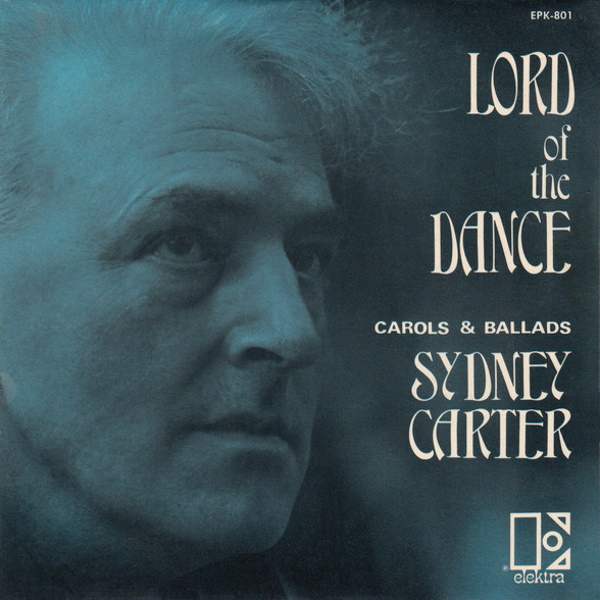
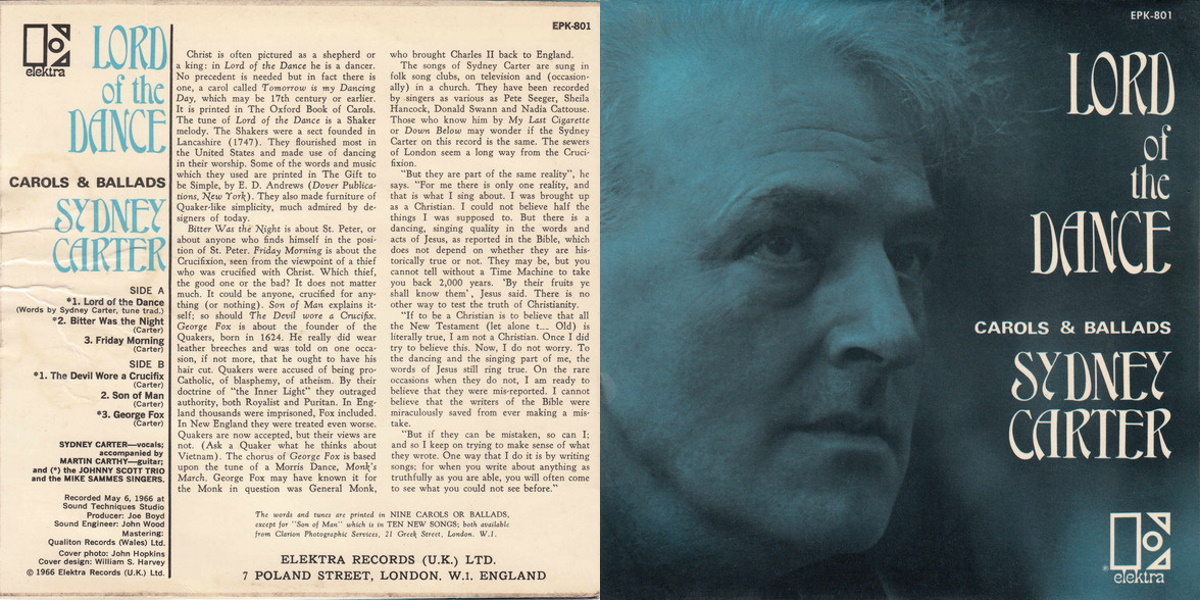
Lord of the Dance, sub-titled Carols & Ballads, is a six-track 7-inch 45 RPM vinyl EP by the English poet, songwriter, and folk musician Sydney Carter (May 6, 1915 – March 13, 2004), released in the UK on Elektra Records in 1966. The EP was recorded May 6, 1966, by John Wood at Sound Techniques Studio in London, England; with Joe Boyd producing. All songs written by Sydney Carter, except “Lord of the Dance” featuring lyrics by Carter set to a traditional Shaker tune.
Featuring Sydney Carter on vocals accompanied by Martin Carthy on guitar. (On tracks A1, A2, B1, and B3 as well featuring the Johnny Scott Trio and the Mike Sammes Singers.)
“Lord of the Dance” was composed by Sydney Carter in 1963. The tune is an adaptation of the Shaker tune “Simple Gifts”, but is accepted and acknowledged as a separate copyright in its own right. Sydney described it as a carol: “a dancing kind of song, the life of which is in the dance as much as in the verbal statement.” The song has been covered hundreds of times, from the 60s (e.g., by Robert Edwin on his 1966-album Keep the Rumor Going, by William Flanders on his 1968-album Love is a Verb, and by Peter Lewis on his 1969-album Sing Life, Sing Love) and on (e.g., by John Fischer on his 1985-album Between the Answers, and by Phil Keaggy on his 2002-album Hymnsongs, and by Jean Watson on her 2015-album Steady My Gaze).
7-inch EP tracklist:
Side One
A1. “Lord Of The Dance”
A2. “Bitter Was The Night”
A3. “Friday Morning”
Side Two
B1. “The Devil Wore A Crucifix”
B2. “Son Of Man”
B3. “George Fox”
Note on the back of the EP sleeve: “The words and tunes are printed in Nine Carols or Ballads, except for “Son of Man” which is in Ten Songs.”
Sydney Carter wrote…
“I see Christ as the incarnation of the piper who is calling us. He dances that shape and pattern which is at the heart of our reality. By Christ I mean not only Jesus; in other times and places, other planets, there may be other Lords of the Dance. But Jesus is the one I know of first and best. I sing of the dancing pattern in the life and words of Jesus.
Whether Jesus ever leaped in Galilee to the rhythm of a pipe or drum I do not know. We are told that David danced (and as an act of worship too), so it is not impossible. The fact that many Christians have regarded dancing as a bit ungodly (in a church, at any rate) does not mean that Jesus did.
The Shakers didn’t. This sect flourished in the United States in the nineteenth century, but the first Shakers came from Manchester in England, where they were sometimes called the “Shaking Quakers”. They hived off to America in 1774, under the leadership of Mother Anne. They established celibate communities – men at one end, women at the other; though they met for work and worship. Dancing, for them, was a spiritual activity. They also made furniture of a functional, lyrical simplicity. Even the cloaks and bonnets that the women wore were distinctly stylish, in a sober and forbidding way.
Their hymns were odd, but sometimes of great beauty: from one of these (Simple Gifts) I adapted this melody. I could have written another for the words of ‘Lord of the Dance’ (some people have), but this was so appropriate that it seemed a waste of time to do so. Also, I wanted to salute the Shakers.
Sometimes, for a change I sing the whole song in the present tense. ‘I dance in the morning when the world is begun…‘. It’s worth a try”.
[Excerpt from ‘Green Print for Song’, Stainer & Bell (1974)
and ‘Lord of the Dance and other Songs and Poems’, Stainer & Bell (2002)]

Reviews
There are no reviews yet.