Description
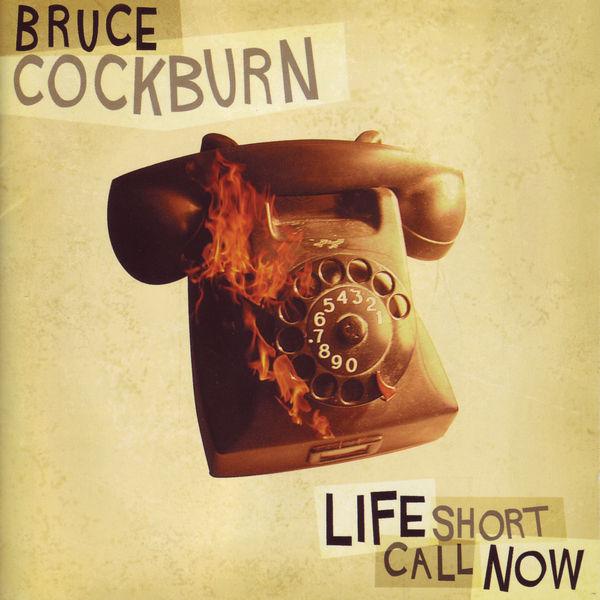
Life Short Call Now is the 22th studio album by Canadian singer-songwriter Bruce Cockburn, released on True North Records in July 2006. The album was recorded February 1-25, 2006, by Jeff McMurrich assisted by Walter Sobczak at National Treasures’ studio at Puck’s Farm in Schomberg, Ontario; with Jonathan Goldsmith producing. Mixed March 5-20, 2006, by McMurrich assisted by Greg Kolchinsky at Phase One Studios in Toronto, Canada. Orchestrated by Dan Parr. Strings arranged and conductor by Goldsmith. All songs written by Bruce Cockburn, except track 7 co-written with Julie Wolf, Ben Riley, and Steve Lucas.
Jon Goldsmith produced a bunch of Cockburn’s albums released in the 1980s. In the meantime, he did have a career writing orchestral film scores. As Cockburn knew he wanted strings on Life Short Call Now he got Goldsmith to produce this particular album. The album features a 27-piece string section as well as guest appearances by Ron Sexsmith, Ani Difranco and Hawksley Workman on backing vocals.
Bruce Cockburn displayed his aesthetic restlessness with his instrumental album Speechless in 2005. Those who have followed his career over the past four decades wondered where he would go next, or indeed if there was anywhere he could go. The question has been answered in spades on Life Short Call Now. Along with his regular band, Cockburn has employed an orchestral 27-piece string section to expressionistically color a good number of these 12 songs with help from producer Jon Goldsmith. Lyrically, Cockburn has returned to the terrain he alone inhabits: intimate observations of the personal, the spiritual, the sociopolitical and environmental concerns. As is also his wont, there are no sloganeering anthems in these songs. From the title track that opens the album, he looks across the Montreal landscape and observes it, not in a journalistic way, but as someone inside it, and asks poignantly; “Can one man fit in a normal life?” The solitary person in the midst of unions, holy and unholy, can find no way to properly say goodbye or welcome. Ani DiFranco sings backing vocals on «See You Tomorrow», where Cockburn turns the tables on himself as he observes a mercenary, and though he understands the man’s empty soul he envies his freedom from guilt to accomplish his task. Isolation in the midst of watching women walk mirrors the pain of sin and of loneliness for the beloved and seeks wholeness which he expresses that beyond “these chains of flesh” there is completion. The gentleness of his approach is also notable. Cockburn isn’t raging here, he’s expressing the hidden, the unseen, the unspeakable. Check the lovely, languid folk song «Mystery», where he embraces what is unknowable infinitely despite his fear and his hunger for it. A four-piece horn section adorns the mix on the outside, underscoring the questions in the grain of the singer’s voice. What happens as the record unfolds is the work of a poet who happens to be a brilliant musician, who has refined his craft not as an aesthete, but as a hands-dirtied participant not only in the process, but in its realization: check the gorgeous falsetto that croons above the swell of strings in «Beautiful Creatures». He asks straight up, from the gut: “When the skin is peeled off it/What is there to say?” And then says it: “The beautiful creatures are/going away…” In many ways, there is a tenderness here that Cockburn’s listeners haven’t encountered since Humans, where fear, desire, shock, awe and boundless love poured from his songs. And they do so here, too, tempered by a bloody but unbowed veteran of love, despair, spiritual hunger, desolation and the acknowledgement of community. Always a guitar to accompany that voice, always six strings whispering through the singer and carrying him through not only emotions, but scenes, places, times, encounters, to be able to speak clearly and directly, yet softly, with one exception: «This Is Baghdad». Here the observer battles the brokenness inside himself as he observes – Cockburn spent part of 2004 there – the mindless destruction for the sake of nothing whatsoever. The display of might by American troops under the guidance of a fearful leader is revealed for what it is: the display of power for its own sake, which is for the sake of nothing. The deep end of the string section hovers around his 12-string, and the hypnotic pulse of Gary Craig’s drums. There are three fine instrumentals here as well. «Peace March», is driven by that now-trademark fluid guitar kissed with a brushed snare, a tempered bassline which reveals the refined texture of a master painter. «Jerusalem Poker» with its handclapped percussion is a jazz tune with its syncopated guitar and muted flugelhorn. The album’s final cut, too, named for Marcel Duchamp’s infamous «Nude Descending a Staircase» is introduced by radio static, and then seamlessly flows into a guitar driven jazz tune with Cockburn playing a Byrdland and doing his best Wes Montgomery as strings shimmer and spiral down; a muted trumpet pushes down on the proceeding as more found sounds carry it – before the final cocking of what seems like a gun as silence abruptly drapes the entire proceeding. Life Short Call Now is absent of metonymy or metaphor; it reports from the inside what is, and what should never be with balance, as well as yearning for convergence. [Thom Jurek, AMG]
> Apple Music (https://music.apple.com/us/album/life-short-call-now/360951233)
CD tracklist:
01. Life Short Call Now – 5:32
02. See You Tomorrow – 4:20
03. Mystery – 5:50
04. Beautiful Creatures – 5:09
05. Peace March – 3:32
06. Slow Down Fast – 3:39
07. Tell The Universe – 5:14
08. This Is Bagdad – 6:21
09. Jerusalem Poker – 5:33
10. Different When It Comes To You – 2:50
11. To Fit In My Heart – 6:06
12. Nude Descending A Staircase – 4:23
Note: Available at Bandcamp: https://brucecockburn.bandcamp.com/album/life-short-call-now
“Different When It Comes To You” (MUSIC VIDEO)
Bruce Cockburn was built on a Friday, and there’s just no fixing him.
At least, that’s what he tells us in the song called «Mystery». And yet, he assures us, “I’ve done okay.”
Indeed, he has done okay. Twenty-nine albums and countless concerts under his belt, and there’s no sign that he’s anywhere near shelving those guitars. He may say that you can’t fix him, but that may be because nothing is broken. He’s still writing some of the most thoughtful lyrics in rock, and his guitar playing continues to dazzle. Unlike many of his contemporaries, he offers more than mere anger at the rapidly declining state of the world, more than mere sentiment for the sake of love. While his albums remain criminally overlooked, he’s pointing the way toward hope with songwriting that stokes the fires of conscience and spurs us into action… whether that manifests itself as political activism or shows of love for our friends and family.
Life Short Call Now is his strongest collection since his 1997 masterpiece The Charity of Night. It’s a colorful, thoughtful, heartbroken expression, fraught with nightmares but fueled by faith. While there are dark and dire passages on this album, the light of love and hope shines brightly and the darkness cannot overcome it.
Still, the darkness does get a fair amount of air time. Lamenting “the callous and vicious things humans display, ” the singer confesses to feeling “the weight of hard feelings” on his conscience. This time, solemn orchestral strains swell all around his guitar like the waves of the dark sea that washed over Sting’s The Soul Cages.
Yes, there are plenty of brooding generalizations: “We create what destroys / bind ourselves to betray.” But there are also piercing specifics. In «Tell the Universe», he delivers a resentful admonition to those who seem eager and empowered to rush us into the apocalypse. (Do I have to name names?) “All those lives not worth a second look,” he mourns, “Tell the universe what you took.”
And then, as if worried that he wasn’t specific enough, he moves into «This is Baghdad», describing the fear of American soldiers, the suffering of those in the bombed-out city, and the hopeless state of chaos.
But these troubled visions come in the middle of the album, after many flourishes of humor and affirmations of hope. The opening notes of the album are characteristic Cockburn – an easygoing riff that sounds like something from Dart to the Heart, and Cockburn describes our culture of fast-access and instant gratification. But then he’s affirming himself, with “no lover, no wife,” asking “Can one man fit in a nomad life?” While he may refuse to pull over for the freeway’s empty promises of satisfaction, he arrives at the conclusion that only a personal connection can bring lasting fulfillment. When he hears the bed “banging on the wall” of the next room, it prompts a confession: “You’ve no idea how I long / For even one loving caress….”
«Slow Down Fast» is a cocky, spirited rant in the vein of «It’s the End of the World As We Know It (And I Feel Fine)». It’s certainly timely, and it gives him opportunity for some inspired guitar fills, but it reminds me more of Billy Joel’s «We Didn’t Start the Fire» than anything, and that’s not a good thing.
«Peace March», on the other hand, lets the music do the talking. It’s a sprightly, confident guitar performance, focused on his nimble fingering – a noble contribution to his large body of instrumentals. Some may find this, and a few other tracks, annoyingly similar to previous recordings, but I find them comforting excursions into playfulness, music for the joy of it. It brings some levity to an album that might otherwise lean toward self-importance.
The album’s lightest moments come during its simplest song, «Mystery» stands as the album’s most memorable and endearing track – a sing-a-long with humorous and thoughtful moments that make us think about how glory is shining through and whispering rumors of glory. Ron Sexsmith contributes hearty backup vocals, agreeing that “Infinity always gives me vertigo / Vertigo / Vertigo … and fills me up with grace.”
In «Beautiful Creatures», he laments the way we have spoiled the earth. We were ordered to subdue, but also to replenish, right? In a mournful falsetto, he sings, “The beautiful creatures are going away.”
It’s as if Cockburn has reached the vantage point described by Bob Dylan in Oh Mercy, where he looked around and declared that “Everything is Broken.” On that same album, Dylan took note of political corruption and the rapidly declining order of the world, but brought it all back home, observing his own culpability in the brokenness. As creation groaned for redemption, so, humbly, did he.
Like Dylan, Cockburn is seeking solace in human relationships, but ultimately he’s following Dylan even farther, looking beyond the human sphere. He seems eager for the day he’ll be drawn out of this weary, battle-scarred flesh and into something new and redeemed. «See You Tomorrow» rides along on an irresistible railroad-rhythm riff as Cockburn describes a day when a mercenary asked him for help. “I have to say, I liked the thought / Of living that guilt-free.” The line reveals his weariness with the accumulation of sins, his own and others. But the refrain is ultimately one of hope in eternity. “The pain on the horizon / can’t sink me in sorrow / ‘Cause I know I’m going to be / Seeing you tomorrow.”
And yet, I can’t help but lift the needle and carry it back to «Mystery», an affirmation of all that is glorious about this life. I want one more run through that soulfully sweet refrain, for that music that sounds as if the piano were recorded a hundred years ago and the guitars played just this moment. Ahh… there we go, the reminder that I need:
“This feast of beauty can intoxicate / Just like the finest wine,” he tells us. “So all you stumblers who believe love rules / Stand up and let it shine.”
It’s a line so good, it’s worth singing again. And he does. And so do I. And so will you. [Jeffrey Overstreet, Looking Closer, 2006]
Reviews
There are no reviews yet.