Description
Mosaics is the eighth studio album by the American singer and songwriter Mark Heard, released on Home Sweet Home Records in March 1985. The album was produced, recorded, and mixed between August 1983 and August 1984 by Mark Heard at Fingerprint Recorders in Los Angeles, California. (Fingerprint Recorders was Heard’s own remote recording studio, which in a previous iteration had been a well-worn Ford box truck.) Though actually recorded before Heard’s 1984 effort Ashes and Light, the release of Mosaics was delayed on the request of the record company who wanted the less rock-oriented Ashes and Light released first.
It is a decidedly rock album (more so than any up to this point) featuring eight new songs written by Mark Heard, as well as “Miracle” co-written with Tonio K. and a cover of “The Power of Love”, a song written by another good friend, T-Bone Burnett, originally released on Burnett’s 1980 solo debut album, Truth Decay. Mosaics is considered Mark Heard’s most focused work of social criticism, and was his final studio album for Home Sweet Home Records.
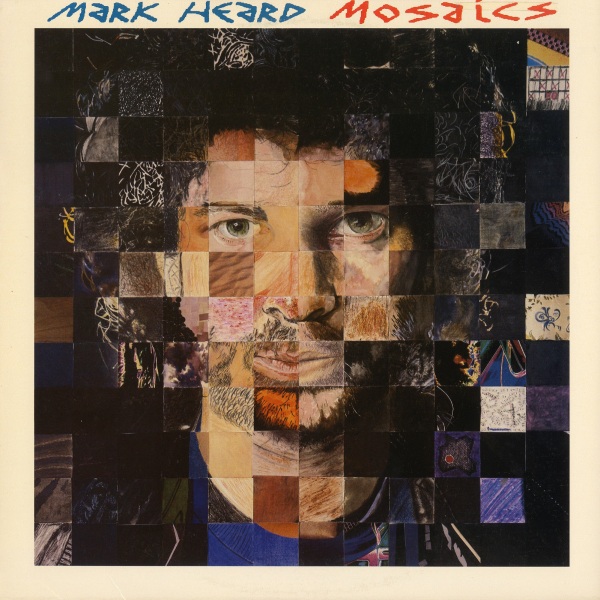
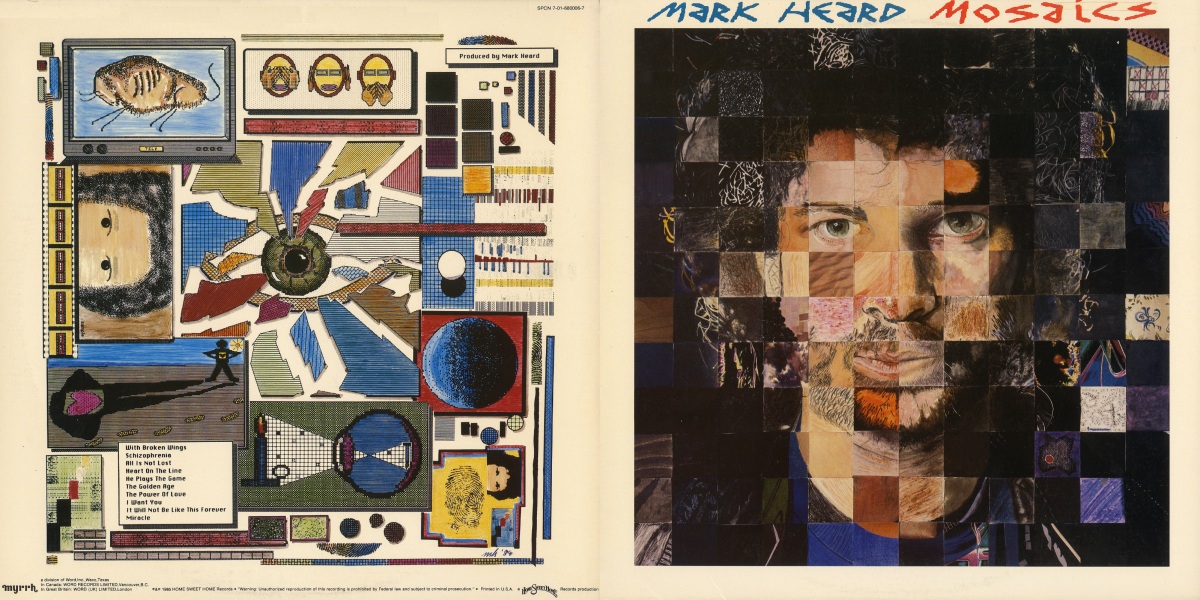
The album front cover is made up of tiny fragments of an image of Mark Heard – each “mosaic” piece painted by a variety of fellow musicians and friends which added up to a composite picture of Heard. (Mark had a photograph of himself taken and cut it up into little squares, then sent those to friends and associates and asked them to draw or paint, in their own hand, a copy of what he’d sent.) Among the “painters” you’ll find artists like Bill Batstone (of Good News fame), T-Bone Burnett (of the Alpha Band fame), Tim Chandler (of Daniel Amos and The Choir), Dave de Coup-Crank, David Edwards, Jerry Houser, Tom Howard, Tonio K, producer Barry Miller Kaye, Ed McTaggart (of Daniel Amos), John Mehler (of Love Song fame), Leslie Phillips (a.k.a. Sam Phillips), Randy Stonehill, Terry Scott Taylor (of Daniel Amos), Pat Terry, and Ray Ware (of Street Level Artists Agency).
Do you have another Mark Heard album in the works at this point?
Last December I put the finishing touches on another rock ‘n roll album. Unfortunately, it has been delayed in its release because Ashes and Light got scheduled first. I feel bad about this as it has been two years since my last rock ‘n roll album came out (Victims of the Age). So I apologize to my rock ‘n roll friends, and ask their patience – I’ve been assured by the company that the album will come out within three months of the release of Ashes and Light. I’m quite pleased with the rock ‘n roll album – topically it is a delving into the simultaneous appreciation of both the horror and the joy of living in this world as created and fallen and restored beings. Some of the song titles are, «With Broken Wings», «Schizophrenia», «All Is Not Lost», and «The Golden Age». It is pretty sparse, with very live drum sounds – John Mehler played again on that one – we did the tracks at his house with the mobile unit. [Excerpt from the liner notes of Ashes and Light]
I prefer to see myself as a writer who is a Christian and I prefer to let my faith flavour my observations rather than dictate them. I prefer my pen to act as a nerve recepter and write about the world – the real one – that exists outside society’s and Christian society’s simplistic, plastic, media-fed notions of what life is and what is most important. [Mark Heard, Strait Magazine, 1985]
Mark Heard’s eighth album, released early this year, is a gem worth going back for. After three releases – the custom ‘On Turning To Dust‘ (’75), the Larry Norman produced ‘Appalachian Melody‘ (’79), and an album recorded in Europe, ‘Fingerprint‘ (’80), available only as an import – Heard grabbed critical attention with two strong rockin’ LP’s ‘Stop The Dominoes‘ and ‘Victims Of The Age‘. These records brought together Heard’s musical influences, The Byrds, Bob Dylan, James Taylor and the early Stones, with a clear lyrical vision and poetic sensibilities.
Two acoustic releases followed; ‘Eye Of The Storm‘ and ‘Ashes And Light‘. Although Heard has labeled his album in promotions as “acoustic” or “rock ‘n roll,” in actuality his work has begun to take a distinct feel that is unique to himself and not easily categorized. Heard has consistantly offered a prophetically sensitive vision in fresh, incisive lyrical images, often touched by his own grapplings with life’s difficulties, a dash of cynical humor, just the right touch of irony, and an acute awareness of poetic justice. This is nowhere more apparent than on ‘Mosaics’.
The cover of this pinnacle in Heard’s work features the artist’s face broken into squares, an actual mosaic with each square individually rendered by fifty of his closest friends. The cover speaks volumes. We see brokenness, yet there is continuity. It is one face, but it is the work of many hands. It is one image, yet is perceived in so many different ways. Throughout ‘Mosaics’ we hear the honest contemplations of one who knows we must look at all of life.
“The tears still fall/ The birds still sing/ And life is bittersweet/ With a schizophrenic ring/ The sun still shines/ The darkness still falls/ We must see both/ If we see them at all,” sings Heard in «Schizophrenia». Here and in «With Broken Wings», «The Golden Age» and «All Is Not Lost» he looks at the two opposing faces of life. The frailty and brokenness of the human spirit on the one hand, the beauty and promise of humanity in God’s creation on the other. The cry of absence, the pride and depravity comes out in the attitudes of «Plays The Game», yet the potential for grace and healing shines through when we put our «Heart On The Line».
Throughout the first part of the record Heard appears to look at all of life’s perplexity, catching glimpses of pure light that shine only in dark corridors. If it seems that Heard would be gloomy at a celebration, beginning with his rendition of T-Bone Burnett’s classic «The Power Of Love» we see also that he has hope against the darkness of night. Staggered by the mystery, personality, power and grace of God, Heard sings “I want you to share this weight and understand . . . to help me through the shades of gray/ And I want you and your love in my veins.”
There may be pain in experience and dark clouds on the horizon, but «It Will Not Be Like This Forever». When Heard concludes that life is a «Miracle», rich in beauty and wonder, it is not the naive and unrealistic praise characteristic of many Christian efforts; rather it is the voice of one crying out from the depth of life experience.
Many have missed or overlooked Mark Heard’s music because it does not promise easy answers and fast resolutions. Like the models in Scripture, Heard gets his hands dirty, giving definition and form to the ideas of Christian expression and integrity. [Johnny R. Cleric, Harvest Rock Syndicate, Vol. 1 Issue 1, Winter 1985]
Mosaics finds Mark Heard in a middle ground between some of his earlier hard rock inclinations and the acoustic rock of, say, Eye of the Storm. That means acoustic 6- and 12-string guitars overlay heavier electric guitars, synthesizers, and crashing drums.
Lyrically, Heard is almost impossible to fault. His words are passionate, angry, incisive, probing, restless, and sometimes soothing. Even when he gets carried away, you forgive him (witness these lines from «The Golden Age»: “Jet-set etiquette consciousness, Monosyllabic goodbyes / …The Golden Age, Electric Neanderthals / The Golden Age, with digital morality”), because he’s really and truly trying to convey something worth saying.
Musically, there’s a price to pay, sometimes, by playing most of the instruments, writing most of the songs, and producing the whole shooting match. «With Broken Wings», «Schizophrenia», «All Is Not Lost», and «I Want You», for instance, sound too much alike. When Heard does vary the attack, it makes good songs like «Heart on the Line» and «It Will Not Be Like This Forever» sounds better.
Where it all comes together in one hopeful, melodic, epic masterpiece is T-Bone Burnett’s «The Power of Love». It’s got commercial hooks, it’s got a heavy message, and it’s one of the highlights of a career that’s really only just begun. On songs like these, the pieces of the mosaics come together for artist, critic, and audience alike. [Bob Darden, CCM, October 1985]
The latest offering from Mark Heard is charged with energy, both musical and lyrical. The title, Mosaics, suggests scattered images carefully placed together to form a coherent portrait. Perhaps this definition best describes Mark Heard’s new record. As an artist, Heard has always been the sort who can describe the world around him in a mosaic-like fashion, snatching little “squares” of the human condition as he sees it and “pasting” these onto his “canvas” – the stereo recording.
While Heard’s last effort, Ashes and Light, was rather “dark” in its tone, the upbeat sound of Mosaics leaves this reviewer’s toes tapping long after the disc has stopped spinning. As I said, there is a great deal of energy here. One could cite the influences to include The Beatles, The Byrds, Bob Dylan, and maybe a dash of Bruce Springsteen. But while comparisons can be helpful, find it repugnant to sum up Mr. Heard’s talents by simple saying, “He sounds like so-and so.” Like any good artist, Heard goes beyond a mere sound-alike, blending the “squares of sound” into a beautiful “mosaic” – a rock-and-roll work of art.
Take the opening cut for example. «With Broken Wings» leaps right at us, with barely an opening riff of introduction. One could compare this tune to the Beatles’ «Nowhere Man» from many years past, and for good reason. The song deftly cuts into the heart of the listener, exposing the “nowhereness” of our fallen state. The imagery here is cleverly drawn from the Icarus story: “With broken wings we beat the air/ And as we plummet we pretend that we don’t care.” «Broken Wings» is followed by another snappy selection, «Schizophrenia», which is reminiscent of the jangly guitar sound of The Byrds, and deals with the difficult issue of our divided nature: “We see the expression/ Of the original face/ And the mask that hides it/ We’re a schizophrenic race.” While Mosaics largely deals with the frustrations of the a fallen world we live in, there are certainly songs which point to God’s love, most notably, Heard’s cover of an old T. Bone Burnett title, «The Power of Love». A noble rendition, to be sure. (See T. Bone’s Truth Decay for the original).
This work marks an impressive performance by Mark Heard. It’s hard to choose a favorite cut, for each individual selection contributes equally to the brilliance of the whole recording. Those who have missed the rock-and-roll spunk of Stop the Dominoes and Victims of the Age will not be disappointed with Mosaics. A delightful album. [Christopher Dale, Vortexx magazine, Issue 5, June-July 1985]
> Apple Music (https://music.apple.com/us/album/mosaics/266531587)
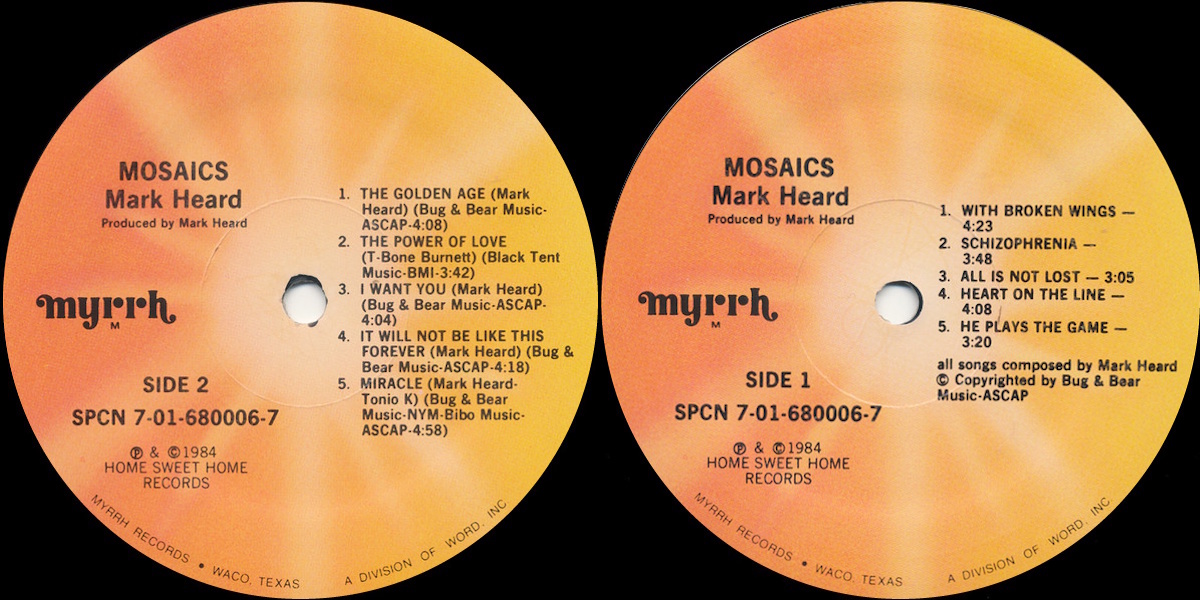
LP tracklist:
Side One
A1. “With Broken Wings” – 4:23
A2. “Schizophrenia” – 3:48
A3. “All Is Not Lost” – 3:05
A4. “Heart On The Line” – 4:08
A5. “He Plays The Game” – 3:20
Side Two
B1. “The Golden Age” – 4:08
B2. “The Power Of Love” – 3:42
B3. “I Want You” – 4:04
B4. “It Will Not Be Like This Forever” – 4:18
B5. “Miracle” – 4:58
Note: Simultaneously released on cassette and 12-inch vinyl LP by Home Sweet Home Records. Later re-issued on CD by Home Sweet Home. The compilation CD Millennium Archives released by Home Sweet Home in 2000 features an old interview with Mark Heard on his album Mosaics, including audio excerpts from that album.
In the 1980s Mark Heard’s songwriting moved beyond mere observation of the consequences of certain societal beliefs and cultural values to a critique of the beliefs and values themselves: a connection between the prevailing worldview that shapes our society and the outcome of accepting such a worldview. In some sense, Mark was exploring through the artistic imagery of songs what Francis Schaeffer was writing about more philosophically in his books: a form of presuppositional apologetics. In short, he asked “Why?” What was the thinking that lay behind what he was seeing?
The entire ‘Mosaics’ album deals fundamentally with our humanness in a way reflective of the American theologian and philosopher Francis Schaeffer’s book ‘Back to Freedom and Dignity’ (1972) – which itself addresses materialist and Darwinian presuppositions by way of a response to B. F. Skinner’s ‘Beyond Freedom and Dignity’ (1971). A central theme running through all of ‘Mosaics’ is the importance of being created in God’s image: not only the inherent worth of human life (“Life is a miracle/ Formed from the chaos/ And loved like a blameless child/ …We breathe every breath/ By the grace of God”), but also the reality and significance of human choice (“The choices we make will be heard til the end of time”). In particular, the album addresses the popular materialist worldview that man is just a machine and that all our actions are predetermined by genetic, chemical, and biological conditions (“They say this is the Golden Age/ In which both virtue and flaw/ And the entire human element/ Are effects of the quantum laws”).
Through these songs, Mark points out not only that these materialist beliefs are false (“And though molecular/ We’re so much more than pure machine/ Though we forgot our origins”), but that they have disastrous consequences. The album is full of vivid imagery of what happens to a society, civilization, age, or culture which, as a whole, rejects the notions of human worth (“We watch life destroyed as if it were meaningless/ Some unborn child – no mother cries/ Some unknown soldier – destroyed by lies”), or rejects the belief in human freedom (“The surface of this sphere/ Becomes a playground for the fools/ Who twist their words like tools/ Jet-set etiquette consciousness/ Monosyllabic goodbyes/ No one cares about no one else/ We’re so used to the capital “I””).
In short, Mark Heard saw not only the obvious effects of our cultural values, but he also understood the philosophical presuppositions behind them, and he related the two.
[Excerpt from the biography ‘Hammers & Nails: The Life and Music of Mark Heard’ by Matthew Dickerson, Cornerstone Press Chicago, 2003]
CREDITS. Produced and Arranged by Mark Heard. Engineered and Mixed by Mark Heard at Fingerprint Recorders, Los Angeles, August 1983 – August 1984. Punch-in’s by: Janet Heard, Dave de Coup Crank, Nick van Maarth, Tim Alderson. Front Cover concept by Tim Alderson. Cover design and computer art by Mark Heard. Photographs by Stewart Ivester. All songs written by Mark Heard except “Miracle” co-written with Tonio K, and “Power Of Love” written by T-Bone Burnett.
Musicians: Mark Heard (Electric 6 and 12 string guitars, Acoustic guitars, leadguitar (except as noted), Bass, vocals, and assorted sounds), Buddy Rufus Greene (Harmonica on “All is Not Lost” and “The Golden Age”), Tom Howard (Synth on “Golden Age”, “Schizo”, “All is Not Lost”), Barry Kaye (Organ on “Forever”), David Mansfield (Lead guitar on “Heart”, “Schizo”, “I Want You”, “Forever”), Bill Batstone (Bass on “Forever”, general hanging out), John Mehler (Drums), David McSparran (Simmons Drums on “Power of Love” and “Miracle”), Harry Stinson (Percussion and Simmons drums). Background vocals by Mark Heard and Leslie Phillips, except: “Schizophrenia” – Mark Heard and Dave de Coup-Crank; “Miracle” – Mark Heard and Dori Howard.
Reviews
There are no reviews yet.