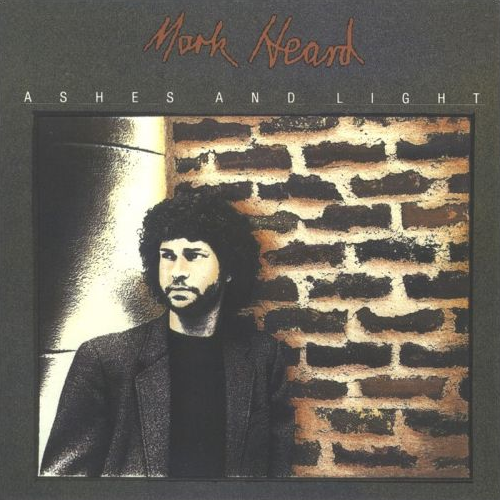
Description
Ashes and Light is the seventh studio album by the American singer and songwriter Mark Heard, released on Home Sweet Home Records in September 1984, distributed by Myrrh Records, a division of Word. The album was produced, recorded, and mixed during April-May 1984 by Mark Heard at his studio Fingerprint Recorders in Montrose, California. All songs written by Heard except “Threw It Away” co-written with a long-time friend, singer-songwriter Pat Terry.
Eager to return to rock’n’roll after the acoustic Eye of the Storm, Heard wrote and recorded the Mosaics album. But his label asked him for another acoustic record first, in hopes of capitalizing on the (relative) success of Eye of the Storm. In five weeks, Heard wrote, recorded, and mixed Ashes and Light, working in his new mobile studio, Fingerprint Recorders. The ashes – some of his most incisive, acerbic writing to date (“Threw It Away”, “We Believe So Well”, “Straw Men”) – were mitigated by the occasional hopeful ray of light (“I Know What It’s Like to Be Loved”, “In Spite of Himself”, “Washed to the Sea”). With the support of musicians like David Mansfield of Alpha Band fame, Tom Howard, Harry Stinson, Carl Pickhardt, David Raven, Billy Batstone, as well as his old pal Pat Terry, Mark Heard created a brilliant album, and a sure classic among fans.
For seven albums now, Mark Heard has been tracking the failings and foibles of the human condition. In his latest acoustic effort, Ashes and Light, the musical poet further examines the bruised, calloused, or questioning hearts of normal, 1980s people. There’s so much substance packed into Heard’s songs that it’s difficult to give them justice in a brief review. For starters, the personal nature of Heard’s lyrics is hightened by the fact that he produces his own albums, tracking the tunes at his home studio, Fingerprint Recorders.
Ashes and Light opens with «The Winds of Time», a jangling juxtaposition of mid-’60s, Byrds-like licks with ’80s production values. Over this bedrock, Heard reminds us that “It takes a saturated soul/ To withstand the winds of time”. «True Confessions» displays Heard’s tendency to write and perform in styles quite similar to a variety of other well-known artists, while maintaining his own musical identity. Here, he sounds like T-Bone Burnett doing Bob Dylan. But it perfectly suits the lyric, “our virtue lies worthless as rumour”.
A country arrangement highlights the melancholy message of «I Know What It’s Like to Be Loved». As Christians, we do know true love, yet we often accept an imitation. «Washed to the Sea» speaks of pain and how time will heal all suffering, though that resolution is seldom seen. Heard harkens back to Rhymin’-era Paul Simon on the ballad «We Believe So Well». Beware the stinging indictment couched in its gentle melody: “Don’t we take exclusive pride / That we abide so far from hell”.
Heard’s intellect sometimes gets the better of him (and us), as on side two’s opener, «Straw Men». Boasting one of the album’s strongest hooks, the song is weakened by lyrics such as, “It’s this pious anhedonia that he loves so well”. (I confess, I had to look up the meaning of anhedonia). «Straw Men» is an otherwise excellent observation on the way we tend to pass judgment without basis.
More of life’s downtrodden characters inhabit the next pair of songs. In «Can’t See Light» Heard sings of “Billy [who] walks around with a callous on his brain”, and in «Age of the Broken Heart» he sings of an unnamed “she” who’s “fought a war with her callousness/ And her callousness won”. A line from «Age of the Broken Heart» poses a rhetorical question for both songs: “What is the crime in crying out to God?” Yet in «Can’t See Light» Billy prefers not to deal with that question, because of the responsibility – and pain – that knowing the truth carries.
«Threw It Away», a wonderful blues update of the Garden of Eden story, could apply to anyone at any time. The lyric “[they had] feet of clay and an inner light” illustrates perfectly the walking contradiction we create. The album closes with «In Spite of Himself», an acoustic piece most reminiscent of «Eye of the Storm», containing encouragement for those who feel maligned and misused by friends.
The characters that populate Heard’s lyrical landscapes never seem to have a good time, but that’s not really a criticism. There is more to life than good times and self-pleasure, and we need writers like Heard to remind us of that. If we overlook Heard’s occasional wordiness, we detect notes of optimism permeating even his darkest lyrics.
An extension of the acoustic mood of Eye of the Storm, Ashes and Light does not signal a new folk direction for Heard. Ashes… boasts a strong backbeat and rhythmic base with elements of blues, as well as Heard’s distinctive country twist. You probably won’t be humming any of Ashes and Light’s melodies after one or two hearings, but it’s still a very enriching album. [Bruce Brown, CCM, October 1984]
> Apple Music (https://music.apple.com/gb/album/ashes-and-light/4261387)
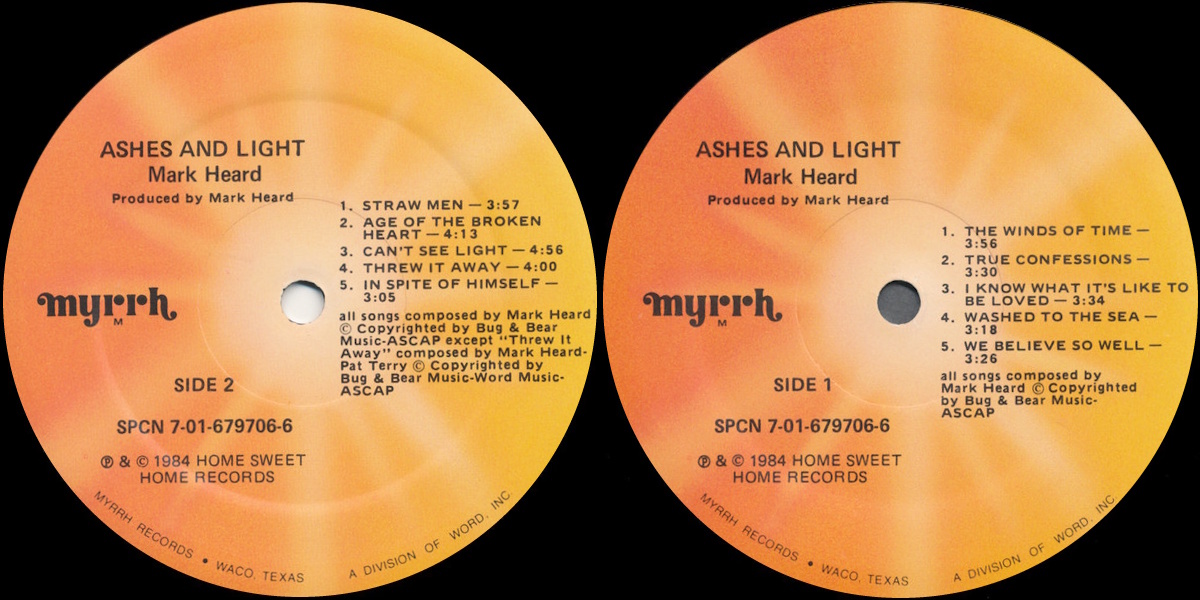
LP tracklist:
Side One
A1. “The Winds Of Time” – 3:56
A2. “True Confessions” – 3:30
A3. “I Know What It’s Like To Be Loved” – 3:34
A4. “Washed To The Sea” – 3:18
A5. “We Believe So Well” – 3:26
Side Two
B1. “Straw Men” – 3:57
B2. “Age Of The Broken Heart” – 4:13
B3. “Can’t See Light” – 4:56
B4. “Threw It Away” – 4:00
B5. “In Spite Of Himself” – 3:05
Note: Simultaneously released on cassette and 12-inch vinyl LP by Home Sweet Home Records. Later re-issued on CD by Home Sweet Home.

 Mark Heard working at Fingerprint Recorders, his studio in LA.
In terms of lyrical approach, where have you gone with Ashes and Light?
Really the songs on this album are tangential to the songs on the upcoming rock ‘n roll album. They primarily express the smell of life as a being on this planet from a Christian perspective, an interpretive synopsis of the phenomena which beset human beings in this culture at this time. «Washed To The Sea» speaks about pain and its realness, but also of its resolve, though that resolve often cannot be seen. «The Winds Of Time» observes that blind trudging optimism, even when based on a Christian framework, will not be sufficient mass to carry one through the independently unsuspected nuances life throws our way. It is not enough in this culture simply to rely on the fact that one knows the answers, even though the answers are true. Our culture does not encourage conscientiousness across the board of experience, and the Christian subculture extends this lack of thought one step further by assuming any person who makes a profession of faith is totally equipped to deal with life, and communicate the essence of truth to others with no regard for the application of the thought form to the culture as it exists, or for acquiring wisdom through experience rather than by proxy.
«True Confessions» is a parallel to «With Broken Wings». «Can’t See Light» is both an indictment of the maxim that ignorance is bliss, and an empathetic understanding of the allure of that maxim because of the pain which opening one’s eyes to the truth often brings. There’s much more involved in the character’s psyche than a simple hiding from the truth – reality is not as cut and dried as we might wish, and we would do well to look at it’s complexity and seek to understand the way environmental, cultural and psychological factors play into the total picture. The simplicity inherent in Christian truth must be applied to that complexity before it can do any good. «Straw Men» is an observation on the value judgments we make on others without sufficient basis. Our society likes to lump things together into generic categories – news is lumped into headlines, processes are lumped into 1-2-3’s. Caricaturing generalities and then matching our perceptions of other human beings to those caricatures, thus defining them, is not the same as understanding.
Someone might know my music, so he thinks he knows me, but he doesn’t. Someone else might not like my songs because they don’t fit his pre-defined categories of what songs by Christians should be like, and if he interpolates that lack of caricature – matching into a judgment about me, he would be wrong. There’s a danger that I might do the same thing to somebody else – so we all have to be careful not to let our conditioned perceptions control our ability to defer value judgments for which we do not have any true basis. That’s a big, big problem in society and within the Christian subculture because of the illusion of instantaneous and true information encapsulated in what are actually only blurbs representing the caricature of the subject from the culture’s pre-defined point of view. [Excerpt from the liner notes of Ashes and Light]
CREDITS. Written, Produced and Arranged by Mark Heard. Engineered and mixed by Mark Heard at Fingerprint Recorders, Montrose, California, April-May, 1984. Assistant Engineer on basic tracks: Dan Reed. Punch-in’s by Mylo Carter, Janet Heard, Pat Terry, Tim Alderson, and Dave de Coup-Crank. Cover Photography and Artwork by Stewart Ivester. Art Director by Tim Alderson. Cover concept by Stewart Ivester and Mark Heard. All songs written by Mark Heard except track B4 co-written with Pat Terry.
Thanks: Tim Alderson for all the late hours and hard work, Pat Terry for friendship deserving of some type of medal or something, Mylo Carter for not getting bored doing punch-in’s in his sleep, Cheryl and Tom for the encouragement and support. Love to John and Jean Heard and much appreciation for their involvement in Fingerprint Recorders; to Susan Heard, to Gian and Prisca and the others in Canton Vaud; to Pat and Pam and Flippy the Fishhead; to the Circle of Cynics, as well as Dave and the Skeptic Tank; to Bill and John; to Chompie’s Grotto; to Tom and Dori; to Dave and Christie, and of course, to Sue.
This album is dedicated to the memory of Francis A. Schaeffer, whose love for truth and whose understanding of the arts has helped me more thanI can say, in my desire to interweave the two.
Musicians: Mark Heard (Vocals, Acoustic guitars, Electric 6 and 12 string Guitars, Slideguitars, Synth on track A2, Bass on track A4 and B4, Harmonica, Accordian), Carl Pickhardt (Hammond Organ), Tom Howard (Synth on tracks – A3, A5, and B3), Pat Terry (Electric Guitar on track A4, Acoustic Guitar on track B4, Synth on tracks – A5, B1, and B5; general comraderie and comic relief), David Mansfield (Fiddle, Dobro, Lead Guitar on track B2), Bill Batstone (Bass), Dave McSparran (Drums), Harry Stinson (Percussion). Background Vocals by Mark Heard, Dave de Coup-Crank and Dori Howard.
Reviews
There are no reviews yet.