Description
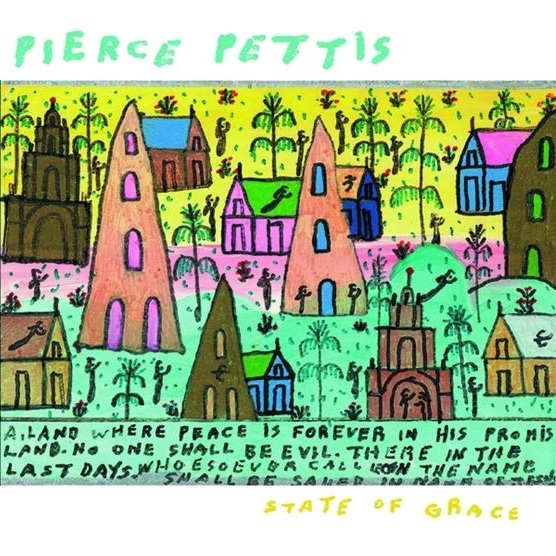
State of Grace is the seventh studio album the American singer, songwriter, and guitarist Pierce Pettis, released on Compass Records in July 2001. The album was produced by Garry West (who co-founded Compass Records with his wife Alison Brown in 1995). The album was recorded at the Sound Emporium in Nashville, Tennessee; the same studio that T-Bone Burnett used for the O Brother soundtrack album. The CD features a painting by Rev. Howard Finster. (Finster probably is best known for the album covers he made for R.E.M.’s Reckoning and Talking Heads’ Little Creatures, the latter subsequently selected as “Album Cover of the Year” by Rolling Stone Magazine.)
“I’ve Got a Hope” was later covered by Carolyn Arends on her album Pollyanna’s Attic released on 2B Records in 2006.
Success projects like the ‘O Brother, Where Art Thou?‘ soundtrack suggest that folk music is a safe place in today’s popular culture to express gospel spirituality. Lucinda Williams can tell people to «Get Right With God» on her latest album Essence, but let Amy Grant try that and watch the insurrection.
Pierce Pettis mines a similar place on his sixth disc, singing of a life under God’s grace. Following a rousing version of the late Mark Heard’s «Rise From the Ruins» (which, thanks to the fiery fiddle of Stuart Duncan, is better that the original), Pettis introduces the title track with a gentle instrumental of the «Doxology», giving grace a name.
In subtle language throughout the disc, Pettis writes eloquent, personal songs of life’s real joys and struggles, his Southern accent adding a credible sentimentality to the work. «Long Way Back Home», co-written with Gordon Kennedy, describes the way the world drains a soul: “The only difference ‘tween the pilgrim and a prodigal son/ Is the difference ‘tween the dream you begin and the thing you become.”
In artful lyrics, Pettis differentiates what’s meaningful from what’s mere distraction, whether unpacking our incomplete attempts at communication («Nothing But the Truth»), waiting for answers to our prayers («All in Good Time») or naming a place for the grief that finds us all («Crying Ground»). Likewise, the simple acoustic music is eloquent in its honesty. The album’s second cover is a solid rendering of Bob Dylan‘s «Down in the Flood», but the best track is Pettis proclaiming «I’ve Got a Hope» that’s “not of this world”. [Brian Quincy Newcomb, CCM, September 2001]
> Apple Music (https://music.apple.com/us/album/state-of-grace/32433538)
CD tracklist:
01. Rise from the Ruins – 3:20
02. State of Grace – 4:06
03. Long Way Back Home – 3:01
04. Georgia Moon – 3:57
05. A Mountaineer Is Always Free – 3:31
06. Moontown – 3:05
07. We Will Meet Again – 3:19
08. Nothing But the Truth – 3:00
09. Crying Ground – 4:03
10. All in Good Time – 3:28
11. Little River Canyon – 4:26
12. Down in the Flood – 4:31
13. I’ve Got a Hope – 2:33
Pierce Pettis’ State of Grace (on Compass Records) was my favorite album of 2001. Since I grew up in Texas thinking the three least pleasant places on earth were Mississippi, Louisiana and Alabama (perhaps because I resented their beautiful names), I cringed when Pettis sang, on the title song, that his home state of Alabama (“from Muscle Shoals down to Birmingham/ from the rolling hills down to Mobile Bay”) was really a «State of Grace». But after falling under the sway of Pettis’ unique persona – a blend of down-to-earth Americana folkie and world-weary cynic with just a touch of deep-south religious visionary – I’m ready to pack my bags and move. Especially to «Moontown» (an imaginary yet “real” Alabama town) where, as Pettis sings, “peace falls like a blanket over me” and where tourists bound to Orlando ask “how we stand it here/ stuck in this dry county/ no Budweiser, no Black Label.”
If small-town values weren’t such an overused and misunderstood phrase, you might say Pettis embodies them in his music, piercing to the soul of these southern places and finding the deep beauty of their landscapes and, more importantly, their people.
Assuming most whatzup readers have not heard of Pettis, here is the brief bio. A mainstay of the American folk scene for more than 15 years, Pettis had his first major recognition for his albums on the Windham Hill label (before it was bought out by BMG and “cut” its non-“Celtic” folk musicians), including a place on some of their great, early compilations (like Legacy and Winter Solistice III, on which I first heard him sing). Along the way, he won the prestigious New Folk competition for songwriting at the Kerrville (Texas) Folk Festival and was, for several years, a house songwriter at Polygram in Nashville (including winning a 1999 Country Music Award for «You Move Me», recorded by Garth Brooks). Despite his acclaim as a songwriter, it is perhaps as a live performer that Pettis is most admired. His shows, mostly in small venues, often solo (sometimes accompanied by his wife or a small band), usually sell out in advance. ‘State of Grace’ probably comes closer than any of Pettis’ earlier recordings (his most recent two are still available on Compass Records) to capturing the energy and immediacy of his live performances.
One aspect of Pettis’ music that flows directly from both his Southern roots and his lengthy participation in the tight-knit American folk music community is the importance of collaboration. Several songs on ‘State of Grace’ (as on most of his albums) are co-written with friends like Tim O’Brien and Claire Lynch, and he always includes a song by his good friend, the late Mark Heard (the album’s opening track, «Rise from the Ruins»).
As a poet (and he definitely is), Pettis returns time and again to a few common themes. The importance of the past and of place, the pain and pleasures of memory («Georgia Moon» and «Little River Canyon» do that thing that artists do – drag up the pain of what we’ve lost in time and yet make us desire the experience again as soon as the song ends), the sacredness of places (like “antebellum mansions where ancient floorboards sag,” or like “Little River Canyon, in a crazy quilt of trees,” or like “the Confederate cemetery (where) a sentry stood on high/ expressionless despite a fuselage of fireflies”), the riskiness of love and faith and, ultimately, the goodness of life. The powerful imagery of «Georgia Moon» – about two young lovers saying goodbye before going away to college (and obviously destined never to get together again or at least never to recapture the intensity of that moment) – haunts the listener in the tradition of the best Southern fiction writers.
Georgia moon, hanging down like a tear in God’s own eye
Laying low in the bottom of the sky
Sneaking up on me, like a thief in the night
And every time it makes me think of you
Long ago beneath that Georgia moonOn the other hand, the Appalachian jig-like celebration of West Virginia, «A Mountaineer is Always Free» (Pettis, with O’Brien) captures the proud independence yet deep connection to the land and family of a settler who “came up the pier when the tall ships were landing” and who “raised all my children on the songs of my youth/ danced to the fiddle and practiced the truth.”
As a musician, Pettis’ dusky baritone voice is complemented by his six- and eight-string acoustic guitar work and masterful harmonica playing. A great company of players includes Tim O’Brien; fellow Alabamian Claire Lynch; banjo virtuoso Alison Brown; and Grammy-winning guitarist Gordon Kennedy. Another beauty of this CD is the spare production style. Nothing feels overdone. Guitars jangle. Human fingers can be heard on strings. No synthesizers anywhere. Which is not to say this is like listening to Joan Baez at the Newport Festival circa 1961. Pettis can rock. He can be bluesy, rootsy and rough (as he is on the «Rise from the Ruins» and Dylan’s «The Flood»). But he can also be soft and contemplative, as on the mystical «We Shall Meet Again».
A final note. The entire CD really is a work of grace and a work of art. From the striking, apocalyptic folk art cover by famed southern folk artist Howard Finster (who, like Pettis, hails from Dekalb County, Alabama), to the photo inserts of 50s and 60s southern scenes (including one of a young Pierce in cowboy outfit and another of his parents dancing), to the final song, «I Have a Hope (that is not in this world)», ‘State of Grace’ is infused with a sense of something deep and beautiful both in and beyond time. Enough to say that in the weeks following September 11, I pretty much lived my life with ‘State of Grace’ as the soundtrack. For something like 17 consecutive weekday mornings just after the horrific terrorist attacks, I was listening to Pettis sing while watching the sun come up over the corn fields on SR 5. It made a difference. [Joe Ricke, Whatzup, 2002]
Reviews
There are no reviews yet.