Description
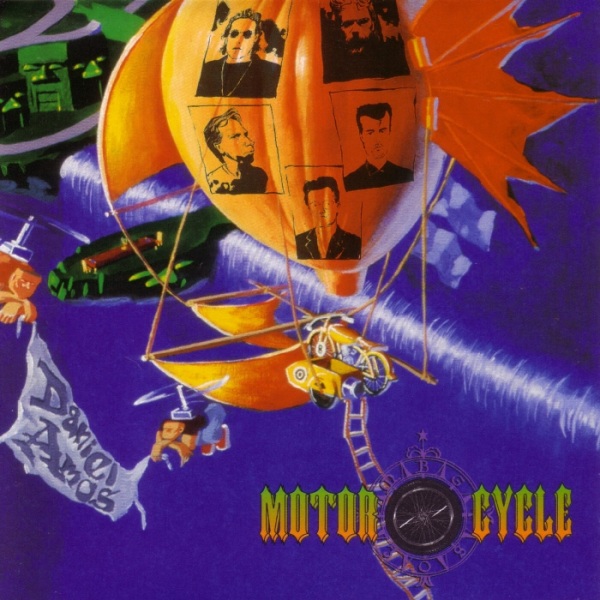
MotorCycle is the tenth studio album by the American alternative rock band Daniel Amos, released on Brainstorm Artists International in February 1993, manufactured and distributed by Word. The album was recorded by Gene Eugene of Adam Again fame at The Golden Recording Room in Huntington Beach, at Neverland in Los Alamitos, and at McCrum’s in Whittier, California; and was produced by Terry Taylor with Jerry Chamberlain and the band for Stunt Productions. (The album title was suggested by Gene Eugene.)
This lush, retro pop/rock album marked the return of guitarist Jerry Chamberlain, one of the founding members of Daniel Amos, who also co-wrote five of the tracks with the band’s main songwriter Terry Taylor. According to the album credits, the words and inspiration of the American writer and theologian Frederick Buechner guided this recording. The album was dedicated to the memory of singer-songwriter Mark Heard (a friend of the band who passed away the year before) and to all “our dear dead dears, if there’s anywhere to be, then you must be there…” see you around.
Meticulously crafted, haunting, and beautiful beyond words, MotorCycle is a psych-pop tour de force. Terry Taylor, Jerry Chamberlain, and Greg Flesch’s triple guitars sparkle and weave lazily between one another as mellotron, piano, and vibraphone gurgle up behind them. Taylor’s storybook lyrics are perfectly suited to this Never-Neverland music, and he spins nursery rhyme stories of little girls («Noelle»), crippled saints («Grace Is the Smell of Rain»), and fantastic dream worlds («My Frontier»). The whole record is as ethereal and haunting as mist, as if the band had rewritten Fearful Symmetry using organic instruments instead of synthesizers. Rather than standing as separate entities, the songs on MotorCycle work together to sculpt a singular Salvador Dali landscape where mountains and stars melt and spill into each other. [J. Edward Keyes, AMG]
Motor Cycle reintroduces us to “the band that won’t go away;” the Daniel Amos with a love for ’60s-influenced pop. Taylor‘s production work with Randy Stonehill on that artist’s Pet Sounds / Sgt. Pepper homage, Wonderama, must have reawakened Terry’s love for the close harmonies, shimmering guitar filigrees and panoramic production techniques of that bygone era. Though the group’s Beatles/Beach Boys/Mersey Beat roots were never completely hidden, D.A. hasn’t worn its ’60’s influences so plainly on its sleeve since 1980’s Horrendous Disc. Also back in the fold for this album is long-time guitar and vocal foil Jerry Chamberlain. Chamberlain pinch-hit as a Swirling Eddie, but hasn’t cut a full album with D.A. for 10 years; his distinctive vocal and guitar phrasings are a large part of the album’s retro-nuevo sound.
The opening track on Motor Cycle, «Banquet at the World’s End», sets the lyrical and musical tone for the entire album. Taylor can be inscrutable or make the theme of a song so plain that you start looking for hidden meanings; he alternates those two approaches on Motor Cycle. Over layers of chiming guitars, glockenspiel, elastic bass and “dit-dit-dit” background vocals, Taylor and Chamberlain sing of a feast which seems only to attract “the poor and lame,” with “their sleazy clothes and orthopedic shoes;” apparently (as is often the case in Taylor’s tales) “the beautiful people” don’t know what they’re missing. «Traps, Ensnares» mixes nasally Lennon-esque vocals with brassy music hall horns, sitar and mellotron for an ominous, yet somehow comforting warning not to fall for the ever present enticements of the enemy. Another favorite Taylor subject, the temporal nature of this life, is addressed on «Hole in the World». The singer knows, from «Banquet», that “the table is set and the door is open” but the afterlife has only been partially revealed (“I’ve been looking for your Holy face, through a window draped with lace”). Taylor follows that with a delicious «I should Have Known Better» rewrite, titled «(What’s Come) Over Me». This bright pop paean to God’s omnipresence might be the band’s best chance in a decade to get some radio play.
As always, Taylor’s family plays an important role in his songwriting. «Buffalo Hills» uses the metaphor of baseball to illustrate how God makes himself visible in what we might consider trivial events. The umpires become “God disguised as men in dark shirts and masks;” the dads watching their sons play are “proud fathers cursing the fates, then speaking in tongues” (not of the heavenly variety, I’ll bet!). «Noelle» is a trippy love poem to Taylor’s daughter. Much as our heavenly father wants to shield us from harm, Taylor prays for a fantasy world where “An angel guards her golden gate / In a place called ‘Fathers Arms’ ” (referring back to the Shotgun Angel track). «Guilty», is a piece of raw honesty aimed at a long-suffering spouse; “I’ve been all wrong baby / Ad nauseam baby… Girl I pray you understand / I’m a tired and broken man.”
Following that, you run smack into the title track, which begins a seven-song cycle elaborating on the themes established during the album’s first half. «Motorcycle» is part travelogue and part documentary, referring at times to the trip the band is presently on, D.A.’s critics (“Hard to breathe easy with naysayers on the sidecar of our motorcycle”) and the band’s historical significance (“We’ve run some red lights… might not even be remembered”). In his one lead vocal appearance, Chamberlain finds the unfolding cycle of life to be «Wonderful», while Taylor, on the other hand, finds «My Frontier» to sometimes be a grim landscape – “‘Neath my face is a graveyard / All my days buried here, the people I’ve been.” Still, the Rubber Soul-soaked «Grace is the Smell of Rain» finds both agreeing that God’s grace is available to all, whether it’s “the old dogs [that] learn new tricks” or “the low of the lows, dregs of the earth.”
Of course, no project from the D.A. camp would be complete without at least one pointed jab at the hypocrisies often evident in the modern church; «Wise Acres» fills the bill on this outing. Even as Taylor caustically sings “I don’t mix with the chemistry at Wise Acres,” he nonetheless sympathizes with their plight – “No one there can see / The greatest enemy / Is the exclusivity.” Rounding out the cycle is «So Long Again», a vocal version of an instrumental theme woven throughout the album. The album ends on a swirling mellotron and percussion note, with the words “Might not even be remembered on our motorcycle,” leaving you to wonder if Taylor & Co. really do believe this album is their last gasp. It’s certainly as melodic and accessible as anything Daniel Amos has done in years; hopefully even a modest success will encourage the boys to forsake premature retirement. [Bruce A. Brown, CCM, February 1993]
> Apple Music (https://music.apple.com/us/album/motorcycle/592507998)
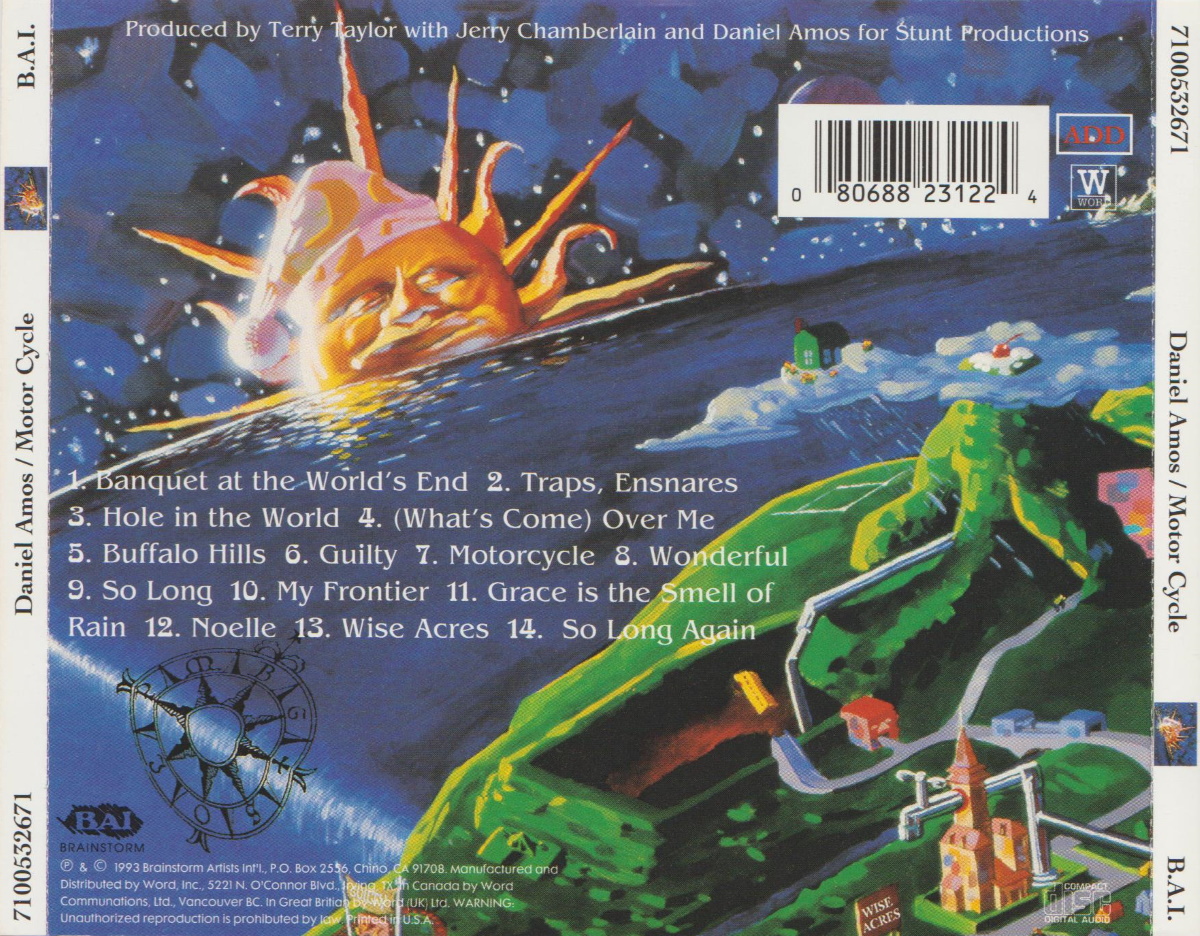
CD tracklist:
01. Banquet at the World’s End – 3:47
02. Traps, Ensares – 3:49
03. Hole in the World – 5:32
04. Whats Come Over Me – 3:48
05. Buffalo Hills – 4:24
06. Guilty – 4:35
07. Motorcycle – 3:33
08. Wonderful – 2:16
09. So Long – 0:56
10. My Frontier – 3:48
11. Grace is the Smell of Rain – 4:01
12. Noelle – 2:43
13. Wise Acres – 2:14
14. So Long Again – 2:53
Note: Simultaneously released on cassette and CD by Brainstorm. The band also released a more than an hour long promo Fan Club CD entitled MotorCycle Tracks featuring selected tracks from MotorCycle plus demos/re-mixes of a few songs, as well as interviews with Terry Taylor and Jerry Chamberlain concerning the new album.
Frederick Buechner calls metaphor the “language of God”. The very fact that Holy Scripture is written in human language qualifies the entire text as metaphor (the Incarnation itself being the grandest of all metaphors – “And the Word became flesh”). Few lyricists speak this language. I count myself as one who is just beginning to learn it’s intricacies. Humbled by an artistic landscape rife with failures and glaring lyrical inanities now encoded and preserved in the long life of the CD, I have, nonetheless, learned a little in the twenty years I have been toiling at my craft. I have learned that valid life-impacting music transcends the hit charts, the gospel cheers and catch phrases – transcends the very business of music itself.
The concept for Daniel Amos’ newest musical endeavor “Motor Cycle”, emerged from my own attempts to cast a mythical sheen over my everyday, sometimes mundane experiences. In this way I was able to build for myself a kind of metaphorical playground in which I could romp and run free, design and sculpt and paint lyrical conceptions that gave weight to it’s simple messages of love , faith and hope. In other words, I wanted to go beyond the surface of things, allowing God to breathe between the lines. My desire was to create a partnership with the listener, wherein together we would set out on a personal voyage of revelation, discovery and unity with the Divine. I am often uncomfortable explaining my lyrics, just as a painter would be if asked to explain his painting. He senses that by doing so he diminishes their sublime revelatory properties. The words of Christ were not always delivered on a silver platter of explanation, and some of the harshest and most cryptic of these (“Eat my flesh drink my blood”) left his followers aghast These were and are words of courage that songwriters today can draw strength from. While there may be some merit, at times, to the notion that we must spoon-feed our listeners, we must also be prepared to pay the price for taking the artistic high ground with prophecies, parables, metaphors, allegories, myths and mysteries that much of modern Christianity may be uncomfortable with.
My heroes – C.S. Lewis, Czseslaw Melosz, Buechner and others – all bolster in me the courage it takes to risk rejection and failure – that which must be risked if we are to attain the artistic relevance in the eyes of our own listeners and our peers. I, for one, am thankful that Lewis in his grand Narnia fable, called his lion Aslan. He refrained from having to explain that Aslan was really Jesus Christ in disguise. I and my children, and my children’s children all thank him for it. We have and will again discover it for ourselves, and in this is it’s great and beautiful power to haunt us all the days of our lives.
Poetry has the ability to continually reveal new and fresh layers of illumination with each new encounter. It’s truly a grand paradox that with ten words a songwriter can paint a picture worth a thousand or with a haunting melody create a mood which opens up horizonless vistas for the listener to partake of. To use the old adage – to create a whole which is greater than the sum of it’s parts. The metaphor is indeed the artist’s playground and within it’s parameters, further up and further in, we call upon the children of God to join us in the frolicsome celebration of all that is known and unknown about this unattainable earth and the great unfathomable God we serve. Let’s occupy it together, until that hour when Aslan returns and carries us away on the back of his wildness and ferocity, to places yet unexplored. [“Further Up And Further In” by Terry Scott Taylor, Release Magazine, 1993]
With its psychedelic arrangements and skewed lyrics, MotorCycle is an artistic and spiritual gem.
As I was discovering indie/alternative Christian music in the early-to-mid ’90s, one name kept appearing in the production credits of albums from many of my new favorite bands (e.g., Mortal, Saviour Machine, Scaterd Few): Terry Taylor. This one man had left his fingerprints on music across a wide range of genres, from industrial and gothic metal to whatever Sin Disease is, which left me curious why such varied artists were working with the guy.
Working backward from there eventually led me to Terry Taylor’s most famous and long-running project, Daniel Amos. Emerging out of the Jesus Music movement in mid ’70s Southern California, Daniel Amos has been a rather hard outfit to pin down throughout the decades. They’ve delved into countrified rock (1976’s self-titled debut), new wave (1983’s Doppelgänger, 1984’s Fearful Symmetry), and in the case of 1993’s MotorCycle, psychedelic pop that hearkened to both latter day Beatles and the exquisite arrangements of Brian Wilson.
MotorCycle is an album that rewards intentional, repeated listens. The album’s fourteen songs are dense and excessive — in the best possible sense of those words. They practically burst at the seams with ideas and flourishes. Exotic psychedelia graces “Banquet at the World’s End” while “Traps, Ensnares” pairs sitar drones with, of all things, saloon piano riffs. The band’s triple guitar attack (Taylor, Jerry Chamberlain, Greg Flesch) adopts a dreamy, surf-like tone on “Hole in the World” while “Wise Acres” packs about a half-dozen guitar solos into its denouement.
Unpacking these layers and hearing the myriad of surprising choices that Daniel Amos made — and how well Taylor et al. made all of those choices work — is all part of the joy of listening to MotorCycle.
Much of the album’s mercurial nature can be chalked up to Taylor’s songwriting, which is best described as skewed. (Again, in the best possible sense of the word.) There are moments on MotorCycle when Taylor’s playfully twisted lyrics make him seem like a Weird Al-esque court jester. How else to make sense of lyrics like these from “Traps, Ensnares”?
Mr. Spoke speaks, deadly nightshade in his brainpan
Mock aliens breed silent blond zeros of fresh young flesh
Ignore the ghosts of books, they’re getting plastered in Paris
Della wears Tupperware, and Major-Domo’s body politicking in Limo LandHarry Fiasco is gulping down his moral fiber
And casts his hard shadow while wearing
Those slippery soft supple slippersAnd then there’s “Wise Acres,” with its gentle skewering of evangelical Christian sub-cultures:
They’re gonna put a fence ’round Wise Acres
And in the end, they’ll tear down Wise Acres
The truth would set them free but no one there can see
The greatest enemy is the exclusivityBut you’ll eventually find — though it might take a few listens — that something else is always going on beneath the cheeky lyrics and clever wordplay.
“Buffalo Hills” and “Noelle” both seem ridiculous at first, even cloying. The former employs extended baseball metaphors while the latter includes lyrics like “She gets her just desserts ’cause the sky is in the pie/She wants her cake, she eats that, too, as the meringue clouds roll by.” But a closer listen to both songs, which were written for Taylor’s kids, reveal them as heartfelt odes to childhood innocence. When Taylor sings “I’ve prayed her into a dream where hate can’t break the spell” on “Noelle,” he taps into a desire that every parent feels at the deepest, most primal level.
Taylor’s lyrics are also ridiculously literate, packed with references to Charles Bukowski, the Bible, C.S. Lewis, and most especially, theologian and author Frederick Buechner.
MotorCycle begins with “Banguet at the World’s End,” and its exotic sonic trappings are used by Taylor et al. to retell Jesus’ parable of the wedding banquet. When the beautiful people of the world can’t be bothered to leave behind their worldly pursuits, the door’s left open for the dregs and outcasts of society, who party the night away “in their sleazy clothes and orthopedic shoes.” (Taylor’s decision to include “mongoloid” — a slur for people with Down syndrome — on the list of outcasts might raise some eyebrows, though. On the one hand, his intent seems clear, given how people with the disorder are often treated by society. On the other hand, it’s still a slur, so yikes.)
But for me, the album’s highlight has always been “Hole in the World,” a gorgeous and haunting ballad about Christ’s Second Coming and the saints’ entry into Heaven. Taylor’s evocative lyrics draw heavily from Frederick Buechner’s The Alphabet of Grace and Whistling in the Dark as he sings:
Hole in the world
Here every tongue cries “Christ is risen“
Hole in the world
I see old enemies embracing
Moonlight falling on the blistered glass
Someone whispers, “Here at last“
That’s when I saw Your shadow passAnd:
My heart is aching, and my legs are broken
Waiting for the hand in the dark
The table is set, and the door is open
Inside, outsideThough I’ve been a Christian since childhood, I’ve often struggled with how to think of Heaven. But artists like Taylor, and songs like “Hole in the World,” help me imagine the unimaginable. It’s a song that I still find both inspiring and comforting, even after all these years.
As I’ve written before, one of my goals with Opus is to shine a light on Christian music that has long-flown under the radar. I don’t necessarily expect non-Christians to know of this music (though they should because it’s great), but I do think it’s a real shame that Christians don’t know more about the wealth of music created by their brothers and sisters, simply because it lies outside the bounds of, say, CCM. With its bizarre arrangements and oblique lyrics, Daniel Amos’ MotorCycle certainly doesn’t fit easily within the lines of “normal” Christian music, but that does nothing to diminish its status as an artistic and spiritual gem. [Jason Morehead, Opus, February 27, 2022]
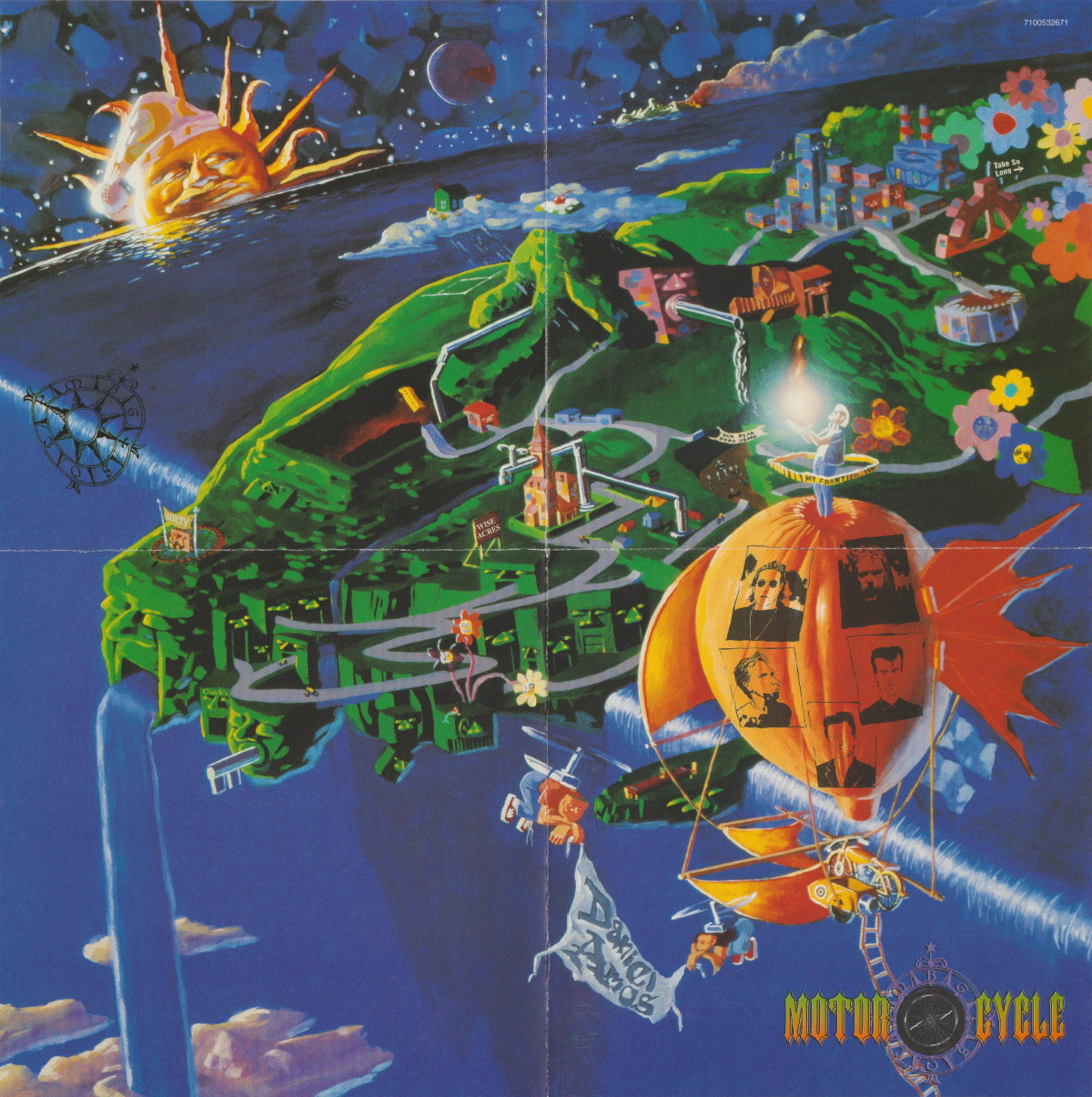
CREDITS. Produced by Terry Taylor with Jerry Chamberlain and Daniel Amos for Stunt Productions. Arrangements by Daniel Amos. Engineered by Gene Eugene with addtional engineering by Bob Moon, Chris Colbert, and Dave Hackbarth. Recorded at The Golden Recording Room, Huntington Beach, CA, at Neverland, Cerritos, CA, and at McCrum’s, Whittier, CA. Mixed at The Golden Recording Room. Mastered by Doug Doyle at Digital Brothers, Orange County, CA. Pre-production demos recorded at Wax Lips. Art Direction and Design by Ed McTaggart. Cover Concept by Terry Taylor, Bruce Heavin, and Jerry Chamberlain. Illustration by Bruce Heavin. All songs written by Terry Taylor or co-written by Taylor and Jerry Chamberlain.
We want to give special thanks to Frederick Buechner whose words and inspiration guided this recording. This album is dedicated to Mark Heard and to all “our dear dead dears, if there’s anywhere to be, then you must be there…” see you around.
Musicians: Daniel Amos is – Terry Taylor (Lead and Backing Vocals, Acoustic and Electric Guitars, Harmonica), Jerry Chamberlain (Lead and Rhythm Guitars, Electric Sitar, Lap Steel, Percussion, Lead and Backing Vocals), Greg Flesch (Lead and Rhythm Guitars), Tim Chandler (Bass), Ed McTaggart (Drums, Percussion). Additional Musicians: Rob Watson (Mellotron, Hammond Organ, Piano), Steve Hindalong (Drums and Percussion on track 2), Buckeye Jazzbo (Trumpets on track 2), Gene Eugene (Piano on “…now for the cliffhanger…”). Backing Vocals arranged and performed by Terry Taylor, Jerry Chamberlain, and Sharon McCall.

Reviews
There are no reviews yet.