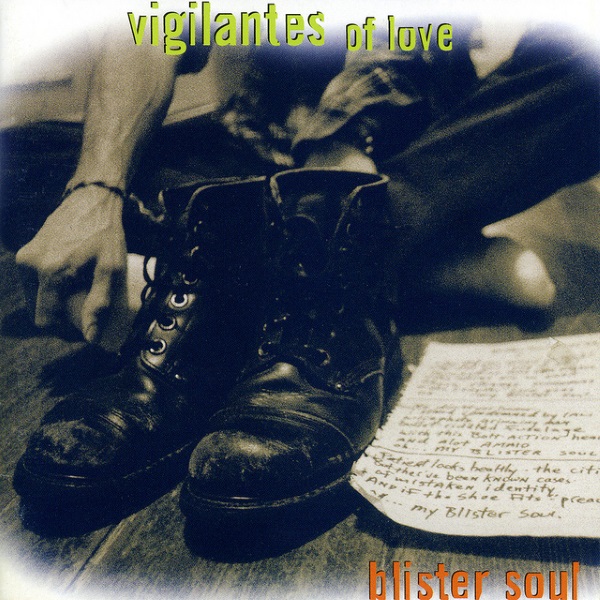
Description
Blister Soul is the fifth album by the American folk-rock/alt-country combo Vigilantes of Love fronted by singer-songwriter Bill Mallonee, release on Capricorn Records in 1995, in co-operation with Fingerprint Records. The album was recorded at John Keane’s studio in Athens, Georgia; January 1995, and was produced by Keane, with Bill Mallonee, Chris Donohue, and Dan Russell co-producing. From start to finish, the record took three weeks to make. All songs written by Bill Mallonee except “Tempest” co-written with Chris Donohue.
Blister Soul was the album that broke Vigilantes of Love to quite a few AdultAlternativeAlbum radio stations in the US. Songs like “Real Down Town,” “Skin,” “5 Miles Outside Monroe” and the title cut introduced the band’s ramped up folk-rock to new audiences and a few modern rock stations in the process.
I’m going to go out on a limb and say that Vigilantes leader Bill Mallonee deserves some of the acclaim afforded his more successful songwriting peers, such as Bruce Springsteen, Tom Petty, Neil Young and John Mellencamp. And prolific? Mallonee chose the baker’s dozen included here from over 50 songs (I’d love to hear some of the discards!). Having exhausted his desire to continue playing gritty rock featured on last year’s Welcome to Struggleville, Blister Soul harkens back to the more organic, acoustic sound of VOL’s 1992 album, Killing Floor. Blister Soul featurs the multi-instrumental talents of Mallonee and Chris Donahue, with producer John Keane and drummer Matt Donaldson in the primary supporting roles. But the real stars are Mallonee’s songs. In «Postscript», Mallonee finds that “There is a window behind those wounds where I see the heart of God/ You got your arms stretched, and the nails go in,” while in «Blister Soul (Reprise)», he marvels at Christ’s sacrifice, when he asks “Why did you give it all? Poured out on cold little misers, and the returns are so small.” Those are just two examples of the work of a writer who’s earned a place in the ranks of rock’s premiere scribes. [Bruce A. Brown, CCM, June 1995]
CD tracklist:
01. Blister Soul – 3:53
02. Five Miles Outside Monroe – 3:05
03. Skin – 5:00
04. Offer – 4:30
05. Baalam’s Ass – 3:45
06. Bethlehem Steel – 4:00
07. Tempest – 2:16
08. Bolt Action – 4:20
09. Parting Shot – 5:37
10. Real Down Town – 3:51
11. Certain Slant of Light – 5:02
12. Unsuccessful – 3:20
13. Blister Soul (Reprise) – 4:25
Note: Simultaneously released on cassette and CD by Capricorn Records. Remastered for vinyl by John Keane and re-issued as a 180g 12-inch vinyl double album in 2025, limited to 300 copies and featuring new cover artwork by Kreg Yingst. Available at Bandcamp: https://billmalloneemusic.bandcamp.com/album/blister-soul-1995

Lancing The Blister Soul
Original Sin, Imputed Righteousness & The Vigilantes of Love
by Shane RosenthalI was recently introduced to rock band by a White Horse Inn listener. After hearing a few songs by The Vigilantes of Love, I became an instant fan. With a sound reminicent of The Waterboys, The Call, U2, Bruce Cockburn, and if I dare say, Bob Dylan, V.O.L. has nevertheless marked their own territory. In the liner notes of their acclaimed CD, Blister Soul, the following review is found:
It’s pretty much the same everywhere you go. You can sense it in the air. From the quiet reserved towns built on the steaming red clay of Georgia — to the toppling ruins and drug-scarred streets of Detroit — to the chaotic, bustling, elevated trains of Chicago — to the teeming, angry alienated misery in the Desire projects of New Orleans — to the opulent, reclusive estates of the Hollywood Hills. In the hearts of people across the country and around the world lies a desperation and emptiness that knows nothing about race, gender, class or language. The heart is one place from where we all can speak. It aches with the unspeakable hunger and an incessant whisper down in its core, that “something” is missing. What it is, is what remains unspeakable.
Hailing from Athens, Georgia, singer/songwriter Bill Mallonee and his Vigilantes Of Love understand this implicitly, as he sings in «Blister Soul», the title track on this harrowing, yet triumphant disc you hold in your hands. “Yeah, the thing we cannot speak of, but the secret we all know, oh this blister soul.” Mallonee has the unspeakable down; he knows its name, and he coaxes, nudges and scrapes at it in every verse in every chorus…he tries to draw it out of the darkness, so we can see it in the clear, unblinking light of day.
Over the course of five records, Mallonee and his band have come ever-closer to the flame of human experience in all its complexity, ambiguity, uncertainty, passion and pathos. In a home-brew of rootsy rock, blues, country and folk, and in the urgency of Mallonee’s haunted, hunted voice, one can hear the 20th century careening to a close… like a speeding train on the wrong side of the track. Their gritty message, no matter how we perceive it initially, is that it is grace that allows us to view our brokenness and loneliness, and grace that allows us the posibility of hope in response, no matter how all-encompassing darkness might seem. The blister soul is the starting point of everyone’s burden and everyone’s hope… (Thom Jurek).
The above reveiw gets to the heart of the matter. You can’t listen to V.O.L. without feeling the impact of their theology of despair: “There’s a smaller place you go, where there’s hardly any sound, where the deals have all gone sour, and the house of cards comes down, and the damage is costly, it’s beyond all dollars and sense, you can’t measure it with graphs and charts or any instruments, yeah the thing we can not speak of, the secret we all know, oh this blister soul.” But rather than leaving you to wallow in self lament, you are gently pointed to a theology of grace: “…and the thing that’s yours for free is the thing I need the most, stifles every boast, stifles every boast.” The music is not overly didactic, or preachy, but comes off as a very realistic and heart felt call to deal with the fact of sin head on. And in this quest to look realistically at sin, and the problem of the human condition, Mallonee and V.O.L. have found the true meaning of grace. As Jurek’s review suggests, “The blister soul is the starting point of everyone’s burden and everyone’s hope…”
Theologians have often described an inseparable link between original sin and the doctrines of grace. For if one has a superficial understanding of the human condition, there will be a corresponding superficiality in the way we view God’s grace and mercy. Thus, if one holds that he or she is basically a good person, then his or her view of salvation will most likely be moralistic; i.e., people who do mostly good things go to heaven. But if a person believes that “no one is good, no not even one” (Romans 3), then for anyone to be acceptable to God at all, there must be an overwhelmingly powerful view of grace, “to the man who does not work but trusts God who justifies the wicked, his faith is credited as righteousness” (Romans 4:5).
This theological link comes through quite clear in the lyrics of The Vigilantes of Love. Notice for example the lyrics of their song, «Double Cure», a song off their 1996 compilation CD simply titled V.O.L. released by Warner Brothers (the title of the song itself being a reference to Augustus Toplady’s great hymn, Rock of Ages, “Be of sin the double cure, cleanse me from its guilt and power”). The lines, “today I am sick of all I am, today is my setback. First I swear I love you, then I stab you in the back,” are juxtaposed with the recurring refrain, “I wanna drink out of that fountain, On a hill called double cure.” One is reminded of the parable Jesus told of the Pharisee and the tax collector:
“Two men went up to the temple to pray, one a Pharisee and the other a tax collector. The Pharisee stood up and prayed about himself: ‘God, I thank you that I am not like other men — robbers, evildoers, adulterers — or even like this tax collector. I fast twice a week and give a tenth of all I get.’ “But the tax collector stood at a distance. He would not even look up to heaven, but beat his breast and said, ‘God, have mercy on me, a sinner.’ “I tell you that this man, rather than the other, went home justified before God. For everyone who exalts himself will be humbled, and he who humbles himself will be exalted” (Luke 18:9-14).
The tax collector had come to terms with the fact of his “blister soul,” and his personal setbacks lead him to cry out for mercy. Yet it is just this sort of “cry of desperation” that leads a man to a proper understanding of justification. This whole process seems to be what is implied in their song «When I’m Broken», “When I’m broken, see what happens, Arms wide open, see what happens…see what happens to me.”
In their song, «Parting Shot», we come to one of the most impressive uses of this contrast between sin and grace. “You lie on the flowers here in the wind, I’ve twisted it all with original sin…there’s a knowledge I traded a long time ago, bartered it all for these rags I call clothes.” Original sin is not simply used here to focus the blame on our first parents, but rather, as Mallonee expresses it, we all seem to be co-conspirators in this spirit of self destruction. And the reference to rags harkens us back to the prophet Isaiah’s lamentation that “all our righteous acts are like filthy rags…and like the wind our sins sweep us away” (Is. 64:6). But later in the song Mallonee faces his own pessimism by admiting to his audience that he has been “droning on and on,” and suddenly changes gears; “Wait, it’s bigger than life, it is gracious and grand, something a child readily understands: ‘Hey you know I sure could use a new suit of clothes, see I’ve gone all threadbare and my shoes are worn, now the flowers are growing right out of these bones [and I can] hear the trumpet sound like Louis Armstrong, when the Great Divorce happens hide me in your song, cause I don’t deserve it and I don’t belong.”
I often get frustrated with folks who seem to think that theology is too difficult for the average person. Mallonee is right, these things are quite simple, something even a “child readily understands.” In the story of The Emperor’s New Clothes, it was after all the child who pointed out that the Emperor was naked. So too, it is easy for us to understand the need for “a new suit of clothes” if we have recognized that our current wardrobe consists of rags. Theologically speaking, this is what is known as imputed righteousness; we are not acceptable to God in our own clothing, but must wear Christ’s righteousness like a robe (see Isa. 61:10, Matt 22:9-13, John 17:19, Rom. 1:17, Rom. 5:19, Rom. 10:2-4, 1Cor. 1:30, 2Cor. 5:21, Phil. 3:8-9). Mallonee’s confidence in this “robe of righteousness” gives him the eager anticipation for the sound of the last trumpet when all things will be made new. But this expectation is neverthess tempered by the realization that “I don’t deserve it and I don’t belong.” When all is said and done, a person really cannot sing “Amazing Grace” until he has fully grasped the other corresponding lines of Newton’s classic hymn, “that saved a wretch like me.”
In their song, «Who Knows When The Sunrise Will Be», we come to see some of the theological influences of V.O.L. “Martin Luther said to one of his brothers, ‘except for one instance, no one can die for another.’ The devil makes me fearful about my survival, [but] one’s gone before to ensure your arrival.” It is interesting that Mallonee quotes Luther, because he is probably the most important theologian to have ever dealt with the doctrines of sin and grace. Luther was a monk who tried to live a God honoring life, but later realized that he could never be good enough to satisfy the righteous demands of a holy God. Then Luther came to his great “evangelical breakthrough” where he realized that the righteousness of God was not merely something God demanded, but also something that he freely gives. For Luther, Christ had “gone before to ensure [our] arrival.” Thus, when Mallonee writes in this song that “I saw a man on the hill in place of my hell,” he is standing in the great tradition of Luther and the other reformers who asserted that the the Christian gospel is not about our efforts, our pursuits, our transformation or our anything. Rather, the Christian gospel is about Christ and what he accomplished on our behalf. In the final section of this song Mallonee delivers a desperate cry, “You can count on your charm, revel in your wealth, improve your appearance, hope in your health, houses of cards tumble and reputations fail, marriages crumble and interest rates sail, there are no more heroes….we’re all blind men, sad men, and dreamers with wishes, paralytics, lunatics and the back street fringes [yet, we] all find a place in your home at your table, you make them well cause you’re willing and able…”
This is a brilliant description of our time, and yet, instead of being hostile and condemnatory of this state of affairs as the Pharisee was toward the tax collector, Mallonee approaches this situation with notable humility, arguing that the Church is made of such members. In other words, the church is a hospice for struggling sinners where Christ is the true medicine for our souls. Uh oh, sounds like I’ve hit the theme of another V.O.L. song, «Welcome to Struggleville».
[Shane Rosenthal, Modern Reformation, 1997]
CREDITS. Produced by John Keane. Co-produced by Bill Mallonee, Chris Donohue, and Dan Russell. Recorded in January of 1995 at John Keane’s studio in Athens. All songs written by Bill Mallonee except “Tempest” written by Bill Mallonee and Chris Donohue.
Musicians: Bill Mallonee (lead vocals, electric and acoustic guitars, harmonica on “Parting Shot”), Chris Donohue (acoustic and electric basses, electric, 12-string and high string guitars, chapman stick, piano, background vocals), John Keane (electric, pedal steel and 12-string guitars, percussion, background vocals), Matt Donaldson (drums), Phil Madeira (hammond b-3 organ, piano, accordion), Newton Carter (electric guitar on “5 Miles Outside of Monroe” and “Balaam’s Ass”), Joel Morris (drums on “Certain Slant of Light”), Andy Carlson (violin), John Evans (harmonica on “Bolt Action” and “Bethlehem Steel”), Billy Holmes (mandolin, hammond b-3, piano on “Real Down Town”), Michael Guthrie (electric sitar). Elissa Hadley (background vocals on “Certain Slant of Light”), Laura Donohue (background vocals on “Offer”), Tina Rudl (background vocals on “Offer”).


Reviews
There are no reviews yet.