
Description
The multi-artist project The Everlastin’ Living Jesus Music Concert was released on Maranatha! Music in 1971. It was the very first album by Maranatha! Music (“Maranatha! assoc. Costa Mesa, Calif. 92626”), featuring studio recordings by various artists related to Calvary Chapel in Costa Mesa, California. Engineered by Buddy King at Buddy King Studios in Huntington Beach, California. Maranatha! Music was a subsidiary company started in 1971 as an extension of the praise and worship music of the Calvary Chapel.
Maranatha! Music’s first two recordings – The Everlastin’ Living Jesus Music Concert and Come to the Waters, the debut album of Children of the Day – sold 25,000 copies in southern California alone during the first six months, propelling the company into worldwide prominence in the area of Contemporary Christian Music (CCM). Musically, many of the Maranatha! groups patterned themselves after the stylistic lead of Love Song which was laid-back country rock sound although there were some exceptions (i.e. the jazz-rock of Sweet Comfort Band or the unique sound of the Children of the Day). Maranatha! Music also stressed the equation of music and ministry as more of an emphasis than the exploration of artistic creativity.
The Everlastin’ Living Jesus Music Concert became the first part of the Maranatha! Series, and was followed by the release of six more compilations released between 1972 and 1980: Maranatha! 2, Maranatha! 3, Maranatha! 4, Maranatha! 5, Maranatha! 6, and Maranatha! 7.
The very first album on Maranatha is actually a collection of studio cuts, not a live LP as the title might imply. Love Song, Children of the Day, and Debby Kemer all perform songs that would appear on future LPs. Also here are songs unavailable elsewhere by Gentle Faith, The Way, and Love Song. The rest of the LP is made up of groups that never had subsequent albums including folk-rockers Blessed Hope with «Something More». Country Faith with Chuck Butler (later of Parable) does «Two Roads». Selah appears to be a female duo and they deliver a wonderful rootsy folk number that sounds like it belongs on one of those FM PBS programs. All the songs on the LP are strong and unlike many other various artists projects, they’re stylistically compatible. Followed by the releases Maranatha 2 through 7. Re-issued on CD. [Ken Scott, The Archivist, 4th edition]
> Apple Music (https://music.apple.com/us/album/maranatha-vol-1-the-everlastin-living-jesus-music-concert/1528859788)
LP tracklist:
Side One
A1. Love Song – “Little Country Church” – 2:38
A2. Selah – “In Jesus’ Name” – 3:47
A3. Blessed Hope – “Something More” – 3:30
A4. Country Faith – “Two Roads” – 5:40
A5. Various Artists – “Holy, Holy, Holy” – 3:00
Side Two
B1. Gentle Faith – “The Shepherd” – 3:30
B2. Debby Kerner – “Behold, I Stand At The Door” – 2:05
B3. The Way – “If You Will Believe” – 4:22
B4. Love Song – “Maranatha” – 3:30
B5. Children Of The Day – “For Those Tears I Died” – 5:10
Note: Simultaneously released on 8-track tape and 12-inch vinyl LP by Maranatha! Music. A Maranatha! 1: Everlastin’ Living Jesus Music Concert songbook was as well published in 1974. Re-issued on CD by Maranatha! Music in 2012.
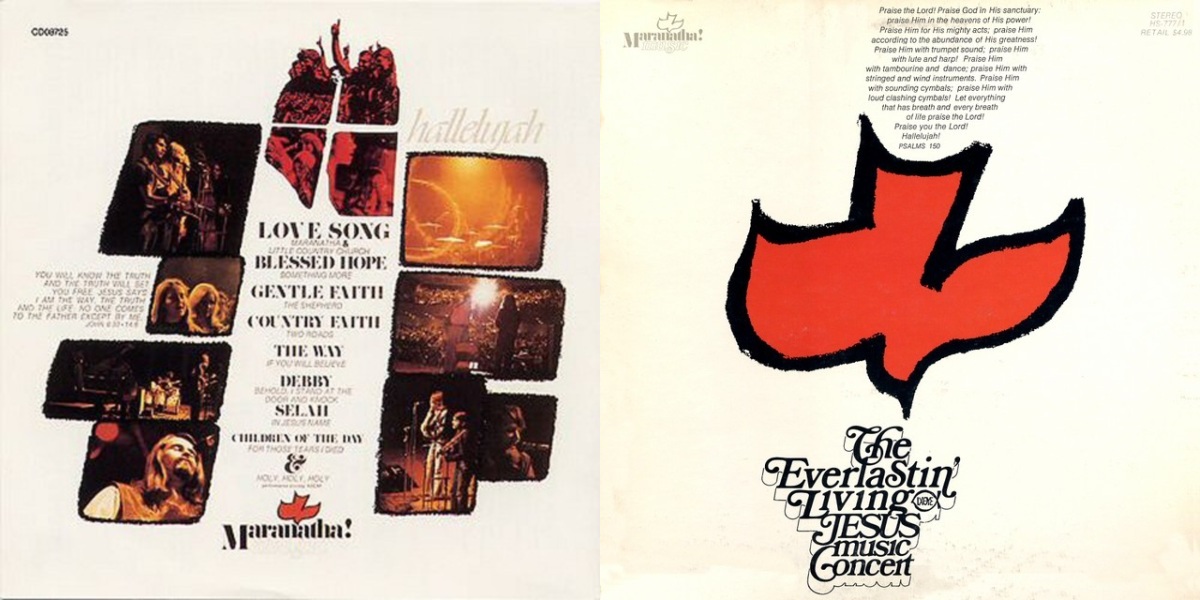
Calvary Chapel Costa Mesa, pastored by Chuck Smith, formed a subsidiary non-profit organization called Maranatha Music/Publishing in 1971 to release music by the artists who flocked to the church. Children of the Day became the first group to record for Calvary Chapel with their classic ‘Come to the Waters’ album. Along with the ‘Everlastin’ Living Jesus Music Concert’ album, Maranatha! Music sold 25,000 copies during the first six months in southern California alone. The label eventually built Maranatha studio (later renamed Whitefield Studios), which was located up the street from the church.
Two graphic artists, Kernie Erikson and Barry Malone, got together over dinner to develop a new logo for the bustling record company. The original Maranatha dove was drawn on the back of a restaurant paper napkin and remains in that style to this day.
For the first several years of the label’s existence, it released everything on the Maranatha label. Around 1980, Maranatha! Music’s president Chuck Fromm decided to form an offshoot more focused on ministry and on those minstrels who wanted a vehicle to allow them to fulfill their calling without having to pursue a record deal wih Maranatha or any other label. This label was called the Ministry Resource Center, or MRC. In addition to providing resources for artists looking to deepen their walk, it was a lower-budget, grass roots record label. Also close to this time, Maranatha created Asaph & Sons, or A&S, a label designed for the edgier new artists at Calvary Chapel whose music didn’t fit with the softer praise and adult contemporary sound of Maranatha proper.
A&S and MRC were blended together around 1984, and Broken Records was born. Joe “Ojo” Taylor of Undercover fame worked all of the labels at some point. In fact, two of earlier Undercover releases were originally A&S and MRC releases, and were re-released under the Broken imprint. In 1985 Maranatha suspended Broken Records.
Later Ojo Taylor and Gene Eugene of Adam Again did revive Maranantha!’s Broken Records and with it, production company Brainstorm Artists International. B.A.I. existed from 1987 to 1997, releasing modern rock and hip-hop from the West Coast Christian alternative music scene.
(As well, in the almost immediate aftermath of Broken’s demise, a new label popped up, Frontline Records, owned by a Calvary Chapel pastor, Jim Kempner. The label focused primarily on modern rock, rap, dance-pop and hip-hop and existed from 1986 until the mid-1990s.)

Reviews
There are no reviews yet.