Description
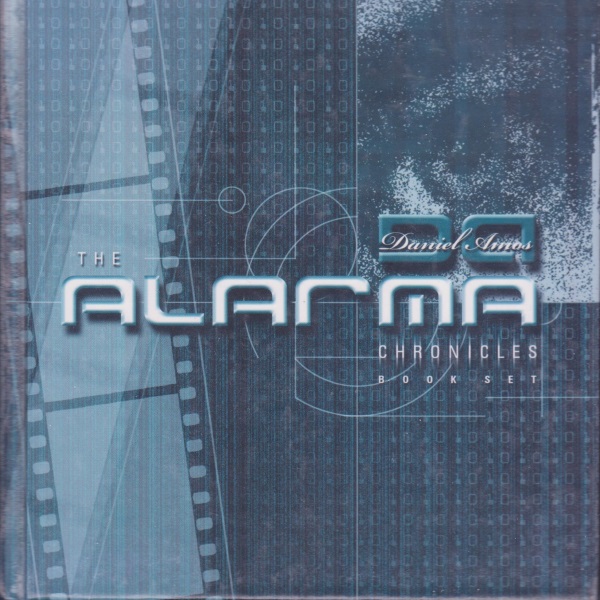
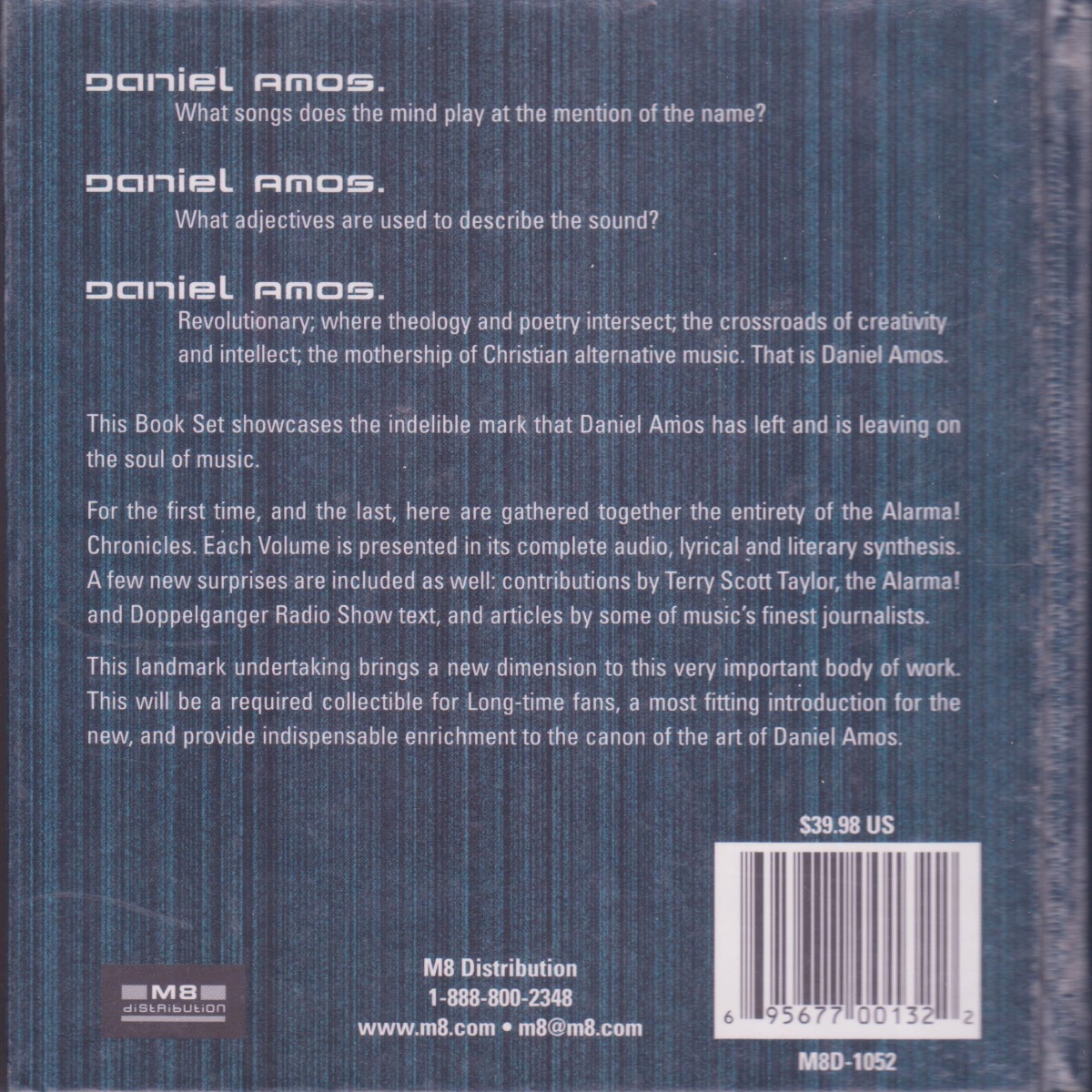
The Alarma Chronicles Book Set is a 2200-ex Limited Edition triple-disc book set by the American alternative rock band Daniel Amos, independently released on Millenium Eight Records in 2000.
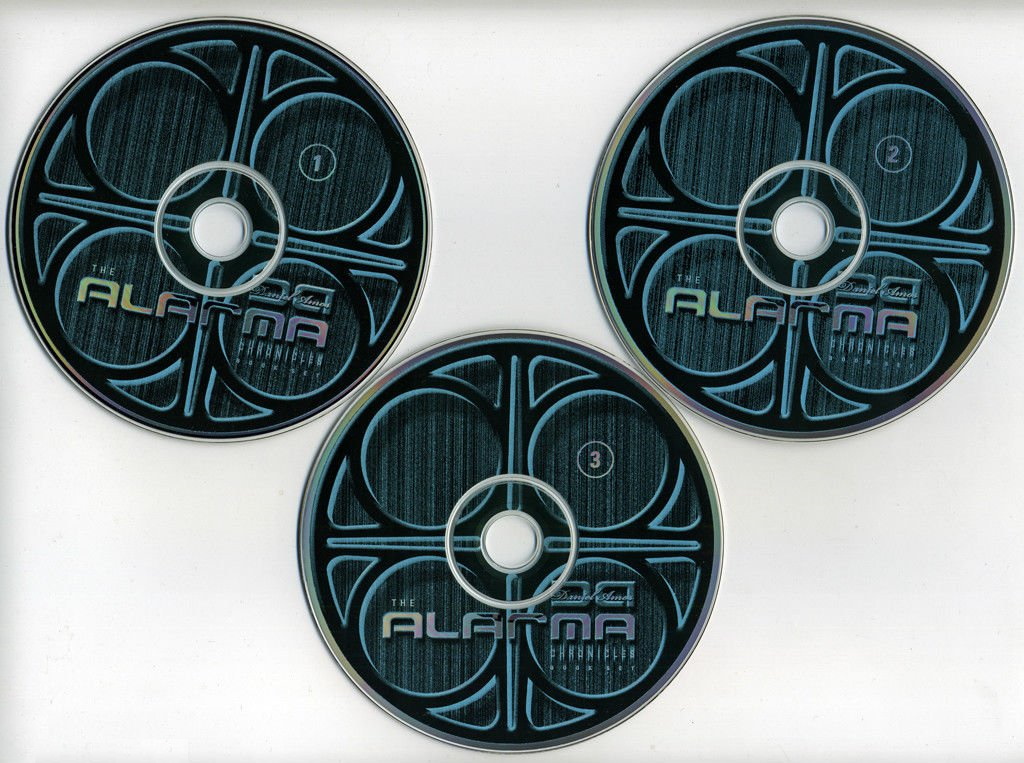
The book set includes the four albums of The Alarma Chronicles on three CD discs; ¡Alarma! (NewPax Records 1981), Doppelgänger (Alarma! Records 1983), Vox Humana (Refuge Records 1984), and Fearful Symmetry (Frontline Records 1986); as well as a 169 page hardcover companion book featuring:
· all the chapters of the original Alarma! novelette story that accompanied the albums
· original and additional artwork
· complete lyric sheets for all the songs, production and band credits
· comments on the project by principal author and songwriter Terry Taylor
· transcripts of the ¡Alarma! and Dopplegänger Radio Specials hosted and produced by Bruce Brown
· a number of articles about Daniel Amos and the ¡Alarma! Chronicles by industry folks and critics like Bruce Brown, Randy Layton, Tom Gulotta, Brian Quincy Newcomb, and John J. Thompson.
When Millennium Eight released The Alarma Chronicles this summer, I was one of the first in line to put down $40 for a piece of history. I suppose calling these four albums by Daniel Amos “a piece of history” may seem grandiose to some. After all, when these albums were first produced in the early eighties, each successive release in The Alarma Chronicles seemed to make Daniel Amos less of a market presence. And at any point in the life of Daniel Amos you could stop someone on the street to talk about this amazing band’s music, and it’s likely John Smith or Jane Doe would say, “Daniel who?” However, the importance of Daniel Amos to alternative Christian music cannot be overestimated. Of course, I’m repeating what many others have already said. Regardless, Daniel Amos has served as an inspiration for countless Christian bands, not only because they engender creativity with their insightful lyrics and groundbreaking musical arrangements; Daniel Amos has served as an inspiration because with The Alarma Chronicles they committed to an artistic vision and pursued it without conceding to commercial concerns.
The Alarma Chronicles’ lack of commercial recognition may puzzle some listening to the collection now; that lack probably has little to do with the sound of the albums. With a combination of earlier influences (such as the Beatles’ pop sensibilities and the Beach Boys’ harmonies) and cutting edge pop music (such as New Wave, eighties electronica, and alternative guitar rock), Daniel Amos seems in step with the musical pulse of the eighties, both its influences and trends. Unfortunately, Daniel Amos fell victim to a series of problems. Their musical style rapidly evolved from country rock to Beatles-inflected pop to the eclectic sound of The Alarma Chronicles. Their fan base had a difficult time keeping stride with the band (especially since Horrendous Disc, the album immediately preceding The Alarma Chronicles, was kept from release for several years). More importantly, a growing Christian music industry was trying to identify itself to its consumers even though it wasn’t quite sure of what that identity would consist. The highly innovative Daniel Amos put out four albums over five years: Alarma, Doppelganger, Vox Humana, and Fearful Symmetry. They linked them conceptually and called them The Alarma Chronicles. They used biting wit and social critique and set it to music that pushed the envelope of Christian music in the eighties. Consequently, the industry and many consumers didn’t know what to do with them.
I don’t mean to assume a superior attitude and suggest I know what to do with them; I wouldn’t want to do that. Their enigmatic quality may make them hard to market, but it also makes their music exceptional. «Central Theme», the first song in The Alarma Chronicles, signals Daniel Amos’s move toward modern pop music. Yet, Terry Taylor exposes his debt to Brian Wilson with vocals not just haunting but melodic and sweet. In some ways a worship song placing Jesus in the center of all things, «Central Theme» is immediately followed by the title song of the first album; instead of reassurance, «Alarma» provides the listener with the bad news that people are turning away from God’s love and the desperate needs of others. This wake-up-call message is punctuated by fast-paced guitar riffs and post-punk vocals, unadorned and sometimes harsh. This album is filled with similar odd juxtapositions such as «Big Time / Big Deal», a New Wave diatribe on the egotism that drives Christian celebrities in a media-driven age, and «Props», a Beatles send-up that questions having blind faith in the virtue of happy endings. These collisions of style and substance are cleverly orchestrated to create music at once unconventional and perhaps even uncomfortable. In many ways, this is the project behind The Alarma Chronicles – to disorient and to see faith in a new way.
Admittedly, that makes the series an extensive undertaking. Despite the potential for the series to lead to moral pomposity, The Alarma Chronicles maintains a fairly consistent and humble tone throughout. Perhaps the most successful album is the second, Doppelganger. Taylor signals his ambition as lyricist with «Hollow Man» (drawn from the work of T.S. Eliot), and that ambition is matched by the clever construction of each song on the album. Functioning as a sustained exploration of consumer culture, of the rhetoric of contemporary Christianity, and even of human perception, Doppelganger ranges from acerbic satire (in «Mall (All Over the World)» and «New Car») to heart-rending social commentary (in «Youth with a Machine» and «Angels Tuck You In»). The musical experimentation continues on this album and the band’s growing maturity is evident. Though their influences are as numerous as on Alarma and are again employed to create a sense of dissonance, the music has a distinctive style which allows it to stand on its own merits. Daniel Amos transcends its musical influences and creates something innovative with the tight arrangements of «The Double» and the manic «I Didn’t Build it for Me».
In my estimation, Daniel Amos took a radical step with Doppelganger toward being the exceptional band they would be in the late eighties and early nineties, lyrically sophisticated and musically superior to most of their contemporaries. This makes the third album in The Alarma Chronicles somewhat disappointing. An interesting experiment with being in but not of a technological world, Vox Humana uses eighties synth-pop to scrutinize the role of faith in a time driven by technology. Unfortunately, this approach gives the album an extremely dated sound and limits its general accessibility. However, this deficiency doesn’t deny the place of The Alarma Chronicles as a unique happening in the course of CCM. Millennium Eight’s deluxe treatment of this collection is justified. The four albums are contained on three compact disks and the accompanying book contains all lyrics, liner notes, and text of radio shows associated with The Alarma Chronicles. In addition, the book includes commentaries on the albums by various critics who have charted the course of alternative CCM. The Alarma Chronicles’ mini-novel, written by Taylor in segments accompanying each album as it was originally released, isn’t Tolstoy, and Taylor obviously tired of writing it. However, it works well as a connective device between the albums. And Taylor obviously never tired of making the music that comprises The Alarma Chronicles.
The final album, Fearful Symmetry, contains some of the best music of The Alarma Chronicles (such as «A Sigh for You» and «Shadow Catcher»), indicating the caliber of the music they had yet to create. Though Daniel Amos’ strongest work would follow these four albums, this book set represents a watershed moment more people need to know and experience. [Terry Wandtke, The Phantom Tollbooth, August 2000]
Note: An Alarma Radio Special LP was released by NewPax Records in 1981 featuring the same jacket as the regular LP, but with sticker on front. The Bruce Brown produced radio special – featuring an interview with Daniel Amos frontman and main songwriter Terry Taylor as well as selections from the album – was aired across the country in the beginning of September 1981. Available at Bandcamp:
https://terryscotttaylor.bandcamp.com/album/alarma-radio-special-an-intimate-insight
A one-hour Doppelganger Radio Special from 1983, produced by Bruce Brown and Stel Pontikes, featuring an interview with Terry Taylor as well as cuts from the record, is available at Bandcamp: https://terryscotttaylor.bandcamp.com/album/doppelg-nger-radio-special


Reviews
There are no reviews yet.