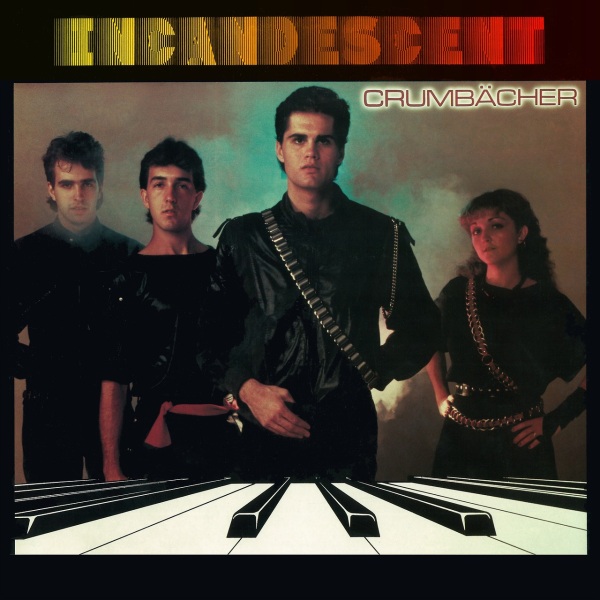
Description
Incandescent is the debut album by the American synthpop band Crumbächer, released on the short-lived Maranatha! Music related imprint Broken Records in March 1985, distributed by Word. The album was produced by Joe Taylor of Undercover fame.
A different mix of the album track “It Don’t Matter” was featured on the multi-artist compilation What’s Shakin’ released by MRC Records in 1984, yet another imprint of Maranatha! Music, while the album track “Jamie” was included on the 7-inch vinyl multi-artist EP Broken Samples, released on Broken Records in 1985.
American pop music changed so quickly in the early 1980s that the big New Wave stars of 1983 (Cyndi Lauper, Duran Duran, Eurhythmics, The Police, etc.) were swiftly becoming a byword by 1985, replaced by a stylistic mishmash of gospel soul, hair rock, and retro-Motown (The Bangles, Dire Straits, Heart, Phil Collins, Whitney Houston). Unfortunately, this time period also marks the interval between Crumbacher’s first concert (December 1983) and the release of their first album (April 1985). As a result, at the time the band seemed like yet another poster child for Christian Music’s eternal “catching up to the times” reputation.
But even then, Incandescent’s insistently uptempo tunefulness (not a single ballad to slow things down) indicated good things to come. Later albums would improve upon it in production and engineering, culminating in the jewel Worlds Away by Stephen Crumbacher and Christopher Duke. There’s still plenty to like in the indie synth feel of Incandescent, whose layered synths and call/response vocals recall ELO most strongly. In bequeathing a new (and creepy) melody to the hymn chestnut «In the Sweet By and By», Crumbacher anticipated Indelible Grace, Chris Tomlin, and other “hymn re-imaginers” by more than ten years. And now, from a perspective 20 years later, Incandescent seems “dated” only in the same way that any 80s album does, and the “behind the times” canard is simply irrelevant now.
As with most 80s CCM, the lyrics reflect a young adult’s thoughts about life as a Christian, directed toward other young Christians, without any clear articulation of how or why one would become a Christian in the first place. God gets a couple of mentions by name; Jesus’ person and work are not referenced. An evangelical listener will easily understand the lingo of undergoing a “radical change” to become “glowing in the dark” as an “understudy to the star of the show,” living under God’s “infrared x-ray eyes.” As an articulation of what we can do for God rather than what He has done for us, everything on Incandescent could be embraced by an orthodox Jew, Muslim, or generic theist. This is not a knock against Crumbacher in particular; taken on its own terms as a lifestyle adjunct for teen Christians, the lack of distinctively Christian content in 1980s “Christian pop” speaks more to the intent of the genre and its process than to a deficiency in the individuals involved. Stephen Crumbacher at least stands above the crowd for reliably interesting turns of phrase and a dedication to extended metaphors which would find fullest expression in the subsequent concept album, Escape from the Fallen Planet.
Also included in the 2013 MP re-release is the 1984 version of «It Don’t Matter», originally released on the What’s Shakin’ compilation album. It sounds even more like Talking Heads than the Incandescent version does, but its limited dynamic range make it more a historical artifact than an alternate version you’d trade for the final product. [R. Berman, 2013]
> Apple Music (https://music.apple.com/us/album/incandescent-remastered/675209787)
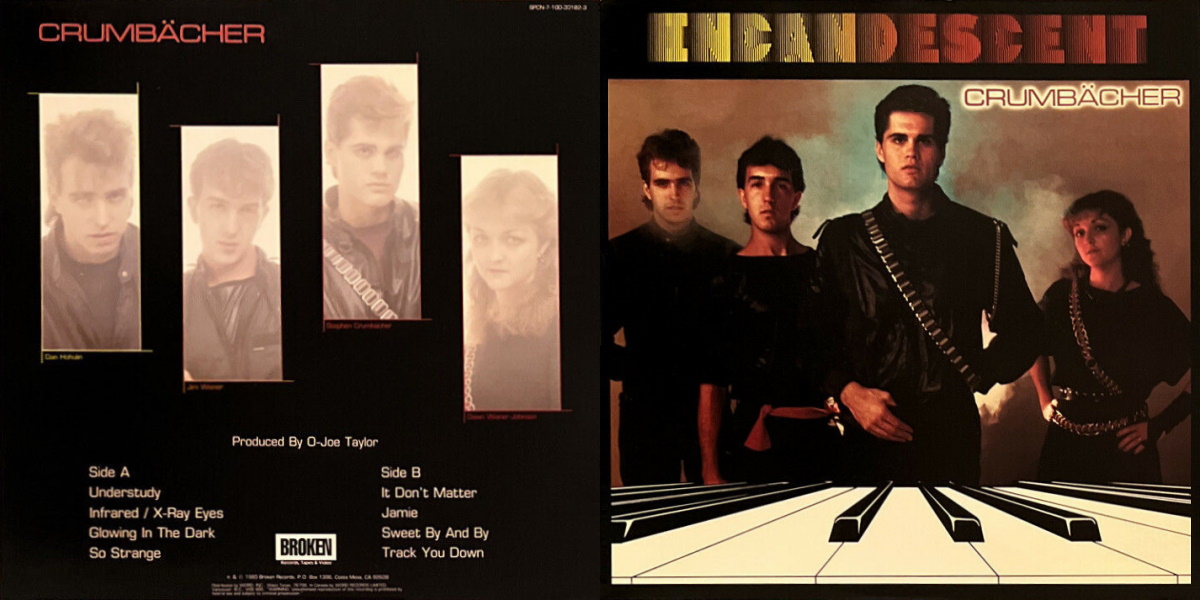
LP tracklist:
Side One
A1. “Understudy” – 3:25
A2. “Infrared/X-Ray Eyes” – 4:16
A3. “Glowing In The Dark” – 5:12
A4. “So Strange” – 5:41
Side Two
B1. “It Don’t Matter” – 4:45
B2. “Jamie” – 4:46
B3. “Sweet By And By” – 3:29
B4. “Track You Down” – 5:16
Note: Simultaneously released on cassette and 12-inch vinyl LP by Broken Records.
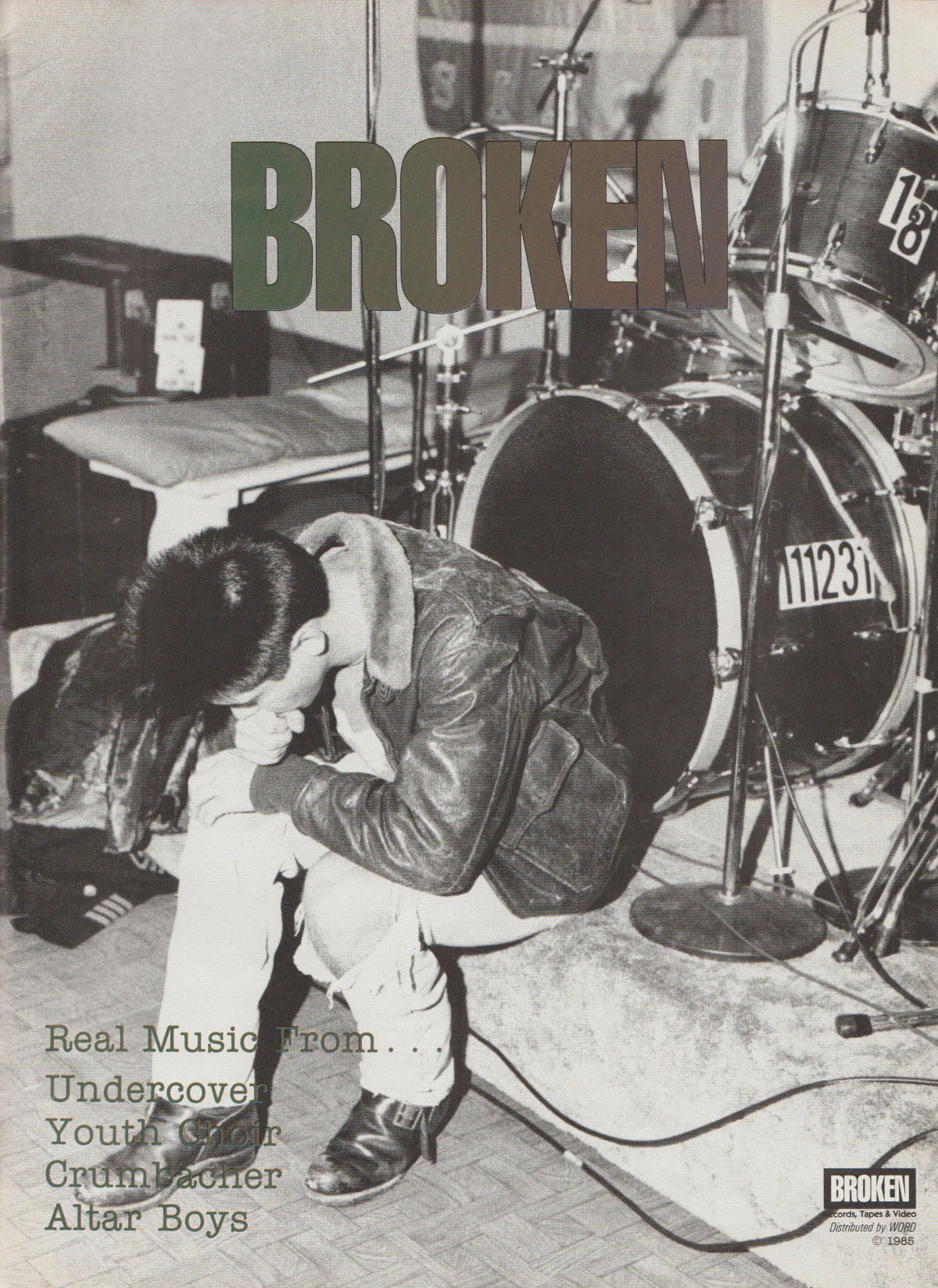 A full-page advertisement for the new Maranatha! Music associated imprint Broken Records – a progressive label featuring artists like Undercover, Youth Choir, Crumbächer, and Altar Boys – was featured in the March 1985 issue of CCM Magazine.
“It Don’t Matter” (What’s Shakin’ Mix)
“Jamie” (MUSIC VIDEO)
Crumbacher, Live in Pottstown, PA, April 29, 1986
After twenty-five or so years of being mostly a fond memory, occasionally augmented by worn-out vinyl or cassette, Incandescent, the debut album by Christian synth-pop band Crumbächer, has been re-released this week.
Before getting into a review of the album itself, some background about the time when it first saw the light of day is in order. Originally released in 1985, unbeknownst to all involved at the time Incandescent was one of the, if not the absolute, final entries in a music catalog that proved vital in contemporary Christian music’s early days. It came from Broken Records, a division of Maranatha! Music that itself was owned and operated by Calvary Chapel in Santa Ana, California, a church that had been one of the primary focal points for the Jesus Movement of the early 1970s. The church also spawned a host of bands and solo artists that routinely played Saturday night concerts at Calvary Chapel plus shows at other like-minded nascent evangelical churches in the area. Nearly all of the artists were primarily if not totally devoted to evangelism, consistent with the church’s belief that Christ’s return was imminent and therefore maximum proselyting was needed so that as many people as possible would be saved prior to, as taught in the church’s theology, the Rapture (all living believers physically leaving the earth and being taken to heaven) and Great Tribulation (the coming and reign of the Antichrist) that would precede Jesus’ coming back to earth. Musically the main style was mellow, with touches of the folk-rock and country-rock being popularized at the time by fellow southern California-based mainstream acts such as the Eagles. This vibe lasted throughout the 1970s into the early 1980s.
By 1983, with new wave in full swing and MTV becoming an ever-growing music presence, the next generation of Calvary Chapel artists had begun exploring genres hitherto untouched, such as rockabilly and punk. As far as the church was concerned, this was tolerable as long as it kept the assorted bands and artists under control. This started falling apart as artists, chomping at the bit for both more artistic freedom and freedom from the restraints of evangelism first and foremost, began spreading their wings. In 1985 Calvary Chapel pulled the plug, dismantling its record labels and dismissing its artists save those devoted to anonymously creating its long-running series of wildly popular übersoft pop praise and worship albums. However, before this decision the church briefly tried its hand at promoting far edgier sounds than those with which it had grown comfortable. Thus, among other modern bands such as Undercover and Altar Boys, under its wings there was Crumbächer.
In musical terms Crumbächer was far more restrained than most of its label mates. The band’s leader, at the time its sole songwriter and always lead vocalist Steve Crumbacher was musically weaned on pop vocal ensembles such as ABBA and the Beach Boys. Filtering this through the less gritty side of early to mid-1980s synth rock, Crumbacher created arrangements of layered keyboards and vocal harmonies galore, all set to danceable rhythms. It was a mix far more akin to a-ha than Ultravox, but this was an afterthought. The songs and musical roots were what mattered the most. That it was placed into synth-pop arrangements stemmed not from any great affiliation with the genre itself, but rather because at the time it was the most effective means of reaching the band’s teen and tweener audience. And reach them it did.
Listening to it now, what is most striking about Incandescent is how, despite the decidedly 1980s style throughout, it holds up remarkably well. It helps that the band (in addition to Crumbacher on lead vocals and keyboards the lineup was Dawn Wisner-Johnson on keyboards, Jimmy Wisner on drums and Dan Hohulin on guitar, with all contributing backing vocals) was instrumentally and vocally proficient. That duly noted, the album’s main strength is that, regardless of how they were arranged to fit the band’s target genre and time period, the songs themselves are well constructed pop tunes. Hooks, melodies and rhythms all come together with graceful ease, creating tunes made for being sung along with as well as providing top-notch dancing material. With any kind of proper push, there would have been Top 40 hits from this album, most noticeably «Jamie», even with its undisguised Christian lyrical bent.
Certainly there is an element of nostalgia here; after all, the album being discussed is twenty-eight years old. However, the enduring quality of Incandescent plus how it taps into a truth that has permeated pop music since time immemorial – kids like to dance – makes this far more than an exercise in remembering when. Want proof? More than a few fans from back in the day, who now have kids of their own, have mentioned on social media that their offspring can’t get enough of the album’s infectious melodies and beats. It might be a child of its era, but Incandescent has the power to shine brightly for generations to come. [Jerry Wilson, Goldfish and Clowns, 2013/07/18]
Reviews
There are no reviews yet.