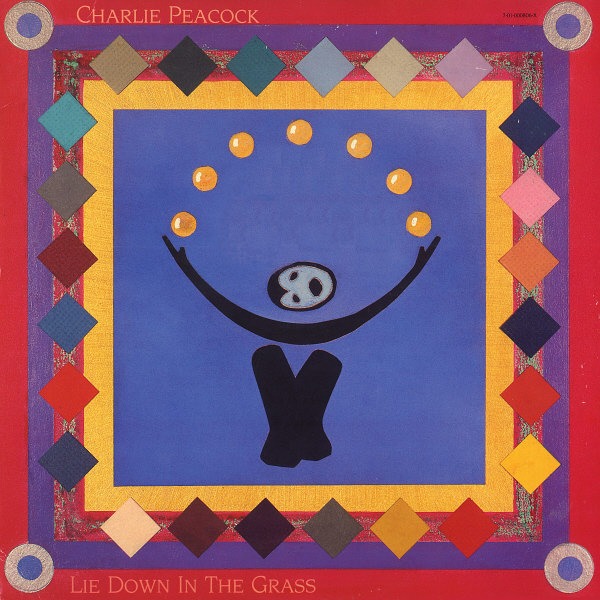
Description
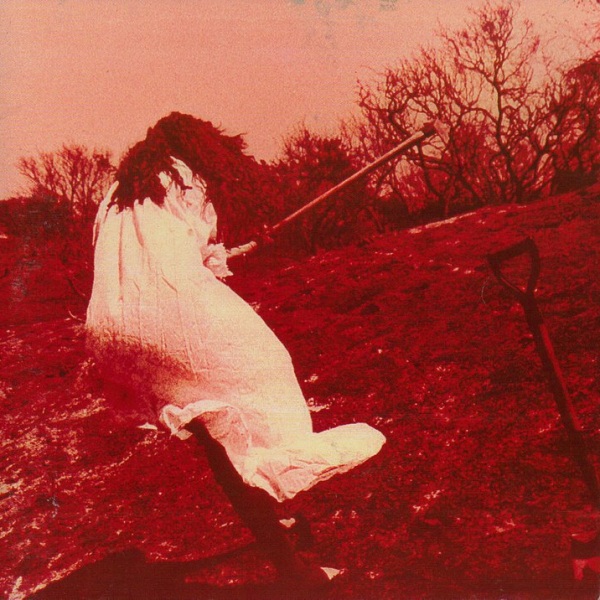
Lie Down in the Grass is the full-length solo debut album by the American singer, songwriter, keyboardist, and producer Charlie Peacock (a.k.a. Charles William Ashworth), released on Exit Records in July 1984, a division of Word. (Peacock began his recording career in 1982 with the 12-inch vinyl single “No Magazines“, b/w “What They Like”, before founding Exit-signed Vector.) The album was recorded by Daryl Zachman at The Warehouse Ministries’ Sangre Studios in Sacramento, California; with Charlie Peacock producing. Mixed by Larry Hirsch at Paramount Studios in Hollywood, California. Featuring labelmates Michael Roe of The 77’s on guitar and backup vocals, as well as Jimmy Abegg and Steve Griffith of Vector on guitar and bass respectively. “Ethnic and orchestral percussion” provided by Bongo Bob Smith. All songs written by Charlie Peacock.
Lie Down in the Grass was included among CCM Magazine‘s Top 10 Albums of the Year, voted number six on a list featuring ten albums released between November 1, 1983 and October 15, 1984. – Peacock’s artistic romp, ‘Lie Down in the Grass’, provides one of the most pleasant sounds of the year. Smith-Newcomb said in the June review: ” ‘Lie Down in the Grass’ is… a truly relevant and totally contemporary artistc statement – not merely trendy, but trendsetting.” According to All Music Guide, the album “immediately established newcomer Charlie Peacock as a songwriter of unusual creativity and intelligence with a willingness to go closer to the cutting edge than just about anybody else in the industry…”
In March 1985, A&M Records released a slightly different version of the album in the mainstream music market. Two of the original album tracks – “Watching Eternity” and “Human Condition” – were replaced by two new songs – “Young In Heart” and “Life Doesn’t Get Better”. Initially, Missing Persons keyboardist Chuck Wild (who did produce Exit signed Vector’s sophomore album, Please Stand By) was slated to produce the two new tracks but Peacock did not like the direction, scrapped it, and produced the songs himself.
In this powerful solo debut, Vector‘s keyboardist Charlie Peacock forays into musical territory until now unexplored by Christian musicians. Evoking the music stylings of Thomas Dolby, Laurie Anderson, Thompson Twins, and Eurythmics, Peacock stands out as a unique artist in his own right. Lie Down in the Grass is not a derivative LP on the coattails of Dolby’s Flat Earth or the Twins’ Into the Gap. It is, rather, a truly relevant and totally contemporary artistic statement – not merely trendy, but trendsetting.
It is to Peacock’s credit that Lie Down is neither Vectorish nor dominated by keyboards. His prowess as composer, arranger, and producer gives backbone and strength to the record. At the root of much new music is a love of the spirit of r&b, popular music. Third World rhythms and descant forms, and the gifts of technology. Peacock relies on traditional instruments – guitars, horns, drums, keyboards – and programmable drum machines, all orchestrated in a sound that is vibrant, thoughtful, and creative.
Lyrically, Peacock’s efforts are as relevant as his music. He captures the human search for meaning («1,2,3 (That’s Okay)» and «Till You Caught My Eye»), truth («Lost in Translation»), and virtue («Who is Not Afraid?» and «Human Condition»).
The title track is a powerful visual metaphor of God’s call to childlike faith and rest. «It’s Gone, It’s Over» looks at the mystery of friendships that fade. «Whole Lot Different (Whole Lot the Same)» illumines the distinction between a Christian’s and a non-believer’s world view. This distinction is then illustrated in two pictures of the future: one hopeful («Watching Eternity») and one not so («Turned on an Attitude»).
Peacock is backed by Bongo Bob Smith on percussion, Michael Butera on sax, and Larry Lunetta on trumpet. Erik Kleven, Eric Heilman, and Steve Griffith play acoustic and electric bass on different tracks. Mike Roe (77s) and Jim Abegg (Vector) add various guitars and even banjo. The arrangements are clean, uncluttered, and orchestrated to be provocative yet easy on the ears. The stereo separation alone is an audiophile’s delight.
Peacock, along with Vector, 77s, Daniel Amos, Steve Taylor, Rez Band, and others, helps bring Christian music out of the past, while witnessing the gospel of Jesus Christ as a light of hope in a darkened world. Lie Down in the Grass is a truly daring venture for Exit, and one which I believe will not go unrewarded. [Quincy Smith-Newcomb, CCM, June 1984]
When Lie Down in the Grass appeared in 1984, the contemporary Christian music industry hadn’t really ever seen anything like it. It immediately established newcomer Charlie Peacock as a songwriter of unusual creativity and intelligence with a willingness to go closer to the cutting edge than just about anybody else in the industry. Peacock later joked that the record earned him a reputation as an “alternative” artist simply because financial restrictions had forced him to use a lot of synthesizers, but that assessment seems unjustifiably dismissive. One of the strengths of Lie Down in the Grass is its modestly eclectic instrumentation: The synthesizers play a supporting role alongside electric guitars, saxophone, trumpet, and an array of percussive instruments that give the record an international feel. Peacock seems to draw from European and American new age influences, but the album never feels derivative. His lyrics are also impressive for an early-’80s CCM record, asking universal spiritual questions without giving them pat doctrinal answers. Songs like «Till You Caught My Eye» and «Turned On an Attitude» indulge a little too liberally in alternative angst, but that was an extremely refreshing development in a music industry dominated by earnest happy talk. More than a decade later, Lie Down in the Grass remains one of Peacock’s boldest and best efforts. [Evan Cater, AMG]
> Apple Music (https://music.apple.com/us/album/lie-down-in-the-grass-remastered/1511022407)
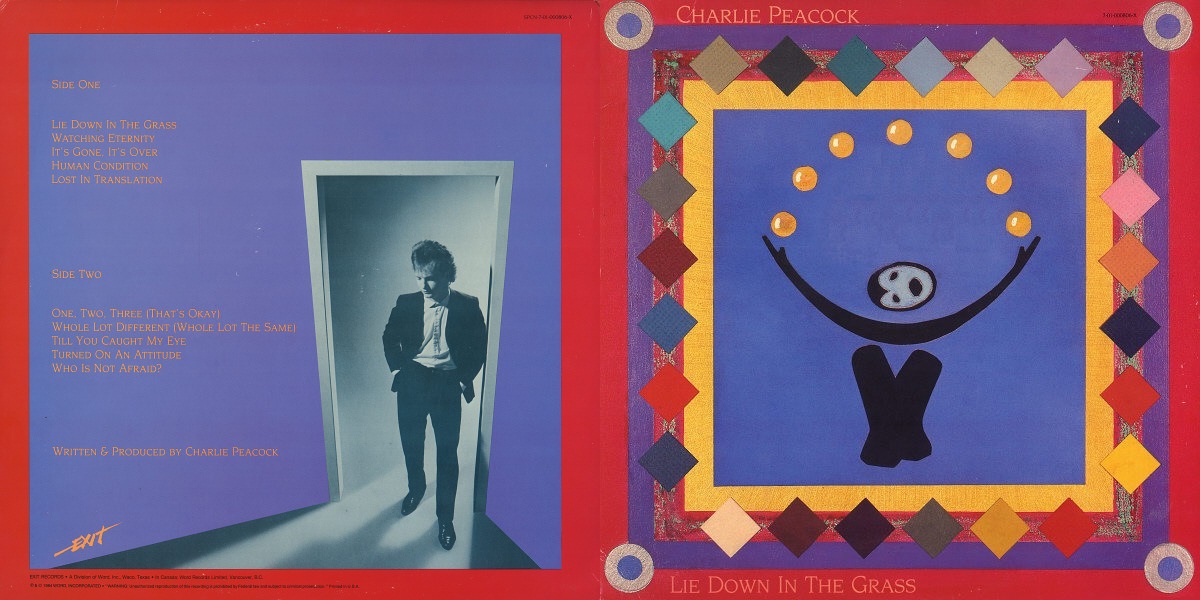
LP tracklist (Original Version, 1984):
Side One
A1. “Lie Down In The Grass” – 3:29
A2. “Watching Eternity” – 2:58
A3. “It’s Gone, It’s Over” – 3:47
A4. “Human Condition” – 3:00
A5. “Lost In Translation” – 3:47
Side Two
B1. “One, Two, Three (That’s Okay)” – 3:45
B2. “Whole Lot Different (Whole Lot Same)” – 3:32
B3. “Till You Caught My Eyes” – 3:30
B4. “Turned On An Attitude” – 2:57
B5. “Who Is Not Afraid?” – 3:00
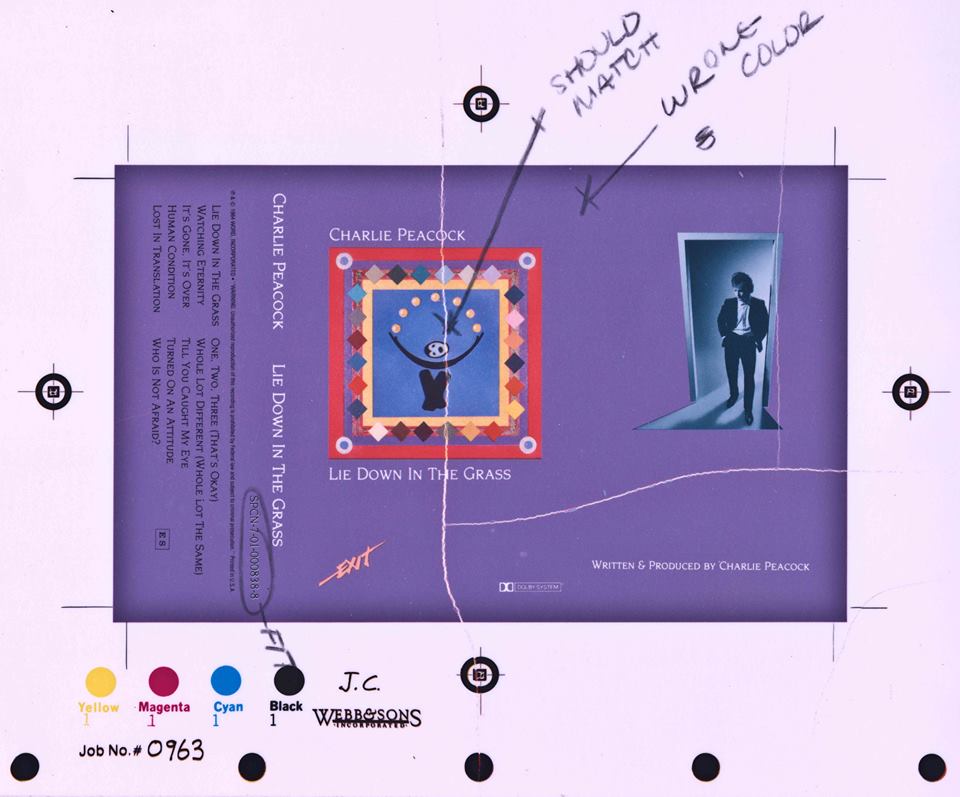
Note: Simultaneously released on cassette and 12-inch vinyl LP by Exit Records. The original Word version of the album was re-issued on both cassette and CD by Myrrh Records in 1992, digitally remastered by Ken Love at MasterMix, Nashville. In December 2014 Charlie Peacock released a Deluxe 30th Anniversary Edition of the album, as digital download only, remixed and remastered and featuring all tracks from both the Word and the A&M versions of the album (12 tracks) as well as 10 bonus tracks.

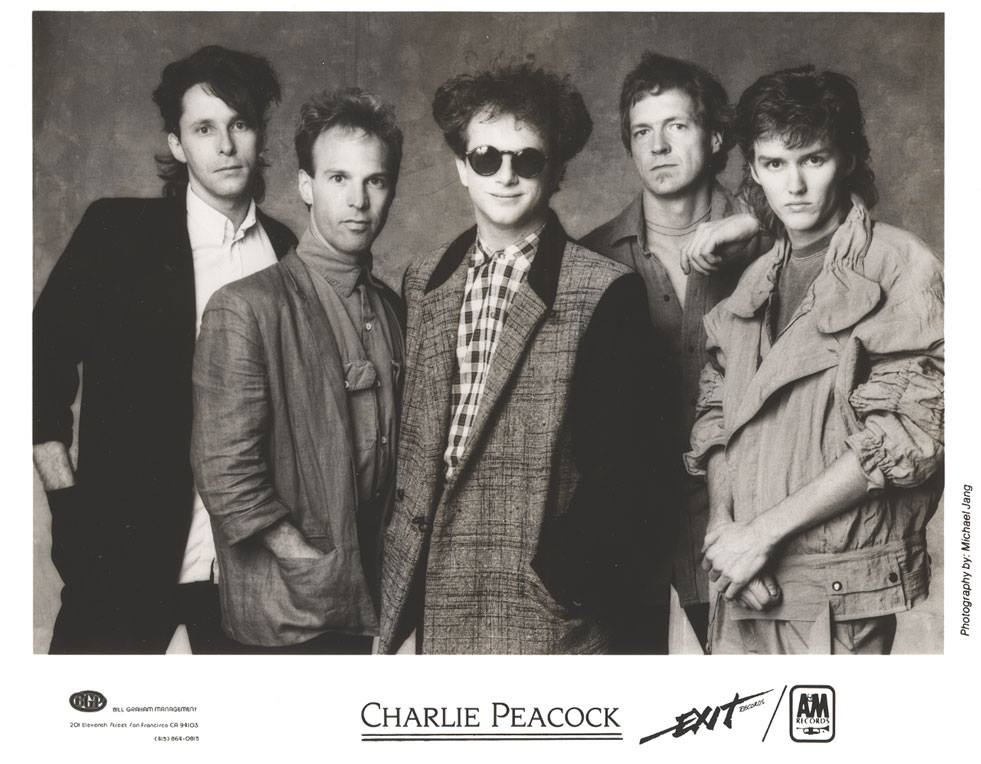 The Charlie Peacock Group: (L-R) Bongo Bob Smith (percussion), Kurt Wortmann (drums), Charlie Peacock (vocals & keyboards), Erik Kleven (bass), Michael Miller (guitar). Photo by Michael Jang.
“Lie Down in the Grass” (MUSIC VIDEO)
Singer/songwriter/producer Charlie Peacock is joined by Jimmy Abegg, Brent Bourgeois, Eric Heilman, Michael Roe, Aaron Smith, Bongo Bob Smith, and Roger Smith, as well as Charlie’s son Sam Ashworth, for this 2020 version of “Whole Lot Different Whole Lot the Same” (a song first recorded in 1984). Recorded remotely (shelter-in-place style) this version adds a new musical/lyrical section, celebrates decades of friendship and music, and remembers some of Sacramento’s finest musicians gone far too young, including Keith Jefferson, Jimmy Griego, Erik Kleven and Vince Ebo.
TrueTunes @45RPM March 17, 2023: Charlie Peacock Revisited (From The Vault)
CREDITS. Produced by Charlie Peacock. Recorded at Sangre Studios, Sacramento, CA. Engineered by Daryl Zachman. Mixed by Larry Hirsch at Paramount, Hollywood, CA. Mastered by John Golden at K-Disc, Hollywood, CA. Design and Illustration by Jim Abegg. Photography by Kent Lacin. Executive-Producer: Mary Neely. Executive Coodinator: Jan Eric Volz. All songs written by Charlie Peacock.
Musicians: Charlie Peacock (Vocals, Keyboards, Drums), Michael Butera (Saxophone), Larry Lunetta (Trumpet), Jim Abegg (Guitars), Mike Roe (Guitars, Vocals), Eric Heilman (Bass), Erik Kleven (Bass), Steve Griffith (Bass, Tom Tom, Vocals), Bongo Bob Smith (Ethnic & Orchestral Percussion), Jim Caselli (Additional Percussion).

Reviews
There are no reviews yet.