
Description
Say So is the seventh studio album by the British singer and songwriter Sheila Walsh, released on Myrrh Records in 1988, a division of Word. The album was recorded by Dave Holmes, Nick Patrick and John Ravenhall at Swot Studios, The Yard and Westside Studios in London, England; and was produced by Richard Osborne with Jon Sweet for Swot Productions. Mixed by Glenn Tommey – with additional mixing by Dave Holmes – at Crescent Studios in Bath, England.
Featuring covers of the Todd Rundgren classic “Love Is The Answer” and “Surrender”, a song written and originally recorded by Vector on their 1985 synthpop/new wave-release Please Stand By. Also featuring “Dorai Sani” written by Steve Griffith of Vector fame. The remaning songs were co-written by Sheila Walsh with Rod Trott and/or producer Jon Sweet, except for “Jesus Loves the Church” which was co-written by Walsh and Paul Field-sideman Dave Cooke (of Dave & Judy fame).
Sheila Walsh’s latest album, her second for Myrrh, reflects a deepening maturity and growing artistic confidence as it continues in the patterns established by last year’s groundbreaking ‘Shadowlands‘ project. Under the creative direction of producers Richard Osbourne and John Sweet, Walsh succeeds in developing a sophisticated statement of dark contrasts and emotional currents. The production is exceptional, recalling Robin Millar’s work with Sade on the jazzier cuts.
Some of the biggest news is to be found in the composer credits. Walsh tries her hand at songwriting, with help form Rod Trott and Jon Sweet of SWOT Productions, along with Dave Cooke. Vector‘s Steve Griffith also contributes two songs, including a remake of «Surrender», originally featured on Vector’s ‘Please Stand By‘ LP. That track echoes several important constants in Walsh’s past records: an emphasis on spiritual surrender to God’s will, as well as the aggressive techno-pop style which characterized much of Walsh’s early work. Electronics remain an important part of the mix on ‘Say So’, yet they take on greater depth and are agumented by a variety of organic musical sounds.
Interestingly, Walsh also covers Todd Rundgren’s «Love Is the Answer», which up until now had been the answer to the trivia question “What was the name of a mid-’70s hit by England Dan and John Ford Coley?” Walsh poignantly reinterprets the song from the perspective of Christian belief; her faith points beyond the lyric to an Answer which Rundgren, a professed agnostic, could only suggest.
In a romantic, literate style, Walsh’s own lyrics use simple images to convey an almost childlike sense of hope and faith; she confesses failures and her need for ever-greater reliance upon the Lord. Walsh compares lives to “empty boxes,” needing to be filled by God’s grace. She sings of “angels with dirty faces, battered and bruised by the fall,” and reflects honestly upon her own weaknesses as a Christian artist. In «Trapeze» she pictures herself as a trapeze performer who has grown too confident in her skills, losing grasp of the Lord’s hand which guides and protects her from falling
With ‘Say So’, Sheila Walsh says a lot. [Mark Eischer, CCM, January 1988]
> Apple Music (https://music.apple.com/us/album/say-so/1741844775)
LP tracklist:
Side One
A1. “Wind Of Change” – 4:07
A2. “Surrender” – 4:27
A3. “Love Is The Answer” – 4:32
A4. “Trapeze” – 5:03
A5. “Dorai Sani” – 6:33
Side Two
B1. “Empty Boxes” – 5:05
B2. “Angels With Dirty Faces” – 3:50
B3. “Jesus Loves The Church” – 4:16
B4. “Human Cry” – 4:12
B5. “Hope For The Hopeless” – 4:24
Note: Simultaneously released on cassette, 12-inch vinyl LP, and CD by Myrrh Records.
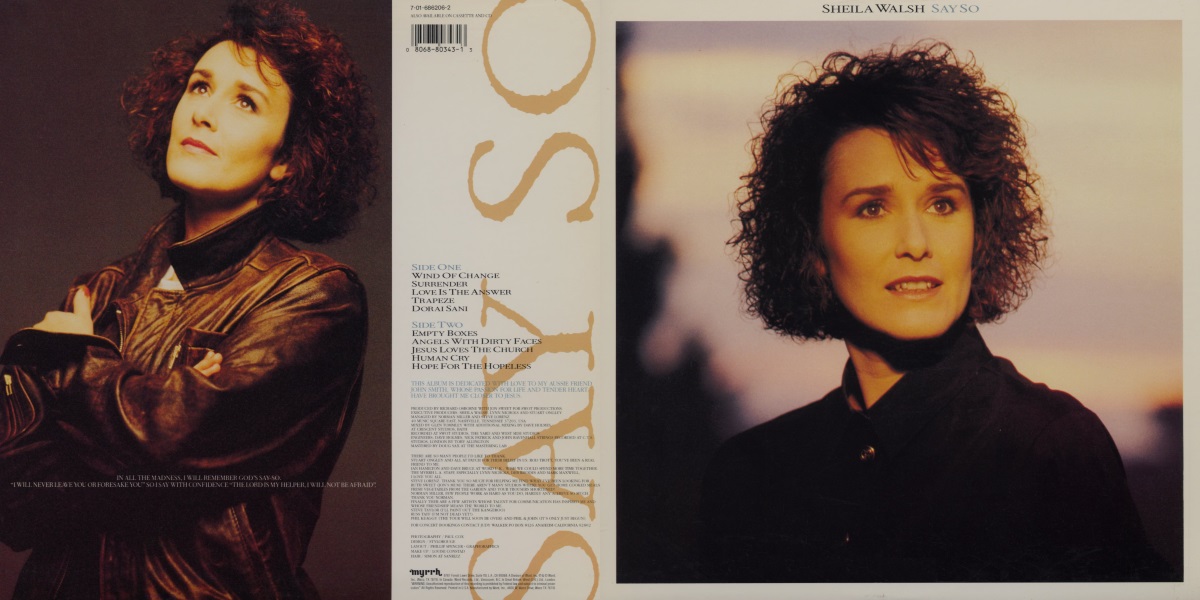
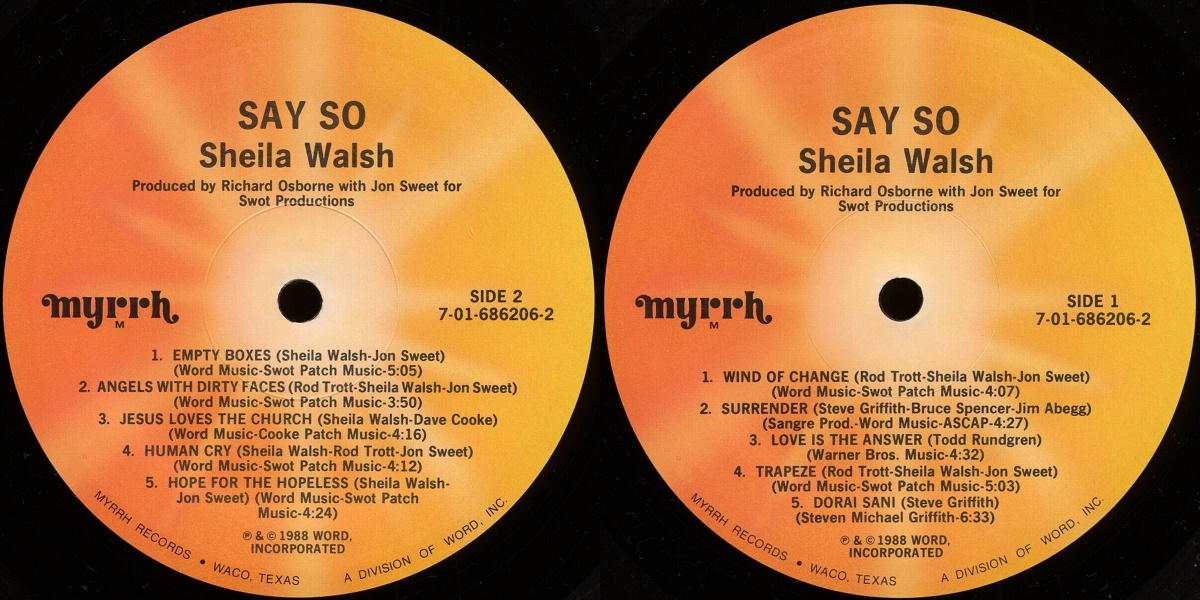
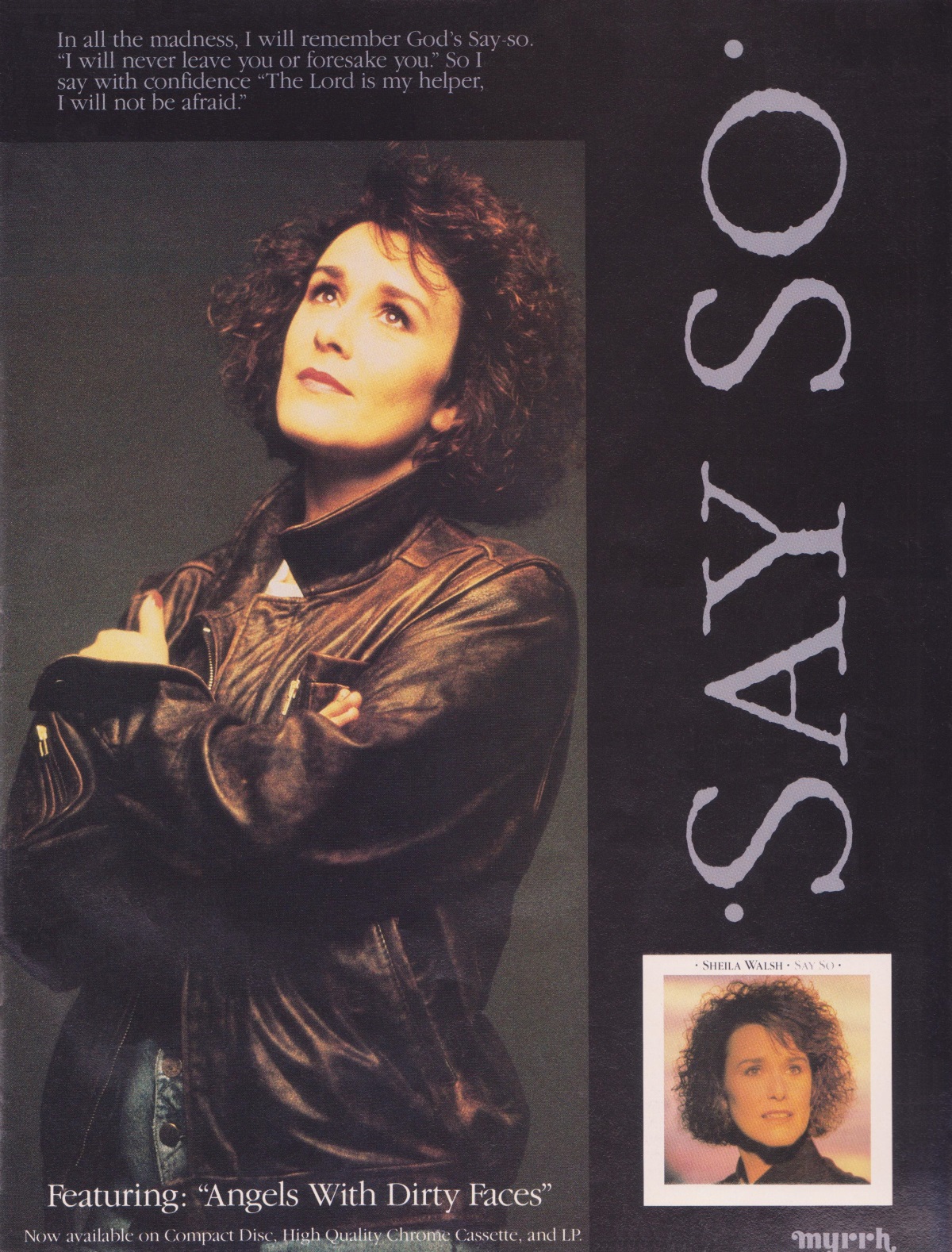 A full-page advertisement for Sheila Walsh’s Say So was featured in the January 1988 issue of CCM Magazine.
“Hope For The Hopeless”, Live at 700 Club 1989
Reviews
There are no reviews yet.