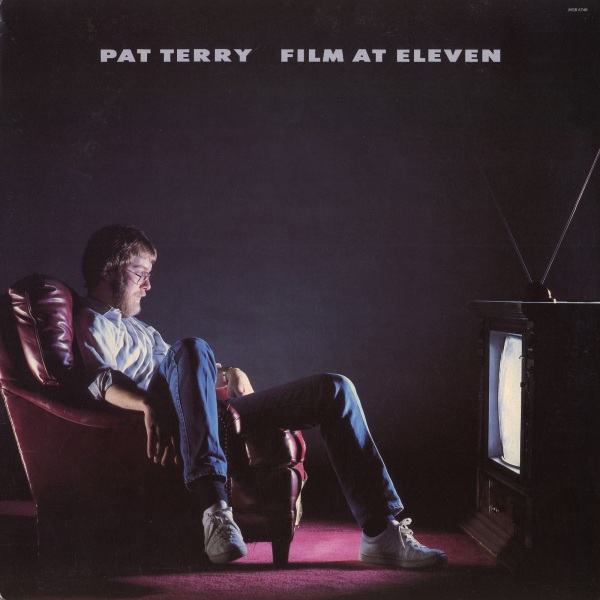
Description
Film at Eleven is the sophomore solo album by the American singer and songwriter Pat Terry of The Pat Terry Group fame, released on Myrrh Records in May 1983, a division of Word. The album was recorded and mixed November 1982 by Mark Heard at Weddington Studios in North Hollywood, California; with Heard and Pat Terry producing.
Featuring Pat Terry on lead vocals as well as acoustic and electric guitars, harmonica, piano, and Korg Polysix synthesizer, backed by a session band consisting of Mark Heard on guitar and backing vocals, Bill Batstone on bass, John Mehler on drums, and Harry Stinson on percussion, with Carl Pickhardt sitting in on Hammond B-3 organ and Tom Howard providing E-mu Systems Emulator (a digital sampling synthesizer using floppy disk storage), voice programming and arrangements for Emulator.
About one-third of the way into this record, an oddly processed voice utters a series of phrases: “Instant Coffee…Instant Tea…Minute Rice…Express Mail/ Real Communication…Responsible Morality…Christian Maturity.” The struggle to reject an “overnight” spirituality and to grapple with the larger and harder issues of life is the message of Pat Terry’s latest album, Film at Eleven (Myrrh MSB-6748). It is in almost every way an extension of topics either mentioned or inferred on last year’s Humanity Gangsters.
In fact, a parallel could be drawn between John Lennon’s first two solo albums and these two by Terry. Like Lennon’s Plastic Ono Band, Humanity Gangsters was a necessary personal statement for Terry. The candid confessions of his limited impact on “changing the world” were therapeutic and liberating for artist and listener alike and left both ultimately inspired with renewed hope. Film at Eleven compares with Imagine, where the artist now speaks more to his audience than to himself, sharing the conclusions he’s reached as well as posing a few new questions to keep us thinking. (If the analogy to Lennon makes you uncomfortable, you can also find the same progression on Mark Heard’s last two albums.)
Film at Eleven leads off with «Cats and Dogs», a catchy tune about the unrest in the world. It orients the listener to reality, where he must dwell for the remainder of the record if he is to derive any of its benefits. Next is «Yard Sale», one of the most difficult songs, and a more rewarding one because of it. The story involves a dialogue between one who urges another to sell some of his precious possessions in order to buy new and “better” things. The second voice is reluctant to part with his belongings because of the sense of history and security the represent to him (a teddy bear, a diary, and a Bible). This could refer to the temptation presented believers to adopt a “new spirituality” for the New Age, compromising our “old-fashioned” faith for the current social mores.
«The World Around Us» follows as a reminder of our community with all of the human race (a continuing thought from last year’s «Open Door»). The remainder of Side One consists of two songs juxtaposed to one another, again a pattern which occurred in the same place on Humanity Gangsters. The first of these, «Change Takes Time», speaks to the Christian musician in particular to face the reality that he’ll “hardly make a dent” in the world’s problems. This might sound like an exercise in futility, but Terry reassures that change will come – in time. The music then bridges to «In My Dream», a beautiful picture of the world to come – only to be brought back to reality by the evening news blaring from the neighbor’s TV set.
Things get tougher on Side Two. After an unpleasant look at our sinful nature, the «Common Bond» for a fallen family, comes the album’s most enigmatic song, «Shadows»: “I could have sworn I saw the New Jerusalem comin’ down in all her glory. / It was only the way the shadows filled the territory.” What is really being seen here? Who is being addressed? The song trails off in an ominous tone without giving any answers. The song seems to deal with the deception and craftiness of Satan, who can appear as an angel of light. Satan can sometimes only be recognized by the “shadows” he casts. As his game gets trickier, it is only the spiritual discernment given to believers that permits us to “see” the shadows.
«Growing Up and Growing Old» deals with pain and suffering and its positive or negative effect on a person’s life. The lyrics here mark Pat Terry as one of the most eloquent lyricists recording today. Finally, «Christ Alone Will Wear the Crown» brings us full circle to talk about fighting, wars, and our inability to help ourselves. The listener is left with the gospel – nothing more and nothing less.
Mark Heard co-produced, played, and sang on this album as well as Terry’s previous one, and the results are evident. The music is very much in line with Heard’s current work – dynamic, exciting, and very involving from start to finish. [CCM, June 1983]
LP tracklist:
Side One
A1. “Cats and Dogs” – 3:18
A2. “Yard Sale” – 4:20
A3. “The World Around Us” – 2:58
A4. “Change Takes Time” – 3:15
A5. “In My Dream” – 4:32
Side Two
B1. “Common Bond” – 3:17
B2. “Shadows” – 5:12
B3. “Growing Up And Growing Old” – 3:52
B4. “Christ Alone Will Wear The Crown” – 4:40
Note: Simultaneously released on cassette and 12-inch vinyl LP by Myrrh Records.
“In My Dream”, covered by Ken Marvin, 2022.
CREDITS. Produced by Mark Heard and Pat Terry. Recorded and mixed at Weddington Studios, North Hollywood, California. Engineer by Mark Heard and assisting engineer by Mike Ross and Wally Grant. Mixed by Mark Heard. Mastered by Steve Hall.
Musicians: Pat Terry (Lead Vocals, Harmonica, Acoustic and Electric Guitars, Piano, Synthesizer – Korg Polysix), Carl Pickhardt (Organ – Hammond B-3), Tom Howard (E-mu Systems Emulator, Voice Programming and Arrangements for Emulator), Mark Heard (Guitar, Backing Vocals), Billy Batstone (Bass), John Mehler (Drums), Harry Stinson (Percussion).
Reviews
There are no reviews yet.